True Love and the Scars of the Past
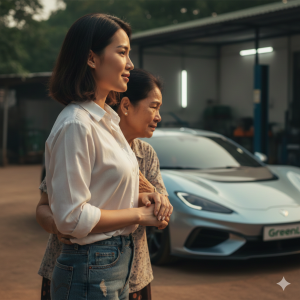
That afternoon, a strange silence fell over Mrs. Hảo’s small dirt courtyard. Only the sound of the wind rustling through the leaves could be heard, like a soft warning of what was about to happen. As Linh stepped off Tuấn’s old motorbike, Mrs. Hảo’s gaze immediately swept over the young woman from head to toe. The look was sharp, scrutinizing, and filled with suspicion, making even Tuấn, standing beside his girlfriend, slightly tremble with worry.
Linh gently nodded, taking the initiative to greet her politely, but Mrs. Hảo’s voice immediately cut in, cold and sharp as a knife:
“A village girl daring to date my son? My son is an engineer, not someone for gold-diggers to cling to.”
The harsh statement was like a splash of cold water in winter. Linh paused slightly but maintained her characteristic gentle smile. She had been familiar with life’s contempt for a long time, but her heart had not become hardened. Tuấn stepped forward, wanting to say something to defend his lover, but Linh lightly touched his hand, signaling him to let the situation unfold naturally.
She was dressed simply: a slightly faded white shirt, plain denim jeans, and old sneakers. No one knew that she had just returned from the boardroom of a major corporation, where she was the ultimate decision-maker for hundreds of employees. Linh concealed her identity and her success because she believed that true love never needed wealth or fame to prove itself.
Tuấn and Linh had been together for over a year. That year was enough for them to understand each other’s hearts, sharing simple meals, evening strolls around the lake, and words of encouragement whenever Tuấn felt inadequate because of his poverty. Tuấn had often said he was afraid, very afraid of his mother’s disdain, afraid Linh would have to endure injustice. But Linh always smiled and said that just being by his side was enough. Little did she know that Tuấn’s worries would manifest so clearly that day.
Mrs. Hảo walked closer, her eyes scanning every detail of Linh. “The shirt looks cheap, doesn’t it? Village girls often choose these styles; they’re not elegant, so you can tell right away.” Then she looked down at Linh’s shoes, slightly curled her lip, and spoke with a voice like salt rubbed into a wound: “Wearing worn-out shoes like that and hoping to be a daughter-in-law in this house? Our family may not be the wealthiest or most prominent, but we certainly don’t accept daughters-in-law who are too poor.”
Tuấn felt his blood boil, but Linh stood there silently, as if those cruel words could not wound her. Deep down, Linh understood that not everyone had enough experience to see a person’s true nature; everyone carried their own scars. And sometimes, people chose to hurt others first to avoid being hurt further.
II. Development: Old Wounds and the Heart’s Choice
While Mrs. Hảo continued to speak ill of Linh in a steady voice, Linh looked around the small house. She noticed the peeling paint on the walls, the furniture aged by time, and, more importantly, the tired figure of Tuấn’s father lying on a long chair on the porch. He coughed in heavy, hoarse spasms, which Linh immediately noticed.
She walked closer, intending to ask about his health, but Mrs. Hảo immediately stood in front of her, snapping: “Don’t pretend to care about him! My family doesn’t need pity from a girl like you.”
Linh paused, her gaze wavering slightly, but then she regained her composure. She realized one thing: the woman standing before her was terrified—terrified of being deceived, terrified of being taken advantage of, terrified her son would be hurt. And that fear had made her bitter.
Tuấn took Linh’s hand and gently pulled her inside. He showed her every small corner, every simple item he had always felt inferior about. Linh listened, smiled, and kept her eyes full of love. But when she looked at Tuấn’s father, her eyes slightly darkened; the heavy coughing, the pale complexion, and the exhausted look in his eyes concerned her. Linh had knowledge of health care from taking her mother to the hospital many times, so just by looking, she knew his illness was not minor.
She turned to Tuấn and quietly asked, “Has your father been sick for long?”
Tuấn looked down, his voice low: “A long time. It’s heart disease. But we’re out of money for treatment. Please don’t say anything to my mother; she’s very sensitive.”
Linh nodded, but a deep concern arose in her heart. She had never seen Tuấn so helpless, nor had she seen Mrs. Hảo hide such profound worry.
While Linh was still contemplating, some neighbors passed by the gate, peering in curiously. Seeing this, Mrs. Hảo spoke louder, as if wanting to prove something: “My family won’t marry a poor daughter-in-law. We’re not in the same class. Look, everyone, am I right? My son is well-educated, but she’s just a village girl, poor, doesn’t deserve him.”
The whole neighborhood fell silent for a moment. Tuấn was stunned. Linh maintained her gentle smile, though her eyes held a momentary sadness. She bowed to everyone, greeted Mrs. Hảo, and then spoke in a soft but firm voice: “I understand. Goodbye, Auntie.”
She turned and walked away, the afternoon sun casting her long shadow on the dirt yard. No one knew that this very moment was when this seemingly small story began to turn in a different, deeper, more surprising direction, changing the lives of everyone present in the yard that day.
That evening, after leaving Tuấn’s house, Linh sat alone on the late bus, watching the bustling crowds outside the window. She rarely allowed herself to fall into such heavy silence, but Mrs. Hảo’s words still echoed in her ears. It wasn’t because she was insulted, but because, deep within the sharp and judgmental look of the older woman, Linh saw something familiar.
The image of her own mother, who had also been hurt, scorned, and endured extreme poverty. Those who have been looked down upon sometimes become the ones most likely to use harshness to conceal the fear of being hurt again.
Linh was born into a truly poor family. Her parents worked as seasonal laborers, the unstable work keeping their lives perpetually difficult. There was a time when they had to eat rice with salt water for a whole week. Then, Linh’s father had a work accident, leaving a huge debt. Linh’s mother went to work from dawn until night every day. Sometimes, she didn’t dare take a break even in the rain, afraid of losing her job. Little Linh, back then, could only stand by the window, watching her mother leave and return, a thin but heartbreakingly resilient figure.
It was those years that ingrained one thing deeply in Linh’s heart: only by studying and working ten times harder than others could she change her destiny. She devoted herself to her studies, to small projects, and then to part-time jobs. From a provincial student, Linh rose to become one of the rare young people to establish her own company at the age of 24. And Greenl was born from that, growing from a small green technology project into a leading corporation in Vietnam with hundreds of talented engineers.
But accompanying that success were calculated glances. She was once proposed to simply because her name appeared on a list of 100 outstanding young entrepreneurs. Some had frankly told her they wanted to date her to change their lives. Because of this, Linh did not want money or fame to be the deciding factor in her relationships. She always lived simply, identifying herself only as a mid-level employee of a Greenl subsidiary. And Tuấn, knowing only that, thought she was moderately well-off, completely unaware she was a billionaire.
Tuấn loved Linh with sincerity and a kind heart, which Linh deeply valued. But that night, when he dropped her off at her door, his face was still red with anger. His mother had been too harsh, too insulting, and Tuấn felt utterly helpless for letting his lover suffer.
He sat next to her in her small rented room, his voice shaking with resentment: “Linh, I’m sorry. My mother, my mother was too much.”
Linh placed her hand on his, her eyes gentle but resolute: “Let me handle it, but not by proving I’m rich. I don’t want to use money to silence anyone, and I don’t want your mother to accept me for money.”
Tuấn lowered his head and sighed: “I understand. That’s exactly why I love you. But I’m still worried.”
He had a feeling things wouldn’t just blow over. Just as he predicted, only a few hours after Linh left, Mrs. Hảo was already gossiping to the neighbors, her voice full of sarcasm: “You can tell that girl isn’t decent just by looking. A village girl pretending to love an engineer; she’s just using Tuấn. What kind of girl rides an old wreck of a bike? No future at all.”
Those words spread faster than the first wind of the season. By the next morning, the small neighborhood was buzzing with chatter.
Linh happened to return to retrieve a scarf she had forgotten. As she reached the entrance, she heard Mrs. Hảo laughing and talking loudly in the yard. Just then, a neighbor rushed over with the morning newspaper: “Mrs. Hảo, look at this! The Greenl corporation just announced a multi-billion dollar electric vehicle project. The young owner is very young, and I hear she’s single.”
Mrs. Hảo scoffed, her voice full of arrogance: “Oh dear, those billion-dollar companies are full of highly educated people who speak English and everything. But those village girls, you can tell by their faces, they probably don’t even know English, let alone be involved in a big project. Linh involved with Greenl? Don’t joke.”
Linh stood behind the gate, hearing every word. She felt a lump in her throat. It wasn’t sadness from being scorned, but the realization that Mrs. Hảo was trapping herself in her old fears. Linh understood because her mother had once thought the exact same way: that the poor would always be looked down upon, that she didn’t deserve anything better.
Tuấn saw Linh standing there, her face expressionless. He quickly ran out, pulled her into a secluded corner, and panted: “You heard it, didn’t you? I’m sorry, truly sorry. My mother, my mother is too stubborn.”
Linh just smiled, a light but profound smile. “I’m not angry. But I understand what I need to do now.”
Tuấn looked at her in surprise. Linh held his hand, her voice slow but decisive: “Tomorrow, I’ll go and meet your parents. This time, in my true capacity.”
Tuấn was stunned, his eyes wide: “Are you sure?”
Linh nodded. This was the moment not only to protect their love but also to heal an old wound in Mrs. Hảo’s heart, and perhaps in her own as well. And that decision was the gateway to the story’s first climax.
The next morning, the sky was clear and gentle. The early sunlight filtered through the old roofs of the working-class neighborhood, making the small alley look brighter than usual. But just a few minutes later, the normally peaceful alley was instantly stirred by a strange sound echoing from the street corner.
The sound of wheels running smoothly, gliding like silk, so quiet people thought it was an illusion. Neighbors looked up curiously, then almost simultaneously exclaimed in astonishment. A silver-blue electric supercar glided to a stop in front of Tuấn’s house. The body of the car shimmered in the sunlight like a giant droplet of water in the small street. On the car’s body was the Greenl logo, a brand that commanded respect just by its name, as it was the most famous emerging electric car company on the market.
People whispered and buzzed, everyone wondering why such a car would appear in a place where the only sounds all day were old motorbikes and vendor calls. The car door opened. Two employees in neat black suits stepped out, walked around to the other side of the car, stood in line, and opened the passenger door.
Everyone held their breath; even a few children playing football froze, not bothering to pick up the ball that had rolled to their feet. From inside the car, Linh stepped out. She still wore the same simple white shirt and trousers, her hair tied back, her face lightly made up, just like the previous evening. But her aura radiated brightly across the entire alley—a bright yet gentle and warm glow, not the distant kind of superficial glamour.
The whole neighborhood couldn’t believe their eyes. Mrs. Hảo emerged from her house across the street, still holding a broom. When she saw the car and then Linh, she stood rooted to the spot, as if someone had just pulled all the air from her lungs.
Linh walked closer to Mrs. Hảo and bowed very respectfully. Mrs. Hảo was so flustered that she dropped the broom she was holding. Linh maintained her gentle smile—not arrogant, not tense, unlike any wealthy person Mrs. Hảo had ever met in real life or seen on TV.
Linh turned to face the neighbors and introduced herself amidst everyone’s profound astonishment: “I am Nguyễn Lệ Linh, the founder of the Greenl Group.”
The entire alley fell into silence for a few seconds; everyone’s expression changed. A person holding a cup of coffee outside their door was so stunned that they dropped the cup without realizing it. The nearby sticky rice vendor opened her mouth but couldn’t utter a word. Tuấn rushed out of the house, frozen, unsure how to react.
Mrs. Hảo was the most distraught. She turned pale and took a step back, wanting to avoid Linh’s gaze, but she didn’t know where to turn. Shame washed over her, making her feel as if she had just been exposed doing something terrible. She recalled every harsh word from yesterday, every glance, every thought that Linh was just a poor, ordinary girl trying to exploit Tuấn. The more she remembered, the more her heart felt squeezed.
But the most surprising thing happened right at that moment. Linh looked at everyone and smiled softly, her voice as gentle as the wind:
“Yesterday, I came here as an ordinary person. Today, I still come as that person, only with an added responsibility for the people I care about.”
There was no boasting, no intention of proving her wealth or power. Every word Linh spoke eased the tense atmosphere, moving many people.
And as Tuấn had worried, Mrs. Hảo suddenly burst into tears. The first cry was just a choked sob, but then she couldn’t hold back, and tears streamed down uncontrollably. She didn’t dare look at Linh, only bowing her head, her hands shaking. She spoke in a broken voice: “Auntie, Auntie was wrong. I have wronged you so much.”
Linh immediately stepped forward and gently held her hand. She did not accuse or show that she was insulted, only looking at her with truly kind eyes: “I understand the pain of those who have been looked down upon, but precisely because of that, we should not do the same to others.”
Those words were like a warm breeze sweeping through the alley. The way Linh spoke was not to preach but to share a truth she had lived. Mrs. Hảo cried harder, but it was no longer heavy shame, but the relief of being forgiven. She leaned lightly on Linh’s arm.
Tuấn stood nearby, his eyes red. He clearly understood that Linh was not just the person he loved but a person with a beautiful heart in a way he had never seen in anyone else.
After that deeply emotional morning, just when they thought things were getting easier, fate once again tested Tuấn’s family in the most cruel way.
That afternoon, Tuấn’s father walked out of the house, his hand placed over his chest, his face showing signs of fatigue. Tuấn saw this and immediately rushed to support him. His father only shook his head, intending to say a few reassuring words, but before he could speak, his eyes clouded over. He collapsed forward. A second later, the whole family screamed in panic.
Tuấn held his father, feeling his breath weaken. Mrs. Hảo screamed for the neighbors. Linh was the calmest. She immediately called the private emergency team of Greenl Care—the specialized medical service for VIP clients and corporate insiders. Her voice was quick but decisive, requesting them to arrive immediately with the highest priority. After hanging up, she knelt beside Tuấn, checked his father’s pulse and breathing, and performed the basic first aid she had learned.
Mrs. Hảo watched Linh, tears streaming down her face. She felt more useless than ever, nearly collapsing to the ground, her hands trembling uncontrollably.
In less than 10 minutes, the Greenl Care ambulance raced into the alley. The doctors and nurses in white coats immediately approached the patient. They quickly checked his condition and told Linh that the situation was critical: “Emergency surgery is required. A few more minutes of delay could be fatal.”
Tuấn was devastated. Mrs. Hảo was shaking too much to stand, crying like a child. As they carried his father onto the stretcher, Tuấn looked at his mother and then at Linh. His eyes pleaded without needing words. And Linh understood.
She quietly told the medical team leader: “The costs, the procedures, everything—I will take care of it. Priority is absolute.”
Mrs. Hảo froze when she heard that. She knelt before Linh, crying and saying amidst sobs that she was sorry, that she was wrong, that she had no face left to look at Linh.
Linh was alarmed and immediately helped her up. She used both hands to lift her, gently squeezing her arm as an embrace of reassurance: “Auntie, please don’t do that. You are the mother of the man I love. I would never let you kneel before me.”
Linh’s voice was soft as water yet steady, as if she was ready to bear everything. Mrs. Hảo cried even more, but it was a cleansing cry, not the defiance she had shown before.
At the hospital, the doctors rushed Tuấn’s father into emergency heart surgery. They required family members to sign papers. A series of large numbers appeared in the cost estimates, making Tuấn dizzy. But Linh gently took the paper from his hand and signed it as if it were routine.
While waiting for the surgery, hours passed. Finally, when her breathing stabilized, Mrs. Hảo spoke. Her voice was hoarse: “I’m sorry, Linh. But do you know why I became like this? I was afraid of mixing wealth and poverty. I was afraid my son would suffer. I was afraid the things I once experienced would happen to him.”
Mrs. Hảo recounted how she had once loved a wealthy man, but his family had insulted her, calling her a social climber, saying she only belonged in the kitchen and the dirt. “They made me feel like garbage. Then they separated us. From then on, I swore I wouldn’t let any wealthy person into my life. I hated the feeling of being looked at with disdain. I was afraid my son would have to endure what I did.”
Tuấn, standing nearby, heard every word, his hands clenched until they were white. He had never known his mother carried such deep pain.
Linh bowed her head, her eyes slightly shadowed. Then she spoke slowly: “My mother was once like you, Auntie.”
Tuấn and Mrs. Hảo both looked at Linh. She told them that her mother, when she was young, had also loved a wealthy man, been insulted and driven away by his family, and told she was unworthy. Her mother chose to leave, raising Linh alone until Linh’s paternal grandfather discovered them and took them in. But the memory of that humiliation stayed with her mother for life. It made her mother always tell Linh to live by her own competence so she would never be looked down upon again.
When Linh finished, the atmosphere was choked with emotion. Tuấn looked at her, and for the first time, he saw a profound sadness in Linh’s eyes, an old wound she kept hidden beneath her usual strength.
Mrs. Hảo unexpectedly grasped Linh’s hand tightly. “I never knew you also had a past like mine, Linh. I was so wrong to you, but I am truly grateful that you still treat my family so well, even when I treated you poorly.”
Linh smiled gently, a smile that seemed to soothe everyone’s aching hearts. “Because I understand, Auntie. Everyone who has been hurt carries their own fear.”
Tuấn watched the two most important women in his life sitting side-by-side, sharing unspoken pains. He felt a lump in his throat and genuinely cried. He had never seen his mother so vulnerable, never seen Linh so compassionate.
Time passed slowly. Finally, the surgery room door opened. The doctor stepped out and announced that the surgery was successful. Tuấn’s father was out of danger.
Mrs. Hảo burst into tears, but this time from relief, not pain. She hugged Tuấn tightly. Tuấn hugged his mother back, then turned to Linh. Before he could say anything, Mrs. Hảo walked over and hugged Linh. For the first time, the embrace was shaky, warm, and full of gratitude. She spoke softly, but everyone heard: “Thank you, thank you so much, my child.”
Linh hugged her back, her eyes also red. It was the moment when prejudice was eradicated, and old wounds were healed.
A few days later, when Tuấn’s father’s health stabilized, Linh began to discuss the future. She met privately with Tuấn and his parents in the hospital room, the sunlight slanting through the window illuminating her gentle yet resolute face.
“I have a proposal, but I will only speak if everyone is willing to listen with an open mind.”
Mrs. Hảo immediately nodded, her attitude completely different from the bitter woman Linh had first met. Linh continued: “I want to invest in your family to rebuild the mechanic workshop of Mr. Tuấn’s father. I heard Tuấn say before that his father once had a successful workshop but had to close it due to illness and debt. I think this is the right time to start over.”
Tuấn was stunned, looking at Linh as if he couldn’t believe his ears. His father blinked, trying to compose himself from the emotion.
Linh hadn’t finished yet. “But I have one condition.” All three looked at her. Linh gently continued: “Auntie and Tuấn must be the owners of the workshop. I will only be a silent investor. I don’t want to appear in the paperwork, I don’t want any shares, I don’t want anyone to call this my project. This must be the revival of your family, not of Greenl or any billionaire.”
Tuấn exclaimed in surprise: “But you won’t get anything back!”
Linh smiled and shook her head: “I get a lot, actually. I get to see the person I love regain his dream. That’s enough for me.”
Mrs. Hảo placed her hand on her chest, looking at Linh for a long time, then said a sentence that Tuấn later recalled as the most memorable of his life: “Wealth and poverty do not determine character. You have taught me a lesson I should have understood long ago.”
After Tuấn’s father was discharged, the whole family was determined to prepare to reopen the mechanic workshop. Linh provided the capital, hired consulting engineers, and introduced new technology, but strictly adhered to her condition: everything must be in the Tuấn family’s name. She stood behind them as a silent supporter.
On the day the workshop reopened, neighbors flocked to see it. Everyone was surprised by the change in Tuấn’s family. Gone was the old, rickety gate, replaced by a new, shiny sign and modern machinery placed under clean white lights. Tuấn’s father stood in front of the workshop, his hands shaking with joy, while Mrs. Hảo wiped away tears. From the start of the ceremony until the end, she looked at Linh with pride and gratitude.
Tuấn walked over to Linh, his eyes peaceful and much more mature than the hurt young man he once was. He took her hand. “Linh, there is something I have needed to do for a long time.”
He pulled Linh to the center of the workshop yard, the very spot where Mrs. Hảo had spoken the words that wounded Linh to her core. The neighbors realized something was about to happen and stopped, waiting in silence. Tuấn knelt down, and the entire courtyard was hushed. Linh brought her hand to her mouth, tears immediately welling up.
Tuấn looked at her with the most sincere eyes: “Linh, I am not wealthy, I am not perfect, and I have nothing to compare to you, but I have a heart that always wants to protect and love you for the rest of my life. You entered my family, warmed my mother’s heart, saved my father, and rebuilt our future. So, right here, at the place that once hurt you the most, I want to turn it into the place where happiness begins. Will you marry me?”
Mrs. Hảo sobbed uncontrollably, clutching her mouth with emotion. Tuấn’s father nodded repeatedly, as if afraid Linh wouldn’t hear clearly. The surrounding neighbors applauded, some wiping away tears at the beautiful scene. Linh nodded, choking up. Tuấn stood up and embraced her, the sound of applause echoing throughout the yard, mixed with joyful congratulations.
A week later, when things had settled down, Linh decided to do something that surprised the whole family. That afternoon, she drove Tuấn’s old motorbike to his parents’ house, just like the first day she visited. The bike had been neatly repaired but maintained its simplicity. Behind it, the white pearl Greenl supercar followed slowly, shining in the sun like a shadow.
When they stopped in front of the gate, Tuấn was surprised and asked why Linh took the old bike. Linh just smiled and said something that made the whole family stand still:
“No matter who I am, no matter how many cars or how much money I have, all I need is still a loving family. I want to remind myself that the first day I came here, I came with my heart. It is the same today.”
Mrs. Hảo cried again, but this time with pure happiness. She stepped forward and hugged Linh like a mother hugging her biological daughter who had returned from afar. Tuấn watched the scene, his heart melting. He knew that from this moment on, his life had entered a new chapter—a chapter with love, family, and healing.
The old motorbike stopped in front of the house, the supercar stood behind it, a subtle reminder of the journey they had taken. It was not meant to boast, but to prove that the greatest value lies not in what a person owns, but in how they treat others.
The story closes with the image of Linh and Tuấn standing in the front yard, holding hands, behind them the revived mechanic workshop, and before them a long road full of hope. The message the story leaves is clear: Do not look down on others, for you do not know what they have been through or who they will become. The person who is insulted yet chooses love is the strongest. And karma always finds its way. Good deeds are always rewarded.
Is there anything else I can help you with regarding this story or perhaps something entirely new?
Disclaimer : This content may be created by AI for entertainment purposes. Any resemblance to real persons, events, or places is coincidental.