The World’s Highest-Security Prison: CECOT (Holding the most dangerous criminals)
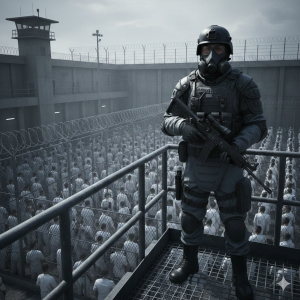
Behind the narrator rises a colossus: the world’s strictest and largest prison by capacity—an immense complex built to confine those considered the most dangerous on earth. It can hold 40,000 inmates, including members of MS-13 and other gangs, men described as psychopaths and sociopaths, people accused of ending dozens—sometimes more than fifty—lives. This is the Center for Confinement of Terrorism (CECOT) in El Salvador, engineered so that those who enter will never leave alive. There is no way out.
The rationale for this mega-prison is the country’s long torment under gangs. Starting in March 2022, under President Nayib Bukele’s administration, El Salvador launched a historic crackdown. In just sixteen months, more than 70,000 people—about two percent of the adult population—were arrested. At night, buses ferried chained gang members to CECOT in tightly choreographed convoys, lines of men seated one behind another, heads bowed, encircled by heavily armed guards. No one dared to resist. Lives changed in a single day. In this documentary, the crew will speak with one of them: a notorious gang leader nicknamed “Psycho.” They will have ten minutes.
What unfolds is an immersion into a closed world: eight modules across 410 acres; double rings of walls; a nine-meter perimeter barrier with electrified fencing; watchtowers; jammers that erase the possibility of communication; and a day-to-day existence stripped to bare survival. It is a place designed not only to prevent escape, but to extinguish the very idea of it. Here is the story—step by step, without omitting or adding a single plot point.
– Built in 2022, the prison consists of eight separate modules over 410 acres. Each pair of modules sits behind two 3-meter-high walls topped with razor wire. The entire facility is enclosed by a 9-meter wall, plus a 3-meter electric fence carrying 15,000 volts. Nineteen watchtowers oversee all approaches.
– Signal jammers blanket a 2-kilometer radius, cutting all communications. Over 600 soldiers secure the perimeter. The message is unmistakable: escape is not merely impossible; it is inconceivable.
– The documentary team arrives with presidential permission, halted repeatedly by soldiers at checkpoints. They must leave all belongings behind—only cameras and microphones may pass. The body scan is exhaustive: a high-capacity X-ray system shows bones and internal organs, primarily for screening new arrivals. In the past, inmates swallowed contraband—micro SD cards, chips, even phone chargers—to smuggle it in.
– A painstaking search follows, down to socks and shoes. Guards wear masks to protect their identities; gangs have extensive external connections. One staff member does not wear a mask—he must meet inmates eye-to-eye. It takes about an hour, even for invited media, to clear security.
– The crew enters the registration room, normally reserved for prisoners only. Captured suspects arrive without IDs and false names; fingerprints and photographs enroll them into the system. Once inside, they become permanent entries—and lose all contact with their families. Visits are forbidden, permanently.
– A stark note: during the sweeping arrests, some innocent people were mistakenly imprisoned. Because there is no contact policy, their families may not know where they are—or if they are alive. For some, this documentary might be the first glimpse of a missing loved one.
– The armory stands on constant alert against riots. Weapons include T65 rifles (akin to M16s), 12-gauge shotguns, and SIG Sauer rifles for tight spaces. Cuffs and chains restrain detainees during transport.
– So far, there have been no escapes. Staff say this place holds the “worst of the worst” within criminal organizations. Riot gear covers head, face, neck, torso, legs, shins, and includes a shield. Given the scale of the compound, the crew boards a bus to reach the modules.
– Around 1,000 staff operate inside. The grounds use acoustic pebbles—walk on them and they scrape and crunch, a crude but effective alarm against stealth. Even imagining an inmate crossing the fortress perimeter, they would still face ring after ring of security.
– The prison is self-sustaining: isolated power and sewage systems prevent external interference. In an outage, onsite systems maintain operations for up to a week.
– The team steps toward modules three and four—once an inmate enters, he never exits through those doors. Within moments, they are surrounded by more than 2,500 inmates. The air tightens; eyes track every step. The narrator locks glances with faces that do not look away. Words fail. A heaviness settles.
– Uniformity is absolute: white T-shirts, shorts, slippers—no other belongings. Many inmates are just past their early twenties, convicted of severe crimes. While infamous criminals elsewhere might have 20–30 proven victims, some here are responsible for hundreds of lost lives.
– No questions to inmates are allowed. If a prisoner tries to communicate with outsiders, guards intervene. A yellow line marks the limit; crossing it would be to walk into danger. Staff warn that everyone knows exactly what would happen without bars between them.
– Each of the eight modules contains 32 cells. A typical cell holds about 80 inmates; sometimes up to 150. Even at less than full capacity, each person has only 0.5 square meters of personal space. There are no courtyards, no ventilation rights, no time outside except on a strict schedule. Sentences are some of the longest imaginable. Those inside will never see sunlight again. Only personnel—and occasionally media—enter and exit.
– The emptiness in their stares suggests a futureless routine. Life has become monotone, almost robotic.
– In the open corner of the cell is the toilet area: two toilets for roughly 80 men. The same zone doubles as the shower; they wash with plastic dippers at a single shared basin. There’s no running water inside cells. A blue barrel holds drinking water.
– Bunks are metal, four levels high, stacked like warehouse shelving. No pillow. No mattress. Each prisoner receives only the bare essentials: white sheet, uniform, socks, slippers, towel. The rest of their hours are spent on the bunks.
– For hygiene and order, personnel shave inmates every two weeks. Long hair and beards are considered unhygienic and potential hiding places for blades.
– Many inmates are tattooed from head to toe, including faces. MS-13 symbols often feature initials or the number 13. Members of rival groups use “18,” “666” (digits that sum to 18, symbolizing the devil), or Roman numerals. Face tattoos mark especially ruthless, high-ranking members.
– A spiderweb tattoo can symbolize being caught by justice and serving a long sentence. Devil horns mark devotion to the devil; some claim their acts follow demonic command. Teardrops denote lives taken; multiple teardrops mean the count is lost. “Laugh now, cry later” masks and clowns declare: endure now, pay later.
– Former MS-13 and Barrio 18 members once carved up neighborhoods, extorting and terrorizing residents. In CECOT, they are housed side-by-side—even within the same cell. Out on the streets, breaching territory meant being torn apart; here, they must learn coexistence. The guards’ answer is simple: this is prison, not the street.
– Above every cell is an elevated catwalk where guards maintain constant visual control. A network of cameras covers every angle, 24/7. Lights never go off. At night, inmates drape towels over their eyes to sleep.
– In a corner, a preacher reads lessons from the Bible. Nearby, a trainer leads physical exercise. These are the only sanctioned activities, totaling one hour per week outside the cell, under armed watch. Space is limited; rotations are strict. “So far, nothing” serious has happened during these hours, guards say.
– When the camera settles on a cell, lips sometimes move in silence. Even from behind bars, some try to send orders outward. One prisoner is caught doing exactly that; the footage is censored to block the message.
– Despite the crackdown, rumors persist that gangs still wield power outside and plan revenge on innocent people. The authorities reply with a dire threat: if that happens, conditions will tighten further. “There won’t even be one meal in prison. They won’t eat a grain of rice. Let’s see how long their hunger lasts.”
– Meals come three times a day—breakfast, lunch, dinner—almost entirely unchanged. Breakfast: beans and rice. Lunch: white rice and pasta. Dinner: much the same, with only the drink varying. There’s no protein-rich food like chicken or meat. Lunch is shown: rice, pasta, two tortillas, and a sugary drink that the narrator sips. Inmates eat with their hands, then must return plates clean. Nutritional deficits likely follow.
– The crew visits a place harsher than anything seen so far: the isolation cell block. If an inmate breaks rules, he can be kept here up to 15 days by law. The doors are sealed; through a grid, staff identify the occupant, pass food, and cuff hands before transfer.
– Inside an isolation cell: a concrete bed, a water bin to scoop drinking water, a basin beside the toilet. The toilet appears recently used and dirty. The only light is a small opening that barely lets the sun in; that opening is also the only source of fresh air.
– What breaks men here is not force but emptiness. “Inside you don’t even see your hands,” a staff member says. Without a book or anything to keep the mind steady, even the toughest begin to crack. For men described as once “playing God,” staff insist, mercy is not the point. Justice is.
– The interview begins with the inmate known as “Psycho.” He has a 34-year criminal history and has spent the past 25 years as a high-ranking member of an organization. Twelve guards are barely enough to secure the area. The instruction is blunt: ten minutes.
– “Remove the mask.” He gives his name: Marvin Ernesto Metano Vásquez. He is 41, though the interviewer says he looks closer to 35. He shows tattoos: “M 13.”
– He joined the organization in 2004, but began his criminal record at age 11. He describes a childhood with a working mother and no father figure, turning to the streets for help, stealing for shoes and clothes. He sought belonging in gangs, tried moving “upstate—the United States” to change, but returned to El Salvador, where gangs were stronger; he fell back into crime and was locked up.
– He says he has always pursued goals until he achieved them—“I accomplished everything I had to do right here. But I’m right here. This is how the devil pays the people.”
– The interviewer asks: is it true that to join, you must end someone’s life? “Yeah.” The first victim must be a relative? “Yeah,” he answers, asserting it’s about gaining territory for the gang.
– He says he lost his mother, father, and son because of gangs, though he could have been with his family in the U.S. “We took wrong decisions and this is the cause.” He addresses youth: go to school; listen to your parents; do not live this life.
– How many lives has he ended? Five? Ten? More? He stops short of specifics. Speaking about “what you used to do in the jails,” he says it could be “a few more than 50,” and “you got to do it sometimes.” How did he become merciless? “In time,” he says, unable to fully answer.
– He has not seen his son since the boy was five. Now the son is 21. He wants to see him, to warn him not to repeat his father’s path. Asked how he copes with missing family—especially given that his victims’ families will never reunite—he admits that sometimes he lies down, thinks, and cries.
– What keeps him alive here? The hope, one day, to change and to look for God. He asks for forgiveness: “Forgive me, ’cause I did some things.”
– Stepping back into daylight is a relief. CECOT is a place one would never wish to enter, not even as a visitor. Yet for those who victimized Salvadorans, it is now a forever home. They once stole the right to live; now they pay with lives confined to steel and concrete. The state’s message is uncompromising: crime is no longer tolerated, and punishment is severe.
– El Salvador once led the world in lives lost—at the peak, 104 per 100,000 in a single year. Past administrations tried truces with gangs; none delivered lasting order. Controversial as the current methods are, by 2023 the rate fell to 2.4 per 100,000, placing the country among the safest in the world. The result is undeniable: neighborhoods have quieted; fear has receded.
– And yet another truth stands beside the statistics: some innocents were swept up in the crackdown. With no-contact rules, their families may not even know if they are alive. Is this true justice—or simply the price of controlling chaos? Is El Salvador witnessing a durable solution, or only a temporary fix that depends on relentless pressure?
– For now, the answer remains uncertain. The world keeps watching.
The documentary signs off: thanks for watching; see you in the next one; don’t forget to subscribe. A final tag: Rui CheneT was here.
Disclaimer : This content may be created by AI for entertainment purposes. Any resemblance to real persons, events, or places is coincidental.