THE REWRITTEN DESTINY: NO LONGER YOUR FOOL
The 70th birthday of my grandmother, Vuong Uyen Nhu, was supposed to be a day of golden celebration. Instead, it became a day of black and white mourning. On that very morning, my grandfather—Chu Ke An—took his own life in the city, following the ghost of his first love who had passed away years ago.
The news shattered the festive atmosphere like glass. Before the funeral altar, Grandma did not weep with longing. With trembling hands, she took her marriage certificate and tore it into jagged pieces. “I bore your children, I toiled my whole life for you, and yet you leave me living as a cosmic joke,” she choked out, her voice raspy with decades of suppressed pain. “Chu Ke An, if there is a next life, I never want to see you again.”
As her vision blurred with tears, I felt a sudden, violent pull. When I opened my eyes, the smell of incense was gone, replaced by the scent of blooming jasmine and the humid air of the 1970s. I had become a “System” inhabiting my grandmother’s mind—back when she was only nineteen.
I saw him. The young Chu Ke An, a handsome scholar with a scholarly air that made every girl in the village swoon, was walking toward Grandma with a bouquet of wildflowers. My younger grandmother stood there, her eyes still filled with the lingering affection of a girl in love.
“Grandma, hit him!” I barked a command through our mental link.
Though confused by the voice in her head, the residual bitterness from her future self seemed to surge. Without a word, she swung her hand. SLAP! The sound echoed through the path. Chu Ke An’s face whipped to the side, his bouquet falling into the dirt.
“Uyen Nhu… why did you hit me?” he stammered, clutching his reddened cheek.
“Because I felt like it. Do I need to pick a special day to slap a fool?” she replied, repeating the words I fed her. The surrounding villagers froze in shock. This was Chu Ke An, the village’s golden boy!
“Vuong Uyen Nhu, are you crazy?” a neighbor shouted. “He’s the best match you could ever hope for!”
Grandma didn’t look back. She marched home, locked her door, and finally spoke to me in her mind. It took thirty minutes to explain “Time Travel” and “Systems.” When she finally understood that this man would spend her life’s savings only to die for another woman on her 70th birthday, her eyes turned cold.
“So, he’s in love with Tran Tu Ha?” she asked.
Just then, a gentle knock came. “Uyen Nhu, are you home?” It was Tran Tu Ha—the “White Moonlight” of my grandfather’s heart and Grandma’s supposed best friend. She looked delicate in her floral dress, holding a basket of cakes.
Grandma opened the door, smiled tightly, and then—obeying my nudge—pushed Tu Ha right back out. “The room is dusty, I just swept. Speak from the yard.” The master of “flipping faces” had been born. When Tu Ha tried to play the peacemaker for Ke An, Grandma cut her off: “The past is the past. Now is now. Don’t waste your breath.”
That night, Grandma couldn’t sleep, so I played a loud, upbeat pop song in her head. “Grandma, get up! There’s a show at the riverbank!”
We crept through the grass to find Chu Ke An and Tran Tu Ha whispering under the moonlight. Tu Ha was sobbing, leaning into his arms. “I tried to help, but Uyen Nhu has changed… it’s all my fault.”
Ke An held her, his voice full of resentment. “She’s ungrateful, Tu Ha. If she continues this way, I’ll just come to your house and propose.”
Tu Ha froze and immediately pulled away. “No! My father… he’s found a rich man in town for me.”
Grandma watched from the bushes, realizing the truth. In her past life, Ke An only married her because Tu Ha’s father wanted a wealthy son-in-law. Ke An was poor, but Grandma’s father was the Village Chief. He had used Grandma as a stepping stone, a bank account to fund his education and business, while keeping Tu Ha in his heart for fifty years.
In the following weeks, Ke An tried to “win her back” through hollow labor. He hoed the fields poorly and brought her a movie ticket, acting like a devoted suitor. Grandma adopted a “Three No’s” policy: No initiative, No rejection, No responsibility. She let him do her chores, took the gifts, but the moment he asked for a commitment, she played dumb.
“Uyen Nhu, I’ve worked so hard for you lately…” Ke An panted one afternoon.
“You’re a good person, Ke An. Truly,” she smiled sweetly, then immediately turned to go home.
“Wait!” He grabbed her wrist. “Give me an answer!”
Suddenly, a tall figure in a faded military uniform stepped in, prying Ke An’s hand away. “Get away from her.”
It was Tran An. Grandma’s first love—the one she had lost to the “right choice” of Chu Ke An in her previous life. He was rugged, steady, and had the quiet strength of a soldier. Unlike Ke An, who looked like a gust of wind could knock him over, Tran An was a mountain.
The tension was electric. “Tran An, this is none of your business!” Ke An yelled.
“If you’re bothering her, it is,” Tran An replied calmly.
The village gossip shifted overnight. Why would Uyen Nhu want a poor student when a war hero and newly appointed official like Tran An was back?
Desperate to prove his worth, Ke An pinned his hopes on his university entrance results. When he became the only student in the village to pass, he held a celebratory feast. Wearing a new suit, he approached Grandma. “Uyen Nhu, I’m a university student now. If you nod your head today, I’ll marry you after I graduate.”
I whispered to Grandma: “He wants you to pay for his four years of tuition.”
Grandma didn’t say yes. Instead, she took a sip of wine and spat it directly onto his new suit. “Congratulations,” she said coldly.
In her past life, she had worked three jobs, ruined her back in a brick kiln, and spent every penny to send him to school, only for him to leave her in a cold room while he dreamed of another. Not this time.
Ke An tried to borrow money for his fees, but everyone turned him down—even Tran Tu Ha’s family kicked him out. Eventually, the village had to crowdfund his education out of pity. He left for the city with a heavy heart, while Grandma began her own empire.
With my modern knowledge and Grandma’s skilled hands, we started a sewing business. We imported high-quality fabrics through Tran An’s connections. Within a year, Grandma wasn’t just a village girl; she was a “New Era Woman.” She built a factory, hired the local women, and became the wealthiest person in the district.
Meanwhile, Tran Tu Ha had run away to find Ke An in the city with the travel money Grandma “generously” gave her. A year later, she returned—pregnant, haggard, and beaten down by life. The “White Moonlight” had turned into a “Bitter Gourd.” In the city, without Grandma’s money, Ke An and Tu Ha lived in squalor. They fought daily over pennies. Ke An blamed her for his poverty; she blamed him for his incompetence.
The “eternal love” that had ruined Grandma’s 70th birthday had crumbled after just twelve months of actual reality.
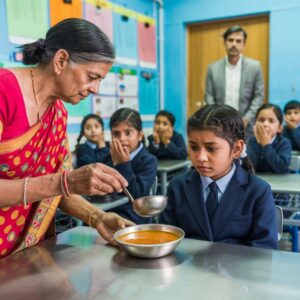
Grandma used her wealth to build a primary school for the village. On the day of the grand opening, the district leaders were there to honor her. She stood on the podium, radiant and independent.
In the corner of the crowd stood Chu Ke An. He had dropped out of school and was back to tilling the earth, his face aged beyond his years. He watched the woman who should have been his wife, the woman who was now a star he could never touch.
“Stop staring,” Tu Ha hissed at him, clutching their crying child. “She’s not yours.”
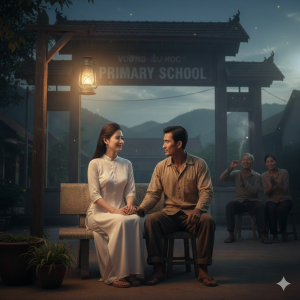
That evening, the sun set over the village in hues of gold and purple. Grandma sat in her courtyard with her father and Tran An. Her father, puffing on his pipe, looked at them and smiled. “Uyen Nhu, the school is built. My heart is at peace. Isn’t it time you thought about… your own home?”
Grandma’s ears turned red. She looked at Tran An, whose steady gaze never left her. “It depends on him,” she whispered.
I felt a wave of peace wash over us. The 70-year-old woman who cried over a torn certificate was gone. In her place was a woman who owned her soul, her fortune, and her future.
Disclaimer : This content may be created by AI for entertainment purposes. Any resemblance to real persons, events, or places is coincidental.