THE RECKONING OF THE NEW YEAR’S EVE DINNER
The scent of agarwood incense on the ancestral altar mingled with the greasy aroma of boiled chicken and the pungent smell of dried bamboo shoot soup, creating a suffocating atmosphere that clung to the throat. This was supposed to be the most sacred moment of the year—the Tat Nien (New Year’s Eve) dinner—where families gather to cast aside the year’s worries and welcome the sacred transition of time.
Yet, sitting small and vulnerable at the heavy ironwood table, Thao felt a chill run down her spine that no thick sweater could ward off. At eight months pregnant, every movement was an ordeal. Her daughter in the womb seemed to sense her mother’s distress, kicking sharply against her taut belly, forcing Thao to wince and gently rub her stomach in a silent plea for calm.
Thao’s in-laws, Mr. Quang and Mrs. Hanh, lived by unwritten rules more rigid than military law. The table was a masterpiece of Northern tradition: square green banh chung, perfectly sliced silk sausages, and bright red sticky rice for luck. But no one dared touch a chopstick until Mrs. Hanh gave the command.
Thao looked around. The house was full—Aunt Bay, Uncle Tu, and various distant relatives were all there, boasting about bonuses, land prices, and their children’s academic achievements. Yet, their laughter and chatter seemed to skip over Thao. She sat there like a lifeless stone, an alien object in their sea of joy. No one asked how she felt; no one cared if the heavy belly made sitting on the hard wooden chair a torture.
Her husband, Nam, was absent. A last-minute crisis at his company had stranded him at the office. He had called, his voice thick with anxiety, promising to be home before midnight. Thao knew he loved her, but his absence had stripped away her only shield. Without him, she was a fish on the chopping block, waiting for the blade to fall.
Mrs. Hanh sat at the head of the table, the seat of absolute authority. Dressed in a plum-colored silk tunic, her hair pinned high and gold rings flashing under the fluorescent light, she smiled brightly as she placed a large piece of cinnamon pork into the bowl of her grandson, Tu’s son.
“Eat up, my boy,” she cooed. “Grow big and strong to carry on the family name and bring glory to our lineage. Not like some people who just waste rice and can’t even produce a son, only knowing how to be fragile and demanding.”
The table went silent. Mrs. Hanh hadn’t named anyone, but every eye turned toward Thao. Thao’s knuckles turned white as she gripped her chopsticks. She was carrying a girl. In this house, despite the modern era, the preference for sons over daughters was a bone-deep marrow. Ever since the ultrasound revealed a girl, Mrs. Hanh’s coldness had sharpened into malice. She viewed Thao’s pregnancy as a debt, a failure of the Nguyen family bloodline.
Aunt Bay, chewing noisily on a piece of chicken, chimed in with a sour smirk. “Oh, Sister Hanh, don’t worry too much. These days, daughters belong to other people; only sons are truly ours. And that Nam of yours is strange—his wife is about to pop, and he’s missing for New Year’s? Maybe he’s out looking for ‘fresh noodles’ because he’s bored with ‘home-cooked rice.’ Men are most likely to stray when their wives are pregnant, you know.”
Thao’s chest tightened with a suffocating rage. Nam wasn’t like that. She wanted to scream, to defend her husband, but she knew that in this house, “talking back” was the ultimate sin. Her father-in-law, Mr. Quang, remained stoic, his eyes fixed on the television, sipping wine in a silence that wasn’t tolerance—it was the cruelest form of complicity. He was the Law; Mrs. Hanh was the Executioner.
“Please, everyone, let’s eat,” Thao whispered, trying to be as small as possible.
Mrs. Hanh ignored her, gắp-ing food for everyone else. Thao’s bowl remained empty and white. The braised pork she liked was at the far end of the table; the vegetables were blocked by a mountain of chicken bones. Before her lay only a bowl of plain fish sauce and pungent pickled onions. Hunger and humiliation burned in her nose. She thought of her parents in the countryside—they would be heartbroken to see their daughter treated as a servant.
“Why aren’t you eating?” Mrs. Hanh’s voice sliced through her thoughts. “Or is country food too beneath a city princess? You’re used to delicacies, I suppose.”
“No, Mother. I’m eating,” Thao said, swallowing a lump of tears along with a mouthful of dry rice.
Twenty minutes into the meal, the rice cooker was half-empty. Mrs. Hanh suddenly slammed her chopsticks down with a sharp clack. The room froze.
“The rice is out,” Mrs. Hanh said coldly. “Thao, get up and serve everyone more rice. Stop sitting there like a statue. Haven’t you lounged enough?”
Thao looked up, stunned. Her belly had dropped low, pressing against her pelvis, making every step a heavy, agonizing task. The doctor had warned her about early labor risks. Just two days ago, Mrs. Hanh had heard her complaining to Nam about her back pain.
“Mother… my belly is very heavy, and it hurts to stand up,” Thao stammered, her hand instinctively cradling her stomach. “Could Hue or Lan help? They are right next to the rice cooker.”
Mrs. Hanh’s eyes widened, her tattooed eyebrows arching into a fierce line. “What? You’re negotiating with me? You think that ‘backpack’ you’re wearing makes you a queen? You think this whole family exists to serve you?”
Aunt Bay scoffed. “City girls… always tired, always in pain. Back in our day, we carried baskets of rice to the fields until the day we went into labor. You’re just spoiled.”
Even Uncle Tu chimed in, “If she’s shy, let it be, but family tradition must be kept. A daughter-in-law must serve. You’ve spoiled her, brother.”
Thao looked at Hue, a younger cousin who started to stand up to help, but Mrs. Hanh barked, “Sit down, Hue! I am talking to your sister-in-law. Let’s see if her bottom is glued to that chair.”
Thao felt the heat rise to her face. She had worked like a slave during her early pregnancy, but this deliberate humiliation in front of the relatives was the breaking point. This wasn’t about rice; it was a power play.
“Mother, I am asking for your understanding,” Thao said, her voice trembling but clear. “The doctor said I must limit movement. My legs are swollen and painful.”
“You’re threatening me with the doctor now?” Mrs. Hanh slammed the table, spilling the sauce. “I birthed three sons, all of them huge. I know what pregnancy is. Get up and serve the rice now. Don’t make me say it a third time.”
Mr. Quang finally turned his gaze from the TV. “Thao, do as your mother says. It’s just a bowl of rice. Don’t make the whole family wait. Be quick.”
The injustice was a tidal wave. Thao looked at their indifferent, mocking faces and felt a fire ignite in her soul. If she stood up now, she would be a servant forever. If she didn’t, the storm would break. But she had to protect her child.
“I’m sorry, Father, Mother,” Thao said, her voice ringing out. “I cannot do it. If you need rice immediately, Hue can help. But if you insist on making me serve while I am in pain, then I will not eat another bite.”
The room gasped. The “obedient doll” had just talked back. Mrs. Hanh turned a terrifying shade of red. “You… you brat! You think because Nam pampers you, you can run this house? You uneducated girl! We brought you here to be a daughter-in-law, not my grandmother!”
The insults poured out—words that insulted not just Thao, but her parents. Thao’s heart hammered against her ribs, but she kept her head. She needed proof. She needed Nam to see the raw, ugly truth, not the twisted version her mother-in-law would tell later.
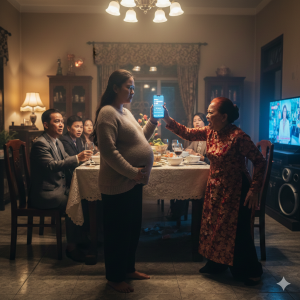
Under the table, her hand slipped into her sweater pocket. Her phone was already unlocked, the camera app ready. She pulled it out and leaned it against a large glass of orange juice. The dark liquid and the tall glass hid the body of the phone, leaving only the tiny lens peering at Mrs. Hanh and Mr. Quang.
“Don’t speak like that, Mother,” Thao said with unnatural calm. “My parents taught me respect, but they didn’t teach me to accept abuse that endangers my child. I am a human being. I feel pain.”
“You still have a mouth on you?” Mrs. Hanh lunged out of her chair, pointing a red-taloned finger at Thao’s face. She began digging up every petty grievance—how Thao couldn’t slaughter a chicken or how she spent too much money.
Thao sat still, her eyes locked on Mrs. Hanh, while her hand subtly adjusted the phone’s angle. “I cannot stand up. I hope the family understands.”
“You want to start a revolution in this house?” Mrs. Hanh screamed, banging the table until the dishes rattled. “If you don’t like serving this family, then pack your things and go back to your mother’s house! Let’s see if they have the face to look at the neighbors!”
To threaten a pregnant woman with eviction on New Year’s Eve was a taboo of the highest order. Aunt Bay tried to “mediate” by forcing Thao to apologize, but Thao refused. “I have done nothing wrong. Harmony cannot be built on the pain of a pregnant woman.”
“Shut up! One more word and I’ll slap that mouth shut!” Mrs. Hanh shrieked.
“Go ahead, Mother,” Thao challenged, her voice icy. “Slap me. You’d be hitting your own granddaughter. Let’s see if the law stays silent then.”
The word “Law” hit the room like a bucket of ice water. Thao began listing her contributions—how she cared for her father-in-law in the hospital, how her and Nam’s savings built the new kitchen. “Loyalty does not mean being a fool. According to the Law on Marriage and Family, a daughter-in-law has equal dignity. Forcing a sick, pregnant woman to work and threatening her is domestic violence.”
Mr. Quang slammed his glass down. “Thao! What nonsense is this? Family rules are higher than any law here. I am the master of this house!”
“Father, family rules must follow the law and morality. I thought you were wise, but you only condone cruelty.”
Mrs. Hanh, emboldened by her husband, moved toward Thao, but her eyes caught something. The orange juice glass. The glint of a lens.
“What is that?” she shrieked. “Are you filming me? You dare film me?”
The table erupted. Aunt Bay and Uncle Tu stood up, horrified. Mrs. Hanh’s face went from red to purple. Panic fueled her aggression. “Give it to me! Give me that phone!”
She lunged like a wounded beast. Thao’s maternal instinct took over. She shielded her belly with her left arm and snatched the phone with her right, dodging the grab.
CRASH!
Mrs. Hanh missed, her momentum sending her crashing into the table, knocking a bowl of hot bamboo shoot soup onto the floor. “Oh heavens! She hit me! She pushed me!” Mrs. Hanh wailed, faking an injury.
The relatives swarmed. “Thao, what have you done? Grab her! Get the phone!”
Thao backed against the wall, her fingers flying across the screen. She opened the family Zalo group.
Tinh!
The sound was small but sharp. “I sent it,” Thao shouted, holding the phone up like a shield. “I sent it to Nam. And to Toàn and Thắng. It’s on the cloud now. You can’t delete it.”
The names Toàn and Thắng hit the room like thunderbolts. Toan was the eldest, a high-ranking Army Colonel. Thang was the second eldest, a sharp, no-nonsense officer. Nam was the youngest and gentlest, but his older brothers were the pillars of the family that everyone feared.
Mrs. Hanh stopped wailing. Mr. Quang’s face went pale. “You… you aired our dirty laundry? Delete it! I order you!”
“The people shaming this family are sitting at this table, Father,” Thao said, tears finally falling from the stress.
Thao’s phone buzzed. A message from Nam: “Wait for me.”
Below it, two status updates appeared: “Toan has viewed,” “Thang has viewed.”
Thao let out a ragged breath. The reinforcements were coming.
Fifteen minutes of suffocating silence passed. No one dared to move. Mrs. Hanh sat slumped in her chair, the “victim” act forgotten. Then, from the hallway, came the sound.
It wasn’t the hurried footsteps of one man. It was the rhythmic, heavy thud of military boots on tile. The sound echoed through the quiet apartment building like approaching thunder.
The heavy ironwood door was kicked open. A gust of cold winter rain swept in, but it was warmer than the aura of the three men standing in the doorway.
Nam was in the lead. His suit was disheveled, his tie loosened, his face a mask of cold fury. Beside him stood Toan and Thang, both in their full winter dress uniforms, their rank insignia gleaming under the lights. The sheer presence of two high-ranking officers in a small dining room was overwhelming.
Mr. Quang’s wine glass shattered on the floor. “Nam… Toan… Thang… you’re home?”
Nam didn’t answer. He walked straight to Thao, kneeling beside her chair. His hands trembled as he touched her face. “Are you okay? Is the baby okay? Are you in pain?”
Thao collapsed into his shoulder, sobbing. “Nam… I was so scared.”
Toan stepped forward, his boots clicking on the floor. He looked at the shattered dishes, the spilled soup, and then at his mother. “Is this a New Year’s Eve dinner?” his voice boomed like a bronze bell. “Or a battlefield where the whole family gathers to bully a pregnant woman?”
No one spoke. Thang, the second brother, walked to the table. He called out Aunt Bay and Uncle Tu by name. “I thought I’d come home to see a family gathering, not a pathetic play. You two have a lot of free time, don’t you? Instead of praying at home, you’re here fueling a fire against your own niece.”
Aunt Bay stammered, “I… I was just advising her…”
“Advising?” Thang’s smile didn’t reach his eyes. “Advising her to endure abuse? Watching her suffer while you eat? That’s your version of family, Auntie?”
Nam helped Thao stand. He pulled out his phone and connected it to the large Bluetooth speaker Uncle Tu had brought for karaoke.
“Mother said she was ‘teaching’ her,” Nam said, his voice dangerously low. “Let’s hear the lesson.”
BEEP.
Mrs. Hanh’s screeching voice erupted from the speaker, amplified ten times. “You think that backpack you’re wearing makes you a queen? … I don’t need a granddaughter! … Get out!”
The cruelty, when played back so loudly, was unbearable. Aunt Bay dropped her chopsticks. Mrs. Hanh covered her face. The “tradition” they boasted of was revealed as nothing more than petty, ancient hatred.
“Do you hear it now?” Nam asked. “Mother said she doesn’t need her granddaughter. She told my wife to ‘get out.’ So tell me, why should Thao and I stay in this house for one more second?”
“Nam… I was just angry…” Mrs. Hanh whimpered.
“Anger is an instinct; restraint is character,” Nam barked. “You didn’t want restraint. You wanted to crush her because she isn’t a submissive country girl.”
Mr. Quang tried to intervene. “Enough! Nam, you are being disrespectful! I raised you—”
“I am grateful you raised me, Father,” Nam interrupted. “But being a son doesn’t mean being blind. You watched her suffer and did nothing to protect her. Is that what you taught me about being a man? To let my wife be trampled for the sake of your ‘face’?”
Toan stepped in, blocking Mr. Quang’s path. “Father, don’t hit him. He’s right. You taught us to be good people, but your goodness is only for show to the neighbors. Inside this house, you are cold. You are about to lose your sons because you chose a fake tradition over your own blood.”
Thang looked at his mother. “Do you know why we chose the military? To protect people. But while we were away protecting strangers, our own sister-in-law was being abused in our own home. We feel useless, Mother. A family is a sanctuary. If the sanctuary is this rotten, we have nothing to come back to.”
Toan put a hand on Nam’s shoulder. “Nam, you did the right thing. If you can’t live here, take her out. I’ll take care of whatever you need. A man’s honor isn’t in shouting at his wife; it’s in making sure she is safe.”
Nam nodded, his eyes wet. “Let’s go, Thao.”
As they walked out, Toan and Thang flanking them like bodyguards, Mrs. Hanh sat in the wreckage of her dinner, finally crying real tears—tears of the sudden, terrifying realization that she was becoming a stranger to her own sons.
The midnight air was biting, but Thao felt a warmth she hadn’t known in years. Nam drove them to a five-star hotel by the river. “Tonight, you are a queen,” he whispered. “We are never going back to being victims.”
As the fireworks exploded over the river at the stroke of midnight, Nam kissed Thao’s forehead and then her belly. “Happy New Year, my loves.”
On New Year’s Day, the “sick mother” act began. Mr. Quang called, claiming Mrs. Hanh was in the hospital with dangerously high blood pressure. But the brothers were one step ahead. Toan was already at the hospital, reporting back that she was perfectly fine, eating chicken porridge and cursing them under her breath.
Nam didn’t budge. He met his father at the hospital later that day, not with an apology, but with a five-page legal agreement.
“Sign this, or we leave for good,” Nam said. The agreement stipulated absolute respect for Thao, no interference in child-rearing, and a legal restructuring of the house’s ownership. “We will pay you back every cent you spent on the house. It will be ours, or we sell it and move. No more ‘favors’ to be held over our heads.”
Mr. Quang looked at his three sons. They stood like a mountain range, unmoving. He realized his era of tyranny was over. With a trembling hand, he signed. Mrs. Hanh, seeing her husband surrender, followed suit.
As they walked out of the hospital into the bright New Year sun, Toan laughed. “By the way, Nam, I talked to my friend—the CEO of your company. That boss who forced you to work on New Year’s Eve? He’s being ‘audited.’ Expect a change in management.”
The three brothers burst into laughter, the sound echoing through the streets, clearing the last of the winter’s gloom. Thao leaned against Nam, watching the spring buds on the trees. The storm had passed, and for the first time, she could breathe.
Disclaimer : This content may be created by AI for entertainment purposes. Any resemblance to real persons, events, or places is coincidental.