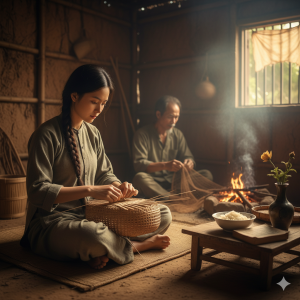
In the small village of Lạc Thôn, where the poor scraped by year-round, lived a girl named Tiểu Vi. Her mother died early, and her father raised her by weaving rented baskets. Although poor, he taught her impeccable virtue. From the age of 13, Tiểu Vi was capable, cooking, mending clothes, and caring for her father devotedly. Her gentle nature and soft-spoken manner, bowing respectfully to everyone, earned her the affection of the entire village.
When she was 16, a matchmaker, known for finding virtuous daughters-in-law for wealthy families, came knocking. She had heard rumors across three villages and arrived at Tiểu Vi’s door. The Trình family from the East Citadel, renowned for their wealth from collecting grain and lending money, sought a wife for their son. Tiểu Vi’s father, pitying his daughter’s poverty, thought marrying into a good family would be a blessing. Not long after, the Trình family proposed with a modest dowry: a bolt of coarse cloth, five measures of rice, and three blocks of brown sugar. On the day of her departure, her father whispered: “Their family has wealth, I do not worry you will starve. You must only uphold the path of a good daughter-in-law; that is all I ask.” Tiểu Vi nodded, tears mingling with her farewell meal, and packed her belongings to follow her in-laws, sitting in the wooden carriage, her heart trembling with uncertainty about her future.
Stepping into the Trình family compound, Tiểu Vi was immediately confronted by Madam Trình—her mother-in-law, the head of the household, a woman of severe disposition and a tongue as sharp as a knife. She had never favored any girl as a daughter-in-law and agreed to the marriage only because of Tiểu Vi’s reputation for virtue. Standing on a high step, Madam Trình looked down at Tiểu Vi with cold eyes and no trace of a smile, deeming her too frail to be the eldest daughter-in-law.
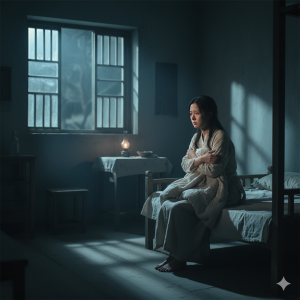
On the wedding night, without any ceremony or feast, Tiểu Vi was led to the west wing, a room smaller than the servants’ quarters. Her husband, Trình Hạo, only entered once, stating coldly: “I married you to obey my mother, but I have no affection for you. From now on, know your place.” She sat alone all night, clutching her blanket, the wind outside whipping against the wooden door like a long sigh for her life.
The following days were a cycle of grueling labor. She rose at 5 AM, kindling the fire, washing rice, cooking porridge, doing laundry, and sweeping the courtyard—all without a single complaint. The servants, used to idleness, took advantage of her kindness and ordered her around constantly. Her mother-in-law watched her every move, seeking fault at every meal, criticizing the lack of ginger in the soup or the cold tea. Tiểu Vi only offered gentle apologies, never arguing. Once, sick with a fever, her shaky hands dropped a bowl of hot soup, burning herself. Madam Trình rushed out, and before asking about her, slapped her fiercely: “This house does not keep useless people.” That night, Tiểu Vi curled up in bed, her hand swollen, tears soaking her pillow, telling herself: “As long as I am filial, Heaven will not abandon me.”
Trình Hạo remained distant, often away, never speaking a kind word. He would walk past her in the garden as if she were invisible. Two full moons passed, and Tiểu Vi was not pregnant. Her mother-in-law began to hint darkly: “A tree that bears no fruit must be cut down and replaced.” Her heart felt sliced by a knife.
Despite the suffering, Tiểu Vi maintained her gentle nature. She worked tirelessly, but secretly shared medicine with sick servants and helped the elderly neighbors by sweeping their yards and fetching water. Gradually, from the servants to the neighbors, everyone grew fond of her, calling her “The Virtuous Daughter-in-law.”
Yet, to her mother-in-law, she remained a thorn. Madam Trình called her to the main hall, pointing a finger: “Don’t think you can win over people with a few small deeds. Until I am satisfied, you have no standing here.” Tiểu Vi bowed, replying: “Mother is right. I only wish to fulfill my duty.”
That winter, Tiểu Vi’s father fell gravely ill. A villager from Lạc Thôn secretly delivered a letter to her. Written in a trembling hand, with ink blurred by water, it begged his daughter to come home once, as there was no one to care for him. That evening, Tiểu Vi knelt before the main hall, holding the letter, pleading with her mother-in-law.
Madam Trình sat on her rosewood chair, her eyes glacial, and refused without mercy: “I married you here to care for this house, not to come and go as you please. Once married, fulfilling your duty here is the truest filial piety.” She slammed the table, forbidding her to mention the matter again. Tiểu Vi choked on her tears, which fell onto the stone floor.
A week later, a messenger brought news: her father had died. She did not cry aloud, only slumped to the ground, her hands trembling as she carried the tray of soup. At lunch, Madam Trình saw her tears and sternly announced: “Grief should be kept within. Crying will not bring the dead back to life. Wipe your face. Do not soil this house.” After her father’s death, Tiểu Vi’s heart was sealed. She stopped smiling and would stay up late mending clothes for the servants, but still received no affection from the family.
After months of cold treatment, Tiểu Vi fell ill again after slipping on a stone in the garden. Madam Trình, upon hearing the news, merely said: “Do not die in the garden. It would bring bad luck.” No one dared help her. She struggled to her feet, muddy and bruised, and dragged herself back to her room, where she suffered a high fever for three days. Only through the kind care of the old wet nurse did she recover.
Meanwhile, Madam Trình, persuaded by a matchmaker to secure a marriage with a wealthy Miss Vương, began seeking an excuse to expel Tiểu Vi.
One noon, as Tiểu Vi was hanging clothes, her mother-in-law stood before her, eyes like cold steel: “I have decided. You are unworthy to be the eldest daughter-in-law of the Trình family. You must leave.” Tiểu Vi looked up: “What wrong have I done?” Madam Trình snapped: “You need not have done wrong. This family does not need the unlucky—the barren, the childless.” Tiểu Vi bowed her head, tears falling silently, not from fear, but from the bitterness of her fate.
That evening, she packed her few old clothes, a needlework kit, and the handkerchief her father left behind. As she walked out the gate, she did not look back, whispering: “I hold no resentment. I only hope in the next life you, Mother-in-law, will understand that a daughter-in-law who endures is one who deserves compassion.”
Tiểu Vi left the Trình household at the start of spring. Directionless, she stopped at a crossroads and sat beneath a large mulberry tree, eyes pale and distant. An elderly woman selling sweet potato cakes saw her frail appearance, stopped, and asked: “Where are you going, young lady, sitting in the sun like this?” Tiểu Vi bowed: “I have no home to return to.” The old woman sighed, gave her a cake, and said: “Eat. Without food, you have no strength to walk.”
From that day, the old woman took her in to help sell the cakes. The stall was in a small, quiet intersection. Tiểu Vi rose early, kindled the fire, and worked diligently, always offering a gentle smile and soft words to the customers. Everyone loved her. A month later, the old woman handed her some money: “I am too old now. If you are willing, you can keep this stall and make a living.” From an outcast with no home, Tiểu Vi now had a small corner to lean on. She lived by the cake stall, toiling, but free from scolding and coldness.
Meanwhile, the Trình family’s luck changed. After driving Tiểu Vi away, Madam Trình hastily arranged the marriage with Miss Vương, who demanded an exorbitant dowry of a hundred taels of silver. The wedding was grand, but within a month, Trình Hạo’s face was etched with annoyance. The new Mrs. Vương did not cook or work, spending her days on makeup and silk robes. She struck the servants she disliked and cried for three days if her mother-in-law uttered a criticism. At meals, she would throw down her chopsticks if the food displeased her. Even Madam Trình had to be subservient. The atmosphere in the house was heavy as stone. Trình Hạo spent more time away from home.
Less than two months later, the Trình family’s fortunes faltered. The Vương family was investigated, their granaries sealed, and the Trình family’s dowry was lost. The servants fled, unable to tolerate the new daughter-in-law. The courtyard grew deserted. Madam Trình began to cough heavily. Sitting alone, she silently looked at the door through which she had pushed Tiểu Vi, feeling a strange void.
One day at the market, she passed the sweet potato cake stall and stopped, recognizing the familiar figure. The girl in coarse clothes, hair neatly tied, skillfully flipping the cakes, her eyes gentle, her smile warm—it was Tiểu Vi. She bowed slightly: “Greetings, Mother.” Madam Trình turned red, then coldly walked away, but from then on, she watched from a distance. The stall was always busy, and the customers were always smiling. She asked a nearby vegetable vendor: “Where does that girl live?” The vendor replied: “She sleeps in the stall. She is very kind. She helps anyone in need.”
One morning, Madam Trình sent a servant to buy a cake. Holding the warm bag, she bit into it. The cake was fragrant, soft, and lightly sweet—unlike any she had ever tasted. She suddenly understood that some things are truly precious only when lost. That fragrance, that gentle sweetness, which she once despised, now brought a lump to her throat.
When Mrs. Vương entered, holding a silk fan, she complained: “That servant I scolded yesterday ran away! Those lowly people aren’t worth keeping.” Madam Trình looked at her, no longer with sympathy. Mrs. Vương continued: “And why were you looking at that cake seller today? How dare the one who was chased out of our house stand tall in the market?” Madam Trình slowly set the cake down and spoke deliberately: “One who can hold their head high has nothing to be ashamed of in their heart.”
Trình Hạo also came to the stall one afternoon. He stood silently for a long time, then whispered: “I often miss you.” Tiểu Vi did not reply, only picking up a dropped cake and setting it aside. “The past is over, please do not mention it.” She looked him in the eyes—no longer the gentle gaze of the young girl, but the firm light of someone who had survived hardship. Trình Hạo felt small. He knew some mistakes in this life could not be undone.
That evening, Madam Trình confessed to her son: “She is living better than I imagined. I wish to invite her back, but I am not worthy.” The next morning, she drove to the market herself, approaching Tiểu Vi with tears in her eyes: “I did not come to command you. I only wish to eat a cake made by your own hands.” Tiểu Vi silently presented the cake with both hands. Madam Trình took out a silk purse of silver: “It is not enough to repay your suffering, but it is my heart.” Tiểu Vi gently shook her head: “I do not need silver. I only wish for you to live in peace and treat others kindly in the future.”
Later, during a storm, Madam Trình fell, and Tiểu Vi helped her, bringing her to her simple home. She cooked porridge and dried her hair. Madam Trình looked at her with genuine sorrow: “I never thought you would still live with such kindness.” Tiểu Vi smiled: “It is not that I am kind. It is that you did not inflict too great an evil upon me then, so I still have a path to live.”
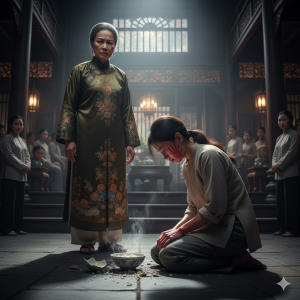
The following morning, Trình Hạo found his mother sitting quietly in Tiểu Vi’s small house. He looked at Tiểu Vi, his eyes full of entanglement. Madam Trình slowly knelt before her: “It is my fault. That year, because of prejudice, pride, and selfishness, I drove you out. A mother-in-law like me does not deserve blessings.” Tiểu Vi quickly helped her up, without resentment. Time had taught her that some people are not wicked, merely blind.
A few days later, Madam Trình returned home but weakened quickly. She told a neighbor’s child, holding a sweet cake bought from Tiểu Vi’s stall: “My former daughter-in-law made this. Her cake is the best.” A short time later, she passed away gently. Tiểu Vi cared for the funeral as if for a relative.
Tiểu Vi received a small package containing the handkerchief she had embroidered years ago and a letter: “Vi nhi, years have passed, and I have grown old… You are a good person, a great blessing that our family lost. If there is a next life, I vow to be your mother, hoping you live peacefully forever.”
Years later, a small girl named Lan, orphaned and poor, appeared by her stall. Tiểu Vi hugged her. From that moment, Lan stayed with her. The simple home was filled with laughter again. Tiểu Vi taught Lan to knead dough and bake cakes.
Many years later, Tiểu Vi’s “Sweet-Hearted Cakes” became famous. People did not remember what they were made of, only that eating them warmed the soul. She lived simply by Lan’s side, next to her garden and the small hearth that stayed red every day. A life of virtue was finally rewarded. The story ends, like Tiểu Vi’s cake, not too sweet, not too bland, but just enough to leave the heart in quiet, lasting reflection.
Disclaimer : This content may be created by AI for entertainment purposes. Any resemblance to real persons, events, or places is coincidental.