The Meal of Gratitude
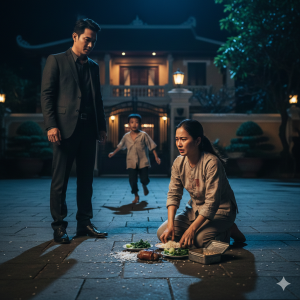
The night had completely fallen, and the cold wind snaked through the large iron gate of the villa. The yellow light cast on the cold pavement stretched Minh Khang’s shadow into a long, slightly trembling shape. Khang, a successful, ruthlessly rational, and cold businessman, had just returned from a stressful meeting.
His expensive black shoes suddenly halted a few steps from the gate. In the dimly lit corner, a small figure was hunched over, secretly handing something in a box to a thin boy in a worn-out shirt. Khang squinted and immediately recognized Ha Vi, the 30-year-old housekeeper who had just started a week ago. The boy was a stranger.
Vi whispered something to the boy, her voice so low it almost melted into the air. The boy received the lunch box with both hands, his eyes sparkling with gratitude but also panic, as if a loud noise would make him scramble away. Vi gently placed her hand on his head, patted him, and turned towards the gate, seemingly about to leave.
Just then, Khang emerged from the shadows.
Vi flinched so hard she almost dropped the canvas bag she was holding. Seeing the tall, stern man, the boy immediately took off, glancing back in terror. In an instant, his silhouette vanished into the night. Khang walked straight up to her, his icy gaze sweeping down to the lunch box Vi clutched tightly.
“What are you doing here?” His voice was even and steel-like, not loud but enough to send a chill down the spine.
Vi stammered, saying she was only giving the boy a lunch box, with no ill intent, but this only deepened the suspicion in Khang’s eyes. He looked her up and down, then at the box, his gaze as sharp as a blade processing a financial fraud case. He stated that the food in the house was not to be taken out, especially not for strangers. Vi paled, hugging the box closer, as if it were the most precious thing she had to protect.
She tried to explain that the meal was not from the villa’s kitchen, but Khang wouldn’t believe it. He coldly warned that the kitchen’s supplies were portioned. If there was any shortage, he would check the spending history immediately. If fraud was found, even for one meal, she would be fired tonight. The night wind picked up, carrying the tense silence between them. Vi trembled slightly, yet her eyes remained resolute. She shook her head, trying to explain, but her words faltered before Khang’s chilling demeanor. He took a step closer, ordering her to hand over the box for inspection. Vi instinctively backed away, clutching the box tighter.
In a momentary tug-of-war, Khang reached out and snatched it. Vi desperately held on, the opposing forces causing the box to fall onto the stone pavement, the lid flying open.
Warm white rice spilled onto the ground, next to it a cheap piece of braised pork and a few slices of simple boiled vegetables.
It was entirely unlike the refined, expensive meals cooked daily in the villa. Khang froze for a single second. This was not what he expected. He thought he would find costly beef or at least leftovers from this afternoon’s dinner. What appeared was a meal so poor he had never seen its like in his life. He had only known the cuisine of hotels, restaurants, and high-end kitchens. This was profoundly unfamiliar.
Vi knelt down, gathering the spilled food, her hands shaking, her eyes filled with worry—not for herself, but for the boy. She spoke softly but clearly, asserting that she had cooked it herself, brought it from her old boarding house, and hadn’t taken anything from his home. Khang continued to stare, his eyes still holding an inexplicable suspicion. He asked why she had to be secretive? Why didn’t she tell him? Why was a housekeeper like her caring for a strange child outside his villa gate at night?
Vi looked up, her eyes moist but determined. She said there were things he wouldn’t understand even if she told him. Khang let out a cynical laugh, asking what a housekeeper who had been there for only seven days could know that he couldn’t grasp. He told her the more she hid, the more suspicious she seemed.
Vi clenched her fists, taking a deep breath. She stood up, facing him, no longer avoiding his sharp gaze. Her face was pale but hardened in an unpredictable way. Her voice was barely a whisper, yet each word dropped like stone:
“You don’t know the truth. I’m only repaying a debt that you yourself created.“
As the sentence ended, the night air was cut by a sharp edge. Khang was stunned, momentarily forgetting the wind and the broken lunch box at his feet. He couldn’t understand. He could not grasp what debt he had created, with whom, when, or why it involved a poor child standing outside his villa gate tonight.
After Vi’s words froze the courtyard, Minh Khang retreated into the house, his mind heavy. He didn’t understand what she meant, but the ambiguity fueled his frustration. He was used to clear problems, data-driven results, and precise answers. Vi had thrown him a riddle he couldn’t solve, which, to Khang, felt like an insult. Khang was inherently rational to the point of cruelty, growing up in a huge villa with every comfort but lacking the most important thing: affection. His father died when he was ten. His mother, Mrs. Hong, was a successful, cold woman. Her love was expressed through organization, direction, and control. She gave him expectations and discipline, but little warmth. Thus, Khang grew up independent, distrustful of others, disbelieving in kindness or moving stories. He trusted statistics over feelings, contracts over promises, and rules over compassion. This was why Vi’s small act disturbed him so much. He disliked vagueness, overly kind people, and his staff sneaking out to get involved with others without his knowledge. He believed people like Vi easily exploit trust to build a good image before secretly profiting.
Yet, since Vi started, he had observed many things that contradicted his prejudice. Vi was diligent, meticulous, and always finished tasks ahead of time. She never complained about waking up at 5:00 AM to prepare breakfast or working through lunch when guests were present. She was respectful to everyone, even the most demanding staff. What was most striking was Vi’s smile—gentle but laced with a subtle sadness, reflecting an invisible worry.
And Nam, the poor 10-year-old boy Vi often helped, lived three alleys away with his sickly grandmother. Nam had no parents and took care of himself and his grandmother, his life revolving around a little rice, some donated milk, scrap metal collecting, and the late-night meals Vi brought. He was the kind of child one glance reveals a profound lack of food and affection. Khang didn’t know all this. All he knew was that Vi often left the staff quarters at odd hours, sometimes returning late, sometimes using her lunch break to go somewhere. He suspected ulterior motives, but in reality, she was only bringing food to Nam, taking his grandmother to the doctor, or getting pain relief from a nearby clinic. But Vi offered no explanation. She simply acted, which reinforced Khang’s suspicion that she was hiding something, using kindness as a shield. He had seen too many like her in the business world—those who feigned virtue to gain trust before striking for profit. Khang feared this more than anything. Ironically, every time he caught Vi doing a good deed, he grew more uneasy, not because he hated good but because he didn’t believe anyone could be that good. He believed kindness always came with a price. The more he observed Vi, the more conflicted he felt. She was the type he didn’t want to trust but couldn’t stop watching.
Another strange detail in the villa was Vi’s constant effort to avoid Mrs. Hong, Khang’s mother. Whenever Mrs. Hong appeared, Vi would immediately lower her head, hide behind someone, or retreat to the kitchen. When they accidentally met, she would stand still, hands clenched, eyes fixed on the floor, as if harboring a deep, unspoken fear. Mrs. Hong, seeing Vi, would quickly mask a fleeting look of annoyance with a composed expression. She knew Vi from before but never said anything. Khang didn’t pay much attention, usually aloof about staff matters. But a few times, he caught his mother’s gaze toward Vi. It wasn’t the look reserved for a regular housekeeper. It was the look of encountering an old ghost. He simply attributed it to his mother’s strictness. He still couldn’t connect the dots.
As time passed, small details made the household staff recognize Vi’s innate kindness. She always shared her food with the elderly security guard, cleaned up after the gardener when he had a bad back, and brought warm water for the cook every cold morning. She did all this without seeking recognition. Her reputation for kindness spread through the villa, winning everyone’s affection. Only two people remained unconvinced: Mrs. Hong and Minh Khang.
Then, the fateful event occurred. That morning, Vi asked to leave earlier than usual. She said it was an emergency but didn’t elaborate, her voice shakier than usual. Khang noticed the abnormality but didn’t ask. He stood on the second-floor balcony, watching Vi rush out the gate, holding a bag of medicine.
That afternoon, Khang had business near Nam’s neighborhood, as his partner was opening a branch nearby. Walking into the alley, he inadvertently heard faint crying from the dilapidated house. He saw Vi kneeling by the bed, with Nam lying unconscious. Nam’s grandmother huddled beside him, her eyes deeply shadowed. Khang stood outside the door and overheard the grandmother’s words: “The girl… she’s exactly like her mother, another victim of the rich.”
The sentence struck Khang like a blow. Her mother was harmed, the rich. All those words coalesced into a chilling suspicion. He stood motionless, hands clenched, his heart pounding in a way he couldn’t explain. Was his family involved? Was Vi’s presence in his house no accident? Was a past he knew nothing about closing in on him? Khang turned and walked away, but the grandmother’s words repeated like an echo in his mind. For the first time in years, he felt the one thing he always avoided: fear.
From the day he heard the grandmother’s words, Minh Khang returned home with a tangled mind. For years, he had lived by pattern, reason, and simple numbers. He believed everything had a logical cause, data, and evidence. But the more he investigated Vi’s story, the more he feared what he was about to uncover.
He began secretly tracking Vi by instructing his secretary to gather information, check old records, and interview neighbors from where Vi used to live. The deeper he delved, the clearer the image of an impoverished, righteous, and resilient girl emerged, completely contradicting the suspicions he had placed on her.
Vi was a brilliant student with almost all top grades. She dreamed of attending a pedagogical university to become a teacher, but life took a sharp turn. When she was 18, her mother died of a severe illness, leaving behind her aging father and young brother. Vi was forced to work while studying. But at 20, her father became gravely ill, requiring long-term hospitalization. The medical costs were staggering, crippling the family. Vi had to drop out to care for her father and work to earn money. Khang read every line, feeling a heavy pressure on his chest. But this was only the first part of the story.
According to the secretary’s files, when Vi’s father died, the family fell into crushing debt. Their small house was foreclosed by the creditors. Vi and her young brother were thrown out onto the street in the middle of the night. Khang was stunned when he saw the creditor’s name. It was a financial company that had once been under the management of his mother, Mrs. Hong. Khang’s heart seized up when he read the final note. That year, Mrs. Hong had signed a foreclosure contract according to procedure but failed to investigate the special circumstances behind it, which drove a poor family to the brink. His mother’s former company was the very institution that caused Vi’s family to lose everything.
Khang leaned back, his hands trembling slightly. He had never imagined a matter related to his own family could carry such weight. Even more astonishing was his next discovery. Vi had never blamed, resented, or sought revenge. Instead, she had applied to be a housekeeper in his own home. The reason she wrote on her application was simply: “To repay a favor.”
Khang shook his head, utterly confused. Repay what favor? His family had cost her everything.
But the puzzle pieces didn’t stop there. Khang was shocked again as he uncovered the second secret. The name of Vi’s younger brother, the one who lived with her and her father years ago, was Nam—the poor 10-year-old boy Vi was silently helping. Nam didn’t know Vi was his biological sister. The records clearly stated that since their father died, Vi had hidden her identity so Nam wouldn’t feel ashamed of poverty or their past. She sacrificed her education, her youth, and her identity just so her brother could grow up in peace, free from the burden of painful memories.
The more Khang read, the tighter his chest became. He began to see a completely different person—not a shadowy housekeeper but a girl carrying the weight of the world with only her two small hands. He had thought Vi was secretive and conniving, but the truth was she was only trying to hide her pain so her brother could have the happiness of a normal child.
The climax was that afternoon. Khang went to the hospital to get papers signed by a business partner. Passing by the emergency ward, he saw a familiar figure: Vi was sitting there, her hands clasped around Nam’s hand, who lay delirious on the bed. Nam had a high fever, his face flushed, his breathing shallow. Vi leaned in, her eyes red, tears streaming down, but she still tried to smile to reassure Nam. She spoke gentle, lulling words. She told Nam about the sky, and that someone loved him deeply even if he didn’t know it. She urged him to be strong, to live because many beautiful things awaited him.
Khang stood outside, watching the scene, his heart constricted. The moment was a breaking point. He stepped into the room, his eyes no longer angry but filled with turmoil. Vi startled, seeing him, but quickly wiped her tears, standing up, trying to maintain her composure. She bowed her head, fearing a reprimand for leaving work without permission to take Nam to the hospital. Khang looked at her for a long time, then asked her to tell him everything. He said he needed to know why she wrote she wanted to “repay a favor” to his family when his own house was the one that drove her father to ruin.
Vi remained silent for a long time. She sat down, her hands tightly clasped, her eyes fixed on a distant memory. She recounted that many years ago, after her father died and she was thrown out, she wandered the streets with a tiny Nam, penniless, with no family or refuge. That night, she was utterly desperate, not knowing where to go. As the two siblings collapsed from exhaustion in front of a restaurant, a man walked out and saw them. That man was Minh Khang’s father.
He asked no questions, simply led them inside, gave them a hot meal, two thin jackets, and paid for a room at a nearby boarding house. He also instructed his staff to bring some cold medicine. When Vi burst into tears and asked why he helped them, he just smiled gently and said, “If you have the chance to help someone later, do it with all your heart.”
Vi said that from that day on, she always believed true kindness existed. It could be small, like a meal, but enough to save the lives of her and her brother. She vowed to live by his words. And when she heard Khang’s family was facing difficulties after his father’s death, she knew she had to do something. She couldn’t repay him with money, so she could only repay the favor with her labor, sincerity, and diligence.
Khang sat like a stone statue. He had never known his father possessed such a kind heart. His life, entwined with his mother’s coldness and the dark side of the business world, made him believe kindness was a facade. Yet, his father had saved Vi, and Vi had dedicated her life to repaying that single act. Khang felt deeply ashamed. He had suspected her, criticized her, and yelled at her. He had accused her of doing good deeds for profit, even thinking she wanted to manipulate his trust. Now, the truth made him feel embarrassingly small.
Vi sat quietly, her eyes less red but still carrying a deep sadness. She said she never blamed his family for the past, as some things in life are beyond control. The one who harmed her father was the company, the harsh decisions of the business world, while the one who saved her was Khang’s father. Vi chose to remember the kindness and not the grudge.
Khang felt a lump in his throat. The things he had always believed, defended, and considered absolute truth suddenly wavered violently. He realized that for all this time, the only truly decent person in this house was the one he had treated the worst.
That morning, in the large house that usually suppressed all emotion, Mrs. Hong felt a heavy heart as she looked at the documents Khang had left on the table. Each page contained information about Vi’s background, her family, and the chain of troubles surrounding her past. She flipped through them, growing colder with each read. She immediately understood Khang had gone further than she imagined. He was delving deep into a girl she had long tried to keep at a distance. Her eyes sharpened with anger, fear, and a hint of guilt.
When Khang returned, she was waiting in the hall. The atmosphere was taut. She looked at him, her eyes blazing. She demanded to know why he was investigating Vi. Khang sighed. He said he needed to know the truth—why Vi always avoided her, why Nam’s grandmother made those comments about his family. Mrs. Hong grew angrier. She accused Vi of being the instigator, the cause of Khang’s doubt, and ordered Vi to be fired immediately. Her words were sharp as a knife, plunging the air into cold silence.
Vi overheard the conversation while preparing to bring Nam some porridge. She stood still for a moment, then quietly put the bowl down. She understood this moment would come. She never wanted to be a burden, especially to a family with so much internal pain as Khang’s. She told herself leaving was best, to restore peace, so Khang and his mother wouldn’t argue. That evening, she submitted her resignation without much explanation. Khang saw it but couldn’t stop her. He was still caught between dozens of thoughts, between confusion and responsibility. Vi bowed her head, her voice soft as a breath, saying she was leaving to avoid causing trouble for them. She wished him peace and departed.
But that very night, Fate tested her one more time. Nam’s fever spiked, and he fainted. His grandmother frantically called Vi, her voice trembling. Vi rushed over, carrying Nam, her legs shaking, but her eyes resolute. At the hospital, the doctor said Nam needed emergency surgery due to a worsening condition, and the cost was enormous, far beyond Vi’s means. She stood before the cashier, crumpling the invoice in her hands, her heart tightening. She had no one to lean on; no one could save Nam but herself.
She returned to Khang’s house, hoping to request an advance on her salary or anything that could give Nam a chance to live. But Mrs. Hong was already standing there, her eyes colder than the winter wind. She asked why Vi returned. Vi bowed her head, her voice choked. Mrs. Hong knew the situation but only spoke a sentence that made Vi’s world collapse: “If you’re poor, don’t dream of taking responsibility for others.” The words pierced her heart. Vi fell to her knees before Mrs. Hong, tears streaming, begging her to lend her the money, promising to work her whole life to repay it. But Mrs. Hong watched without a word of comfort. Her years of emotional detachment led her to believe poverty meant weakness, trouble, and dragging others down.
Khang, standing on the staircase, heard everything. His heart felt squeezed. He saw Vi collapse, saw her desperation, and saw his mother’s arrogant silence. The question he had long avoided echoed in his mind: Should he listen to his reason or his heart? He remembered his father’s diary, which he had found while cleaning the old room. In it, his father had written a sentence that now rang clearly like a bell: “Look at people with your heart, not your wallet.”
The quote was a cleave through all the walls he had built over the years. He walked down, standing between his mother and Vi. The wind from the door made the space suffocatingly heavy. Khang helped Vi stand up. He looked resolutely at his mother, and for the first time in his life, he spoke against her wishes. He said he would help Nam, whether she agreed or not. Mrs. Hong furiously accused him of being tricked, of being exploited, but Khang wouldn’t back down. He said blind suspicion only imprisoned oneself.
The confrontation between mother and son made the seemingly unfeeling house tremble. And then, the secret of the past was revealed. When Khang checked the records and questioned old company staff, he discovered a truth Mrs. Hong probably never wanted him to know. Vi’s family losing their home and her mother’s subsequent hardship were not directly caused by Mrs. Hong. It was due to a former subordinate who exploited the company’s name to seize land from the poor, shifting all the blame onto the powerless. Mrs. Hong knew part of the truth but remained silent, fearing it would damage her and the company’s reputation.
Khang stood silent, and Vi took a step back, her eyes wide with pain and shock. She had been wrong all these years; the person most at fault had never paid the price. Khang turned to his mother, his eyes calm but cutting. He spoke a sentence that completely silenced Mrs. Hong: “You stayed silent to protect your reputation, and she stayed silent to protect her brother. You chose power; she chose humanity.”
The words stripped away all the armor Mrs. Hong had worn for years. She burst into tears—not tears of sorrow, but the tears of someone who realized her mistake but didn’t know how to fix it.
Vi looked at the two of them, her heart aching. She didn’t want to destroy any relationship. She only wanted to save Nam and live in peace. But now, all the secrets had erupted, pushing everyone into a vortex. Khang turned back, taking Vi’s hand. He asked her to trust him one time. He would help Nam, clarify everything, and correct the mistakes of the past. Vi looked at him, her eyes full of tears, pain, and a tiny glimmer of hope. She nodded. At that moment, the story entered a completely different chapter.
On the day Nam went into surgery, the hospital corridor stretched endlessly, straining the souls of those waiting. Vi tightly clasped her hands, her heart so worried that every second felt like an eternity. Khang stood a distance away, his eyes tracking every slight change in her emotion. He had used all his connections, from top doctors to the best equipment, to give Nam a fighting chance. He knew this was not just about helping a child, but a way to mend the invisible damage his family had inflicted on Vi’s.
The surgery lasted for hours. Nam’s grandmother sat trembling, occasionally coughing, her body visibly frail. Vi knelt beside her, holding her hand tightly. Khang brought the grandmother a warm cup of water, placing it in her hand, then looked at the operating room door with a plea in his eyes. This was the first time he truly wished someone to be saved, not out of responsibility, but out of heart.
When the operating room doors opened and the doctor emerged, all three jumped to their feet. The doctor announced the surgery was a success. Vi staggered and burst into tears, like a child who had been holding back for too long. The grandmother slumped onto the chair, tears streaming down. Khang stepped forward and held Vi. She let him embrace her without resistance. In that moment, he knew he would never leave her again.
A few days later, Nam woke up. He saw Vi first, his eyes weak but brightly lit. He immediately asked if his grandmother was okay and if his sister had eaten. Vi laughed through her tears. The grandmother decided to reveal the truth she had held for years. She placed her hand on Nam’s forehead, her voice choked. She told him Vi was his biological sister, the one who had sacrificed her entire youth to raise him and bear the burden of the adults’ debts. Nam’s eyes widened, and he burst into tears. He wrapped his arms around Vi, hugging her tightly, as if afraid to lose her again. Vi hugged her brother, her tears soaking his hair, seeping into the memories of both.
During Nam’s recovery, Khang always visited. He brought fruit, toys, and the gentle smile that few had seen before. Every evening, he contemplated his past actions, the emotionless judgments he had made about Vi. One afternoon, as Vi prepared to leave the hospital, Khang came to her. He looked directly into her eyes and apologized. It was a sincere apology, not flowery, not veiled by power. Vi listened, then simply shook her head, her voice light as a breeze. “I don’t help people to be repaid. I just do what is right.”
The answer silenced Khang. He realized Vi didn’t need an apology; she needed action. She lived by faith and kindness, a belief he had lost and she had brought back to him.
A few days later, Mrs. Hong actively sought out Vi. In front of the poor girl she had once disdained, she bowed her head. The action surprised both Vi and Khang. She apologized for her silence, her arrogance, for letting past mistakes harm an innocent family. She promised to make amends for some of the losses. Vi looked at her for a long time, then gently nodded. She chose not to harbor resentment because hatred only prolonged the pain. She let go for a lighter heart. Mrs. Hong wiped her tears, realizing Vi was the strongest person here.
Khang started an endeavor his father had dreamed of: opening a fund to support poor children. The fund was named after his father, as a way to reconnect with the emotional bond he had lost. And the person he chose to manage the fund was Ha Vi. He trusted her because she always saw the things he and his mother had overlooked. Vi initially refused, but Khang told her he needed someone with a heart warm enough to guide the children. Vi thought it over and accepted. When she signed the papers, Khang sighed in relief, like someone who had found the light.
Nam recovered faster than expected, returning with the bright smile of a child who deserved to be loved. He clung to Vi and Khang. One day, he hugged Vi and said she was the best person in the world. Then he looked at Khang with a mischievous glint in his eye and added, “Mr. Khang is good too.” Khang laughed, ruffled the boy’s hair, his heart warmed as if touching something he had lost long ago.
As time passed, everything gradually returned to peace, but there was a change within each person. Khang realized Vi had healed his heart with her patience, kindness, and unpretentious humanity. Vi also realized that after all the pain, everything could turn into something beautiful if one was brave enough to face it.
One weekend evening, as the wind gently blew through the trees at the end of the street, Khang casually saw Vi carrying lunch boxes to a few poor children near the old park. He watched from a distance. She was still attentive, still bending down to ask each child if they had eaten enough. The streetlights illuminated her face, making her look like a warm patch of light in the vast darkness.
Khang walked up and asked why, even after her life had changed, she continued doing this. Vi paused for a moment, then smiled—a gentle smile like the March wind. She said, “Because once upon a time, someone saved me with a lunch box. And from that moment, I understood that a small act of kindness can change a person’s entire life. I’m only passing on the good I received.”
Khang smiled. It was a faint, yet strangely warm, smile. He stepped closer, his voice deep yet full of determination:
“In that case, allow me to join you.”
Vi looked at him, her eyes wide, then softening. She nodded. The two walked side-by-side. Their footsteps harmonized under the golden streetlights, as if they had been walking this path together for a long time. The future ahead opened up like a bright path, full of humanity, kindness, and hope.
And that was their new beginning. The path they chose with their hearts.
Disclaimer : This content may be created by AI for entertainment purposes. Any resemblance to real persons, events, or places is coincidental.