THE LUNCH RUNNER’S REVENGE: A TALE OF TWO MOTHERS
In the elite halls of the provincial key high school, where the air was thick with the scent of old money and high expectations, I was a ghost. I was the girl in the oversized, faded uniform, known not by my name, but by the heavy bags I carried.
The year I was at my poorest, I became the school’s “errand girl.” For one yuan per delivery, I navigated the labyrinth of dormitories, bringing hot meals to students who were too busy—or too lazy—to visit the canteen. On a good day, I earned 500 yuan. It was a life of survival, built on the steam of pork buns and the clinking of small change. I was content in my invisibility until the day the world fractured.
A sleek, black limousine pulled up to the school gates, and a couple draped in luxury stepped out. They didn’t come for the honors list; they came for me. They claimed I was their biological daughter, swapped at birth in a cold hospital room eighteen years ago. But in this world of high stakes, a “true daughter” was merely a threat to the “fake” one who had spent a lifetime securing her throne.
The fake heiress, Tran Tinh So, didn’t welcome me with open arms. Instead, she arrived like a whirlwind of malice, smashing my delivery cart to splinters and demanding the principal expel me. I knew I couldn’t win against her influence—not yet. I packed my meager belongings, ready to retreat to the countryside.
But then, the unexpected happened. A few days later, the principal arrived at my rented room, laden with gifts and apologies. “Please come back,” he pleaded. “The dormitory kids are rioting. Without your food runs, the school is falling apart.” It turned out that while I was gone, the “elite” students had realized they couldn’t survive on the canteen’s “dark cuisine”—strawberry stir-fried with bitter melon. I had become an essential artery in the school’s heart.
I returned, but the struggle was far from over. My foster mother—the woman who had raised me in poverty—was a woman of steel. When I was accepted into the provincial key school with a tuition fee of 10,000 yuan, I wanted to choose the cheaper district school. She didn’t hesitate. She dragged me to the city, paid the fees with every cent she had, and left herself with only 1,000 yuan for us to survive.
“If you have the talent for the best, I won’t let you bury your future in the mud,” she said, her eyes unwavering.
To help her, I expanded my business. It started with a single White Rabbit candy given to the top student, Tham Thanh Due, during a hypoglycemic spell. Soon, he became my first “VIP” customer. Through him, I met Ha Chi Vien, a national-level athlete who ate enough for three people, and eventually, the arrogant young master Ha Tu Ngon.
Tu Ngon was the type of boy who threw away gourmet bento boxes because they were “bland.” I introduced him to the world of “peasant” delicacies: Xinjiang spicy rice noodles, stinky river snail rice noodles, and crispy pan-fried buns. He was hooked. He didn’t just pay for food; he paid for the experience of feeling alive. My business flourished, allowing my mother and me to move into a slightly better apartment.
Then, the biological parents returned. This time, they didn’t ask; they took. My foster mother, fearing she was holding me back from a life of wealth, pushed me into their car and watched through tears as I was driven away.
The Tran villa was a gilded cage. Tinh So’s resentment peaked when she realized my “commoner” connections were stronger than her “noble” ones. One morning, she locked me in my room to stop my morning food deliveries, hoping to ruin my reputation for reliability.
I didn’t panic. I messaged the group chat. The response was a digital roar of despair from the students. But help came from the most unlikely places. Ha Tu Ngon arrived at my third-story window on a construction lift he had “borrowed” from his family’s company. Tham Thanh Due was waiting below, having tracked my location through a photo of the floorboards I had sent.
The tension exploded back at school. Tinh So, cornered and desperate, cornered me in the restroom. She showed me a photo of my foster mother scrubbing greasy tables, calling her “trash.”
“This is your real mother,” she sneered. “Be careful, someone might ‘accidentally’ spill boiling soup on her.”
That was the breaking point. I didn’t care about the inheritance, but she had threatened the woman who sacrificed everything for me. I didn’t use my fists; I used a mop soaked in toilet water, driving her and her cronies out in a frenzy of disgust. When she threatened to have her uncle, the principal, expel me again, the school revolted.
The top students threatened to transfer. The athletes went on strike. Ha Tu Ngon threatened to pull all construction funding. The “Lunch Runner” was no longer just a delivery girl; she was the glue holding the student body together.
I played my final cards with surgical precision. I visited my biological father with homemade porridge, playing the role of the neglected, longing daughter to highlight Tinh So’s selfishness. I appeared at my biological mother’s high-society tea party, forcing her to acknowledge me in front of her peers, effectively shattering Tinh So’s exclusive claim to the family name.
The cracks in the Tran family became chasms. Tinh So’s uncle was investigated for corruption after an anonymous tip—likely from the students she had bullied—and Tinh So herself was eventually sent away, her reputation in tatters.
I chose not to stay in the villa. I returned to the 40-square-meter apartment with the mother who truly loved me. I realized that power didn’t come from a last name; it came from the people who stood by you when you had nothing.
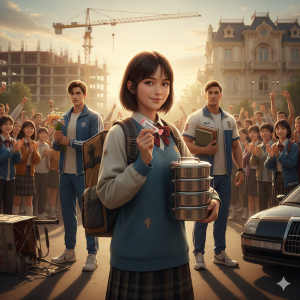
Years later, as a graduate of a top university, I stood at the gates of my old high school. I had handed my “delivery empire” to a hardworking girl from a poor background, giving her the same chance I had.
Ha Tu Ngon, Tham Thanh Due, and Ha Chi Vien were there, holding bouquets. We weren’t the children of tragedy anymore; we were the masters of our own hunger. My biological father still sends money, which I save for a rainy day, but I never joined his company.
I looked at my mother, who was smiling in the sun. I had found my way out of the shadows, not by becoming a princess, but by remaining the girl who knew exactly how much a single yuan—and a warm meal—was worth.
Disclaimer : This content may be created by AI for entertainment purposes. Any resemblance to real persons, events, or places is coincidental.