The Light from Oil-Stained Hands
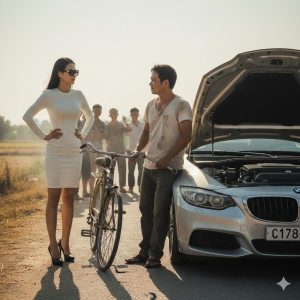
In the blazing heat of a scorching summer noon, the empty village road seemed to be on fire. The air was thick and hot, swirling through the parched, yellow fields, carrying the scent of dry earth. Suddenly, the roar of a sports car engine cut through the silence, then died abruptly. The gleaming silver luxury car lay motionless in the dusty road, like a proud beast that had collapsed under the oppressive sun.
The car door swung open. A young woman stepped out, her white, form-fitting dress highlighting her elegance, dark sunglasses obscuring half her face, and her high heels sinking slightly into the dry dust. She exhaled sharply, her voice filled with annoyance and contempt: “Oh, for heaven’s sake! A multi-billion car breaks down in the middle of nowhere like this?”
From the end of the road, a man around 35 years old, in a faded, oil-stained t-shirt, holding a wrench and pushing an old bicycle, approached. He stopped, his gaze gentle yet profound, seeming to see right through the haughty appearance before him. He spoke softly, his voice rough but strangely warm: “Is your car broken? Let me have a look.”
The woman tossed her head back, her red lips curving into a scornful smile: “Do you know what kind of car this is? It’s an imported V8 engine. If you can fix it, I’ll marry you.“
The flippant remark drew laughter from a few nearby villagers. She thought it was just a joke to vent her frustration, but the man didn’t laugh. He looked at her for a moment, then spoke slowly, his tone calm and devoid of offense: “I don’t need you to marry me. I only need the car to start again so you can get to where you’re going.”
The atmosphere suddenly quieted. She paused, then crossed her arms and stepped aside. “Fine. Go ahead and try.”
He bent down and opened the hood. Heat billowed out, mixed with the smell of burnt gasoline. He had no modern equipment, only a few old tools secured with rubber bands. The woman inwardly scoffed: Is he seriously going to fix a supercar with that scrap?
He checked each part, wiped oil, listened to the engine, and gently touched the pipelines. Sweat dripped onto the ground, but his eyes remained intensely focused.
“How long have you been doing this to be so confident? This car was made by my company. Even my engineers need specialized machines to fix it,” she demanded, hands on her hips, her voice full of doubt.
He still didn’t look up: “I used to be an engineer, but now I just fix cars for hire.”
The answer stunned her. An engineer? She didn’t believe it, yet his eyes, when he spoke, held no boastfulness, only a calm statement of fact.
He tightened a bolt, reconnected a loose wire, and touched a small component near the combustion chamber. She heard a faint “click,” then he turned to her: “Try starting it now.”
Hesitantly, she got into the driver’s seat. She pressed the start button. The engine roared to life, echoing down the street! The villagers cheered and clapped. The woman’s eyes widened in astonishment. It really started.
He wiped his hands on an old rag, stood up, and smiled. “It’s done. Just a loose ground wire.”
She got out of the car, looking closely at him. The sun shone on his tanned face. Sweat trailed down his neck, but his eyes were extraordinarily bright and serene.
“Impressive, but you’re still poor.”
She turned and got back into the car, closing the door. The sound of the wheels rolling on the ground left behind a silent man and a faint smile. He watched her go, not angry, only feeling pity for a woman who had never understood the true value of a person.
As evening approached, a cool breeze blew from the fields. He sat by his old bicycle, cleaning his tools, and quietly said to himself: “People can have everything, except peace, if their hearts only know how to look down on others.”
The luxury car disappeared, leaving a faint cloud of dust, like the boundary between two worlds: one of vain splendor, the other of humble truth. But that very boundary was about to create a fateful encounter that would change both of them.
From that day on, Minh Khue’s sports car took her away from the dusty village road. But in her mind, the image of the man in oil-stained clothes and his tranquil eyes kept returning. She wondered why the look of a poor man could bother her so much. She was used to being feared and flattered, but facing him, she felt something different—something she had intentionally forgotten for years: calmness, kindness, and sincerity.
Minh Khue, 33, was Vietnam’s youngest auto tycoon, running the Kim Auto Group. The press called her the “Iron Lady”—beautiful but ruthless in business. Her decisions were always precise, cold, and final. But beneath that exterior was a soul scarred by many wounds.
When she was 14, her father, Mr. Kim, a talented but poor mechanical engineer, was betrayed by his best friend, who stole the copyright for the electric car design he had painstakingly developed. He was left nearly bankrupt, and the family fell into hardship. Since then, a bitter belief was etched into Minh Khue’s mind: The poor often betray for food and change right for wrong for profit. She grew up with that obsession. When her father passed away, she took over the company, vowing never to let anyone trample on her trust again. She treated employees with extreme harshness, never letting anyone get too close. To outsiders, she was the epitome of capability; to loved ones, she was a lonely soul amidst a mountain of money and power.
One morning, nearly a week after meeting the mechanic, Minh Khue was in a high-rise conference room. The new car project, launched just three months prior, suddenly faced a serious technical error. Hundreds of customers returned their cars, export contracts were postponed, and the company’s stock plummeted. The chief engineer reported they couldn’t find the cause.
Khue slammed her hand on the table. The team fell silent. She asked coldly, “Why can’t anyone find such a simple error?”
A young engineer stammered that someone had warned about this risk last year, but that person had been fired at the time.
“Who?” she demanded. Her eyes were sharp as a knife.
The engineer lowered his head: “It was Mr. Trung, the former chief engineer.”
The name brought silence to the room. Minh Khue remembered him clearly. Five years ago, when she took charge, ambitious and eager to launch the new model to prove her leadership. Trung had objected, arguing the design needed more testing due to a potential flaw in the safety sensor system. She thought he was hindering progress, even suspecting him of taking money from a competitor. In one meeting, she signed his termination papers, despite his attempts to explain.
Five years later, that very flaw returned to destroy all her pride.
She stood motionless, her hands clenched. Her heart was torn between regret and hurt. She had never apologized to anyone in her life. Now, to save her company, she had to face the man she had once crushed.
That evening, she drove aimlessly. The city sky was grey. The words of the mechanic echoed in her mind: “I don’t need you to marry me. I only need the car to start so you can get to where you’re going.”
Her car turned onto the suburban road where she had stopped a week ago. A faint yellow light shone on a shabby sign: “Trung – Mobile Auto Repair.”
She stopped and stared at the sign. Inside, under a pale neon light, he was still working, his hands stained with oil, his old shirt faded, sweat soaking his back. She took a deep breath and walked in. The tap of her high heels echoed on the cement floor. He looked up, his eyes as calm as the first time they met.
“Broken down again?”
“No, I came to see you about something else.”
He nodded, put down his tools, and wiped his hands. She briefly recounted the company crisis and the inexplicable technical fault. Every word she spoke was a cut to her own pride. He listened silently, then asked one question: “Do you only believe me now that I was right?”
She didn’t answer, just bowed her head. He sighed, his eyes still gentle: “I wasn’t angry back then. I understood you only wanted to protect your success. But success that loses trust is just an empty shell.”
She looked up, surprised. He spoke as if he held no grudge.
“I want you to help me. If you help the company overcome this, I will give you anything you want.”
He looked at her, smiling faintly: “I don’t need money. I only need the truth to be revealed.”
The statement silenced Khue. In a world where everyone was ready to sell their honor for power, she had met someone who said the opposite.
She nodded, her voice quiet: “I promise.”
He turned back to his desk, opened an old technical notebook, and drew a few lines. The light illuminated his face, calm and confident. In that moment, she saw the image of her father, who had believed that only the honest are truly strong.
Before leaving, she paused at the door. He was already engrossed in his work, oblivious to her. Outside, a light rain began to fall. She smiled faintly, a rare smile after many years. Perhaps this time, she had met the only person who could help her fix not only her car but also her own mistaken pride.
That morning, Minh Khue drove to Trung’s repair shop again. Her heart was in turmoil. This time, she came not just for the company, but for something deeper: to correct a mistake that had lasted five years.
Trung was still simple in his faded grey shirt, his hands covered in oil. When he saw her, he merely looked up, his gaze neither surprised nor cold, but a kind of serenity that made her feel lost.
“I told you the truth then, but you didn’t believe me. Do you need me now?” he asked, his voice steady but carrying a weight that made her heart tremble.
She clenched her hands and looked down at the ground. The pride of a tycoon who had never bowed to anyone was fiercely tested. But behind her were thousands of employees, and the future of a corporation her father had dedicated his life to building.
She spoke softly: “I know I was wrong. But my company is on the verge of collapse. If you can help, I will give you half of the company shares.”
He looked at her, smiling gently, a smile as light as the wind: “I don’t need money. I only need justice to be revealed.”
She froze. After a few seconds of silence, she nodded: “Fine, I will let you do it your way.”
So, after five years, Trung returned to the Minh Tan factory. The factory gate was still tall, but his look was different now—no longer painful, only calm. He loved his work, not power. He acted out of responsibility, not for fame.
He requested full access to the old technical data. He spent hours in the research room, quietly reviewing every blueprint, every line of code in the energy sensor system software. His eyes were glued to the screen, his concentration so intense that no one dared disturb him.
Three days later, he walked into the technical meeting room with a thick file in his hands. He spoke clearly: the fault was not in the material but in the new control software. The new engineering team had changed the energy control structure without checking compatibility with the old sensor chips, causing erroneous current feedback and overheating.
“I warned about this five years ago, but no one listened,” he added quietly.
Minh Khue sat at the head of the table, her hands clenched. In that moment, she understood that her arrogance and prejudice had led the company into this crisis.
He worked with the old engineering team to fix the error. After nearly a month, the new system was stable. The cars passed all rigorous tests. Partners returned to sign contracts, the stock soared, and the company was reborn. She stood on the high floor, looking down at the factory, a surge of gratitude filling her heart.
But the storm hadn’t passed. News spread: Tycoon Minh Khue admitted past mistakes and rehired the wrongfully dismissed engineer. The media swarmed. Competitors rumored she had fabricated the technical file to regain investor confidence. The stock plummeted again. The board of shareholders began to divide, suggesting her removal from the CEO position.
She remained silent through it all. During those days, only Trung quietly stayed. He didn’t interfere, didn’t defend, just worked.
“They want to dismiss me,” she whispered to him one day.
He only looked at her, his voice calm: “If they take away your reputation, you still have your integrity. And integrity, if maintained, will eventually regain everything.”
The extraordinary shareholders’ meeting took place amidst a public outcry. The board chairman spoke sternly: “Minh Khue, the shareholders have agreed to propose your removal from the CEO position.”
She looked up, her eyes dry, not pleading. At that very moment, the door burst open. Trung walked in. He wasn’t wearing a suit, just a simple shirt, but his gaze silenced the entire room.
He placed a thick file on the table, his voice low but firm: “I was directly responsible for fixing the recent technical error. All data has been recorded. The fault did not originate from Ms. Minh Khue but from the new technical department. I have proof here.”
He projected the records of the validation process. “I warned that this change could cause the error. And I affirm that without Minh Khue’s insistence on keeping the old procedures, the damage would have been ten times greater.”
The chairman cleared his throat: “Who are you to speak here?”
“I am just a mechanic who was wrongfully dismissed by this company, but I cannot remain silent when an innocent person is slandered,” he replied.
The room fell silent. She looked at him, tears welling up. The man she had insulted in front of so many was now standing up to protect her honor.
The meeting ended in the opposition’s defeat. As people left, she approached him.
“Why did you do that?” she asked softly.
He smiled: “Because I owe you one thing: to make you believe that there are still good people in the world.”
Tears streamed down her cheeks. For the first time in her life, Minh Khue, the proud tycoon, cried in front of an ordinary man. He stood there, neither comforting nor blaming, just looking at her with an immense compassion.
She whispered: “I’ve lived my whole life in fear, afraid of betrayal, so I chose to believe in money instead of people. But you make me ashamed of that.”
He just smiled and said gently: “A person only needs to dare to trust once, and that is enough.”
In that moment, her pride shattered, revealing the true woman beneath.
Fate always chooses the moment to inflict the deepest pain. A few days later, as Trung was driving home to visit his mother, the road was slippery from heavy rain. Suddenly, a child darted out. Without hesitation, he swerved the car, which skidded and crashed into the roadside embankment. The child was only lightly scratched, but he was rushed to the hospital in critical condition.
The news reached Minh Khue during a meeting. She froze, papers dropping from her hands, and immediately drove away in the rain.
When she arrived at the hospital, he was on a white bed, tubes everywhere, his breath shallow. The doctor said he was out of danger but still in a coma. She sat by his bedside, holding his rough hand, tears falling incessantly.
“You saved me twice—once with justice, once with your heart. And me? I’ve lived my whole life without knowing what love is,” she murmured.
One morning, he opened his eyes and saw her sitting there, her eyes swollen. He smiled weakly: “No one wins, no one loses. Just knowing how to value others is enough.”
When he recovered, she made a surprising decision. She stepped down from her executive position, handed over management to the vice president, and quietly moved to the countryside with him.
In the small house surrounded by fields and the sound of birds, she learned to cook, do laundry, and laugh sincerely at the rooster’s crow. She established the Ánh Trung Foundation (Light of Integrity) to help technical workers who had been wronged or unfairly dismissed.
He often said: “I haven’t lost anything; I’m living true to myself.”
She realized that only by losing everything does one understand that the most important thing is not money, but kindness and peace of mind.
On the opening day of his free vocational class, she came. She was so different now.
He teased gently: “Do you remember what you said that year? If I could fix the car, you would marry me.”
She bowed her head slightly, smiling as she slowly replied: “Now both my car and my heart have been fixed by you. Will you accept?”
The class erupted in laughter and applause. Trung blushed, shaking his head and smiling.
Their wedding was simple, held in the small countryside, with wildflowers and the blessings of the villagers and his students.
During the ceremony, a young student asked: “Teacher, you’re the best mechanic, and she’s the owner of the biggest car company. Who won?”
She replied for him: “No one won, because when you truly love, both win.”
They looked at each other and smiled. The story ended the next morning as they opened the gate of the workshop together to welcome new students. The sound of the engine, laughter, the smell of oil, and the morning sun blended.
The lesson was clear: Never look down on others just because they are poor. Because sometimes, in poverty lies a precious thing money cannot buy. Money can buy status, but not character. And most importantly, only forgiveness and sincerity can mend a human heart, just as he fixed her broken car, and unknowingly, repaired her arrogant heart.
Disclaimer : This content may be created by AI for entertainment purposes. Any resemblance to real persons, events, or places is coincidental.