The Final Chapter of the Past
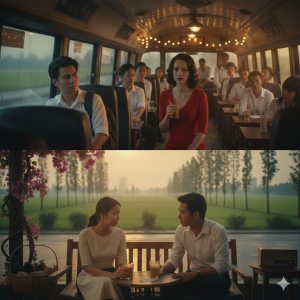
Phan Sang sat quietly on the old, red coach, leaving Saigon for Ca Mau after many years away. Many years—a period long enough to transform a skinny, self-conscious boy burdened by poverty into a successful man, but not enough to fully heal the deep wound in his heart from a decade ago.
The countryside wind rushed in through the slightly opened window, carrying the earthy scent of dry straw mixed with the familiar salty tang of the brackish water region, where the mangrove forests embrace Ca Mau. The rhythmic chugging of the bus engine stirred up a rush of memories. Phan Sang leaned back, his eyes gazing distantly through the dusty glass, as if piercing through layers of forgotten past.
In his mind, the scene of their breakup reappeared. A drizzling afternoon, standing beneath the eaves of the old school. The girl wore a pure white áo dài, her long black hair lightly wet with rain, her voice cold, yet her eyes were close to tears. “You will never be able to hold your head high, Sang.”
The phrase, light yet heavy as lead, was neither an accusation nor an encouragement. It was the final period to all the youthful illusions he once harbored—that love could conquer poverty, that sincerity could trump materialism. But reality had slapped him hard: she chose another, the son of the timber factory owner, who drove a gleaming SH scooter, wore fragrant clothes, and carried a thick wallet. He was merely a skinny young man cycling an old bicycle, occasionally working as a construction helper to afford tuition fees.
That morning, in the 27th-floor office of the PHS Foodtech Group headquarters in Saigon, Phan Sang sat before the large window overlooking the city. Below him, streams of vehicles flowed like an endless river of ants. His desk was neatly arranged with a laptop, a pile of unsigned documents, and an old phone—the only one he had kept since his student days, a constant reminder.
The phone vibrated with a message from an unknown number. “Hello, old friend. The 12A1 10-year reunion will be held this Saturday evening at Memory Coffee near Ganh Hao River, Ca Mau. Hope to see you there.” Below it was a final note: “Class President and Hong Nga are the main organizers. The earlier, the better.”
Phan Sang read each word slowly. The name Hong Nga was like a small needle, pricking the part of his memory he thought was sealed. His heart slightly wavered. A class reunion? After ten years? He leaned back, closing his eyes. On one side lay a packed meeting schedule with Japanese partners awaiting; on the other, a past that still stung when lightly touched. He let out a slight laugh, a gentle puff of air carrying a bitter taste.
Moments later, his assistant knocked, bringing the flight booking itinerary for an overseas business trip. Phan Sang paused, then said, “Cancel the flight. I have to go to Ca Mau for a few days for some personal matters, and I’ll take the opportunity to survey the local branch.”
“Yes, sir. How would you like to travel, Chairman?”
“By coach, to recall the old feeling.”
And so he was here, on the old red coach, leaning back and watching the sky turn golden through the window. He smiled. Every meter brought him closer to the past, and also closer to the day he would quietly step into the reunion—without title, without entourage. Just Phan Sang, the boy once scorned by his lover for being unable to hold his head high, returning not for revenge, but simply to stand tall and walk past them.
The Memory Coffee shop nestled by the Ganh Hao River. Low-hanging yellow lights illuminated the rustic wooden tables. The soft lapping of water against the embankment mixed with the Acoustic music from a small speaker, creating a profoundly nostalgic atmosphere. The river wind was cool, carrying the characteristic scent of mud and salt from Ca Mau.
Phan Sang stood outside the gate for a long time, watching inside. He wasn’t rushing, just standing in silence, as if waiting for his former self to step out of memory. Inside, old friends had gathered almost entirely. Laughter, clinking glasses, and calls by high-school nicknames filled the air.
Hong Nga, the girl who had once caused Phan Sang sleepless agony, was the center of attention. She wore a tight red dress, dark red lipstick, and her hair was lightly curled. In the dim light, she was striking and alluring, her eyes full of haughty pride.
“I heard Sang was invited too. I wonder if he’d dare to show up,” a friend whispered.
“Hmph, if he comes, he probably borrowed someone’s ride. He was dirt poor back then; I doubt he’s much better off now.” Nga smirked dismissively, sparking muffled giggles from her close friends.
Suddenly, a figure stepped in through the entrance. The light didn’t fully illuminate him, only revealing a tall silhouette, a simple white shirt, dark pants, and an old backpack casually slung over his left shoulder. No one recognized him immediately. It wasn’t until he came closer that a surprised voice exclaimed, “Good heavens, is that Sang?”
The atmosphere suddenly quieted. Eyes darted around. Phan Sang offered a faint smile, “Yes, it’s me. Long time no see.”
“Oh my God, ten years! Do you even remember your old friends?” The voice brought back the merriment, but a few pairs of eyes quickly scanned him from head to toe. No luxury watch, no chauffeur, no signs of wealth. Some smiles turned awkward, some nods were purely social.
Hong Nga leaned back in her chair, curling her lip, “So you actually made the effort to come back, huh? Taking the coach, I thought you’d abandoned your hometown for good.”
Sang clearly heard her but didn’t reply. He calmly pulled up a chair at the corner table, next to a few old basketball friends. After a while, someone asked, “What are you doing now, Sang? I heard you’ve been in Saigon for ages.”
“Just fiddling around with various businesses,” he answered casually.
Hong Nga half-smiled. “Fiddling around for ten years and not coming back, must have been quite a struggle, right? But never mind, the main thing is to have fun. It’s commendable that some people who can’t even afford a decent car still made it to the reunion.”
A chorus of chuckles echoed around the table. A few embarrassed glances, a few people watching Sang, waiting for his reaction. He only gave a faint smile. His eyes held no anger, no sadness, like someone detached from worldly affairs. This composure momentarily unnerved Hong Nga. She remembered him as weak, had seen him cry. But the man before her was no longer the young boy from a decade ago.
Unexpectedly, the door opened again. A middle-aged man walked in, shirt tucked in, clutching a stack of files. He anxiously looked around. As his eyes landed on Phan Sang’s table, he immediately hurried over.
“Oh my God, it really is you, Chairman! I’ve been looking for you all afternoon. I called several times, but you didn’t answer!”
The entire cafe fell silent. Hong Nga spun around, her face pale, the hand holding her glass trembling slightly.
“Uh, Uncle Hong?” someone stammered.
“Yes, it’s me. I’m looking for the Chairman to sign some urgent documents. Without his signature, we can’t present them to the General Director tomorrow morning.” Mr. Hong’s eyes were fixed solely on Phan Sang, his gaze respectful and tense. He bowed low, his voice apologetic, “I’m so sorry, sir. I didn’t know you were in Ca Mau. If I had, I would have sent someone to pick you up at the station.”
The room was stone silent. Phan Sang slowly stood up, retrieving a pen from his backpack. He signed the top sheet and folded the documents. “The files are complete. Send them to Saigon tomorrow morning.”
“Yes, yes, thank you, Chairman. Please excuse me.” Mr. Hong bowed again and turned to leave. Passing his daughter, he only managed a fleeting glance, his eyes revealing something indescribable—disappointment, regret.
Hong Nga remained frozen, as if she couldn’t believe the man she had mocked as “dirt poor” was the Chairman of the PHS Group, where her father served as the Deputy Director of the Ca Mau branch.
She stood up awkwardly and approached him. “Sang… are you really the Chairman of PHS?”
Phan Sang didn’t look at her. He picked up his water glass and took a sip. “It’s been ten years, Nga. I don’t need your recognition anymore.”
“I’m sorry, I didn’t know. If I had known… if I had known I wouldn’t have said those things…”
He gave a slight laugh, his eyes cold as a winter river surface. Hong Nga froze, her lips trembling. “Back then, I was young and foolish…”
“You chose money then, and you regret it now because I have money. But regret doesn’t mean you can get it back, does it?”
He stood up, gave a slight nod to everyone. “Thank you, everyone. I had a pleasant evening.”
Then he turned and walked away, calmly and decisively. No one called out to him. Only Hong Nga remained standing there, hands limp, eyes glistening. That night, a light rain fell on Ca Mau. Phan Sang’s footsteps faded into the sound of falling water and gentle waves. An old chapter had closed—without fanfare, without hatred, leaving only a man walking away, feeling light, as if he had never been abandoned.
The next morning, the riverside cafe was emptier than usual. Phan Sang sat alone by the window, ordering a black coffee, no sugar—the one thing he always drank when he needed to be clear-headed and avoid being soft-hearted.
Hong Nga walked in. She was different from the night before: no tight designer dress, no red lipstick, no arrogant gaze. Just a girl in a white shirt, her hair neatly tied back, noticeably thinner. She pulled a chair opposite him. “I only need five minutes. After that, I won’t bother you again. I promise.”
Phan Sang didn’t answer. He looked out at the river, waiting for the wind to pick up so he wouldn’t hear his own heart beating too clearly. “You’ve truly changed. I didn’t think you could rise up to be a leader, command respect like yesterday.”
“It’s not a change. It’s just that I didn’t stop when you walked away,” Sang replied in a deep voice.
Hong Nga gave a faint laugh, her eyes welling up but hidden. “Back then, I was afraid of hunger, afraid of poverty, afraid of being the wife of a man who would forever live in aspiration. I chose reality. But yesterday, when my father bowed to you, I realized that what I considered reality was just an illusion.”
Sang looked up, his gaze calm as river stones under flowing water. “No one blames you for choosing your own path. I only regret that you never turned back to see how the person you left behind managed to stand up again.”
She lowered her face, gently tightening her grip on the glass of melted ice water. Time seemed to drip onto their memories. “Are you still angry with me?”
“No. I was once hurt, once angry, but that was the feeling of a young man. Now, I only feel pity—for you, and for my former self.”
A long silence. Sang stood up. He took out his wallet, left money on the table, and gave a courteous nod. “I wish you well. And if one day you choose to love someone, don’t choose them for their wallet.” He walked away, his back straight, without haste. Every step was a line drawn, marking the end of the years that had bled in his heart.
On the table, the waiter noticed the small piece of paper he had left. It contained only one line: “Thank you for once making me realize I needed to be different.”
The next day, a silver-grey Limousine rolled out of Ca Mau as the sky was still shrouded in early morning mist. Phan Sang sat in the back seat, gently flipping through his brown leather notebook. The white page before him already had the first line of text: “Mekong Delta Branch: Initiate clean agricultural processing project, prioritizing local resources.”
His hometown felt like a dream from which he had awakened. No longer weighed down, no shadow of the past lover holding him back. He recalled her words from that rainy day under the old phoenix tree: “You will never be able to hold your head high, Sang.” He had believed her then, painfully so. But today, in the luxury car, with a heart free of resentment, he knew she had helped him stand up, to prove he didn’t need to hold his head high for anyone else—just walking the right path was enough.
His phone rang; it was his secretary, Khanh Linh: “Yes, Mr. Sang. Everything in Saigon is prepared. The meeting for the Long An factory is tomorrow morning, and Ms. Lam left some documents last night.”
The name made him pause. “Lam… Nguyen Yen Lam?” he asked, his voice lower than usual.
“Yes, sir. She submitted a proposal to improve the logistics chain for the Mekong Delta, very clever and detailed.”
He smiled, a very slight smile. That girl was simple and humble. She didn’t know who he was, didn’t need him to prove anything; she simply helped a man in trouble, believed a silent person. That was what he remembered.
The next morning, at the PHS Tower, Phan Sang entered the meeting room on the 18th floor. He maintained his old habit, sitting at the back to observe. On the large screen, Yen Lam was adjusting her presentation slides. Her voice was clear and articulate, yet unforced.
“Based on the flow analysis and current transportation status, I propose reorganizing the Mekong Delta into three main routes… costs could be reduced by 12 to 15%.”
Phan Sang narrowed his eyes. This was the girl who had helped him when his car broke down on the side of the road in Can Tho, when he was pretending to be a transport employee for a survey. That day, she stopped, opened her trunk for jumper cables, and simply said, “Don’t worry about it, I’m happy to help if I can.”
A senior Logistics manager asked, “Ms. Lam, why would you propose eliminating a traditional supplier without prior financial committee approval?”
Yen Lam didn’t hesitate: “Because I believe if we wait four weeks for approval, the agricultural products out there will perish in two days. I take responsibility if this proposal causes losses, but I cannot take responsibility for the company losing the trust of the farmers.”
There was courage without arrogance, sharpness without showmanship. Phan Sang smiled. He raised his hand. “I have a point. I have a question for Ms. Lam. If the company gave you full authority to execute this project for three months—no supervision, no interference—would you dare?”
She looked surprised for a moment, then stood straight, answering without hesitation. “I wouldn’t just dare; I’m always ready.”
The meeting ended. Yen Lam walked out, just as Sang was passing by. “Thank you for asking me directly,” she said, her face earnest.
“Thank you for answering honestly,” Sang replied, a slight smirk playing on his lips.
She tilted her head, looking at him for a moment. “I think I’ve met you somewhere before.”
Sang shrugged, composed. “Perhaps on the side of the road somewhere, when my car broke down.”
Yen Lam paused. “Ah, it was you?”
Sang didn’t answer, just smiled and continued into the elevator, leaving the girl standing there, eyes wide, mouth curved in a quiet smile. She didn’t recognize him as the Chairman, nor did she care to speculate. She only remembered helping a stranger without needing a reason. There are people who come into your life without caring who you are, rich or poor. And those are the people you never forget.
One Saigon afternoon, Phan Sang sat in the cafe. He was looking at Yen Lam, who was concentrating on her presentation file a few meters away. Just then, Khanh Linh called: “Mr. Sang, there’s an urgent report from Ca Mau. You need to look at it immediately.”
The highly confidential internal report stated: a surprise audit discovered numerous fictitious invoices and fraudulent contracts at the PHS Ca Mau branch. The final signatory was Deputy Director Nguyen Van Hong—Hong Nga’s father—who approved several payments in violation of procedures, resulting in an estimated preliminary loss of nearly 5 billion VND.
Phan Sang narrowed his eyes. This man was Hong Nga’s biological father. He looked through the window. It was still raining. An old chapter clearly hadn’t closed.
“Are you busy tonight?” he asked Lam abruptly.
“I was planning to leave early. Do you need additional support?”
Sang smiled gently. “No. I just want to invite you to dinner. No work, no pressure. Just a simple dinner between two people who once met on the side of the road.”
Her eyes lingered for a few seconds. “Alright, but only if you stop calling me ‘chị’ (Ms.),” she replied, a rare playful glint in her eyes.
He laughed, a genuinely warm sound.
A few days later, Hong Nga came to the group’s office. She was not loud, not heavily made up, in a simple cream-colored dress, her hair loose, her eyes dark from lack of sleep.
“I thought you wouldn’t agree to see me,” she spoke first, avoiding eye contact.
“I thought you wouldn’t dare to come,” he replied softly, closing the door behind him.
“Do you think my father is truly guilty of the misconduct?” Her voice was faint, almost pleading.
“I don’t need to think. I only look at the data, the procedures, and the signatures. I am acting for the 3,000 people who are drawing a salary from this company, including you, Nga.”
Hong Nga bit her lip. The arrogance of the past dissolved into thin air in the cold, luxurious room. “I’m not asking you to forgive him. I just want to say one thing: I was wrong back then. I chose the wrong person, misjudged the person. And now I’m paying the price.”
Phan Sang was silent, not out of emotion, but because there was nothing left to say. Everything had ended a long time ago; only some people refused to admit it.
Later that evening, at a roadside bánh xèo (Vietnamese pancake) stall, Yen Lam asked, “Why didn’t you tell anyone you were the Chairman?”
“I wanted people to treat me genuinely. I needed to see how they worked, not how they flattered me.”
“Lam,” he said slowly. “If one day you knew someone was deeply hurt, do you think that person would still have the courage to trust anyone?”
“Yes, they would,” she replied without hesitation, “as long as the other person is sincere.”
Amidst the drumming rain on the plastic awning, their eyes met. No promises, no haste. Perhaps this was the beginning of a new chapter.
At the end of the month, a high-level disciplinary meeting was held. Phan Sang sat at the head of the table.
Mr. Nguyen Van Hong walked in, looking exhausted. Phan Sang slowly read: “According to the independent investigation… Mr. Nguyen Van Hong, Deputy Director of PHS Ca Mau branch… arbitrarily signed three real estate acquisition contracts beyond his authority, causing a loss to the group of over 12 billion VND, far exceeding the initial preliminary investigation figure.”
“I only want to say one thing,” Mr. Hong’s voice was hoarse. “I never thought the person facing me today would be the boy who came to my house asking for a job in worn-out sandals… You have changed, and I misjudged you.”
The vote was 100% in favor of disciplinary action. Mr. Tran Duy Thanh, Head of the Group’s Inspection and Discipline Committee, concluded: “The total loss caused by your three unauthorized transactions amounts to 12 billion 326 million VND… If you do not proceed to compensate the full amount within 15 days from today, the Group will file a formal complaint with the Ho Chi Minh City Economic Investigation Police Agency.”
“We are not acting out of spite, but out of respect for the final moments of a former colleague. We do not act with revenge, but we do not protect wrongdoing.”
Mr. Hong trembled slightly. “I understand. I will arrange it to the best of my ability.”
After the fateful meeting, Mr. Hong sold all his assets. He raised over 10 billion VND, still insufficient. He borrowed from old friends, even sold his ancestral land. He left Ca Mau, moving into a small, rented house near U Minh forest, working odd jobs for a beekeeping and clean vegetable farm.
Hong Nga also withdrew from all social activities. She moved to live with her father, helping to package honey. Every morning, she hand-wrote small labels for the jars. Pure Honey, made from the sweat of people who once erred, now amending their ways.
At night, amidst the chirping of crickets, Hong Nga looked at the flickering oil lamp. She recalled the years of vanity and Sang’s old words that she had so cruelly denied. “A man who patiently walks to the top of a hill can stand taller than someone who takes the elevator.” She had laughed then; today, she silently shed tears.
She never asked Sang for forgiveness. But every time she saw her father’s back hunched over the honey jars, she understood: sometimes, the greatest form of love is not returning to the person you once betrayed, but ensuring that your loved ones do not fall again.
On a late weekend afternoon, Phan Sang and Yen Lam sat together at a small cafe.
“Perhaps when everything is no longer about balancing things out,” Sang said, watching the sunset. “But with you here, I feel peaceful no matter where I am.”
They made no promises, nor did they express their love in grand words. They simply stayed together, not out of pity, not because of status, but because they had walked through the dark turns of the past together.
Phan Sang was no longer resentful. Yen Lam was not rushing to name their love. And Hong Nga, the girl who once stood aloof, was now relearning the lesson of humility and the value of a heart that looks back to live more decently. Justice may sometimes be late, but it always arrives on time.
Disclaimer : This content may be created by AI for entertainment purposes. Any resemblance to real persons, events, or places is coincidental.