The Evidence of the Underdog
Hai Phong awoke to a thin, cold rain, chilling as mist. At the old bus station, where the rusty corrugated iron roof offered scant shelter, a young girl named Linh huddled, holding a stack of lottery tickets damp with the smell of paper. She was accustomed to being invisible, to the dismissive shake of heads. But today, the atmosphere was charged. The wind carried more than just moisture; it blew news onto makeshift phone screens on the water vendor’s counter, where densely-typed headlines scrolled.
The name of a billionaire — Khang — was uttered, not in praise, but through veiled insinuations about his competence and honor, concerning a sudden decision to withdraw from operations. The cold words flashed by, too fast for anyone to question. Linh didn’t fully understand, but she recognized a familiar injustice. The crowd buzzed, then fell silent, as if the truth had just been sealed shut.
Elsewhere in the city, in a stark, white-lit boardroom, Khang stood amidst a circle of empty chairs, silently accepting the neat, polished narrative. When the heavy door closed, he walked down the long corridor, his figure seeming to have lost its shadow.
On his way, a brown paper envelope slipped unnoticed from his briefcase. No one saw it, except Linh. She picked it up; the corner bore a faint stamp and an old number, hinting at things long filed away. Linh ran to return it. Khang looked at her, his gaze lingering longer than necessary, as if seeking an anchor.
The next news bulletin played, mercilessly naming Khang. Linh heard the word “betrayal” drop into the crowd, unclear who it was aimed at. She remembered her own father, and the day people had used similar words six years ago to close a chapter of his life he was never allowed to tell.
Khang paused under an awning, the heavier rain soaking his shoulder. Linh saw his unconcealed exhaustion. An idea struck her, quick and clear. Softly, she pointed down the vacant alley leading to her rental room—a place to escape the rain, and the prying eyes already gathering. Khang hesitated, then nodded.
The two, one large and one small, walked away amidst the rain and the traffic. Little did they know that this moment marked the beginning of an extraordinary journey, where a lottery ticket girl would rescue a man plummeting from the heights of power, and in doing so, open the path to her own truth.
The rental room was deep within a narrow alley, just large enough for an iron bed, a kerosene stove, and a chipped wooden table. When Linh opened the door, her mother, Cô Hạnh, looked up from mending an old shirt, stunned to see the stranger. Her gaze was long, filled with worry and apprehension, as if one wrong step would invite disaster.
On the small television, the afternoon news continued. Khang’s name was repeated with colder commentary: a billionaire past his prime should step aside. Cô Hạnh quickly turned off the TV, pulling Linh close, whispering that they should not get involved with the rich. She feared scrutiny, eviction, and the painful exhumation of their past.
Khang spoke, his voice deep and slow. He explained that everything started with a lapse in judgment six years ago. Trusting his close relatives—Chú Vũ and his right-hand man Tuấn—too much, he signed a document without thorough inspection, creating an opportunity for manipulation. By the time he realized it, the incident had been constructed into a complete narrative, with the blame shifted to an ordinary, voiceless worker.
Linh fell silent. Six years ago was when her father was taken away, leaving an empty space in their room. She looked at her mother, who understood but kept her head bowed. Two different fears collided in the cramped space.
Linh opened the brown envelope and placed the aged, discolored papers on the table. She looked up at Khang, realizing that bringing him here was more than just escaping the rain; it was a choice. Despite the fear, she would not turn her back. She had been helpless six years ago. She would not let it happen again.
The next morning, Linh tucked her lottery tickets into her pocket, but instead of the bus station, she turned toward the port’s loading and unloading zone. She sought out Bác Sáng, a thin, older warehouse keeper who used to work with her father.
Linh presented the brown envelope. The faint stamp on the corner immediately changed Bác Sáng’s expression. His hand trembled as if touching something deliberately forgotten. He pulled Linh to sit down and quietly recounted the story: a scandal required a scapegoat to pass smoothly. The poor were easiest to suspect, easiest to silence. He had seen documents switched, cover pages changed, and responsibility shifted. Bác Sáng vividly recalled seeing Linh’s father working at the loading area on the exact day the records placed him at the scene of the incident.
Bác Sáng pointed out that the envelope was merely a shell. The crucial parts of the evidence had been separated long ago, meticulously broken down so no one person held the entire picture. To find the source, they had to access the company’s archive, where the “responsibility transfer agreement”—the key to the setup—was hidden.
Linh swallowed hard, asking if Bác Sáng dared to help. He offered a sad smile, admitting he had lost his job and his honor for almost speaking up before. But looking into Linh’s eyes, he saw the desperation of the marginalized. He feared more dying without ever proving Linh’s father was wronged.
That evening, Bác Sáng joined Khang at the room. Khang gripped his hands, his face a mix of pain and anger. Bác Sáng concisely outlined the plan: they needed to retrieve the separated case file, find the old proof of time and location, and, crucially, secure the responsibility transfer contract.
Khang was hesitant, fearing exposure. Linh looked at both men and spoke with quiet certainty: “If you want justice, you must dare to seek the truth, not for revenge, but so that a poor person is not blamed simply because they are weak.” A strange alliance was forged: a betrayed billionaire, a discarded warehouse keeper, and a lottery ticket girl seeking justice for her father.
Near midnight, Bác Sáng and Linh left the room. Khang remained behind. Bác Sáng used an old key to open a side door to the archives. Inside, the smell of old paper and dry dust hit them.
In the archive room, Bác Sáng found the six-year-old section. He pulled out a thick folder. Suddenly, he stopped and withdrew a thinner sheet with a familiar code—the separated part of the case file. Then, an old dispatch receipt slipped out, its paper yellowed but the stamp clear. It contained the exact time and area code. This was black and white proof: the accused could not have been at the documented location at the designated time.
Bác Sáng quickly clipped the receipt, then pulled out the “contract” page that cleverly shifted responsibility. He folded the pages and tucked them into the cloth bag Linh used for her lottery tickets.
Just then, footsteps echoed in the hallway. The door opened, and the light revealed Tuấn, holding a notebook. Tuấn gave a knowing smirk. “Bác Sáng, why are you in the archive after being laid off?” Bác Sáng tried to remain calm, claiming to retrieve forgotten personal items. Tuấn glanced at Linh, then stared intently at the cloth bag. Finally, Tuấn demanded Bác Sáng go to the security office to sign a log of his after-hours visit—a noose tightening around Bác Sáng’s fragile dignity.
Bác Sáng looked at Linh, signaling her to leave first. She subtly shook her head, but he placed a hand on her shoulder, gently urging her toward the back door, whispering, “Go to your mother, remember to give this to Khang.” Linh understood the sacrifice. She ran into the dark alley, her heart pounding, the light papers in her bag feeling heavy with her father’s entire life.
When Linh reached the rental room, Khang was waiting. He rushed over. Linh handed him the bundle of papers. Khang’s face drained of color as he examined the stamps, the times, the addendums. He understood the truth he held, and the price Bác Sáng was paying.
In the new, cramped room, Khang read every line. This was no mistake; this was a setup. He contacted Chị Mai, a trusted lawyer. She confirmed the strength of the evidence: the old dispatch receipt and the responsibility transfer agreement, proving the deliberate manipulation. Chị Mai also pointed out that the six-year-old file had been purposefully separated—indicating high-level corporate interference.
Meanwhile, the net was closing in. The media onslaught intensified with a new article detailing the billionaire’s “incapacity” and alluding to moral failings. Khang quietly said, “They want me to disappear.”
Chị Mai proposed a two-pronged strategy: prepare a clear presentation and safeguard the evidence. Khang split the documents: Linh kept the originals in her bag, and Chị Mai took the copies to a secure legal deposit box.
The pressure mounted. A knock came at the new room door. The landlord reported someone offering unusually high rent, asking specific questions about the mother and daughter who sold lottery tickets. Khang realized he had to divert attention. He used an old contact to leak a decoy story: Khang had left Hai Phong to recuperate. Concurrently, he officially filed a request to clarify his executive status, signaling he was not disappearing.
Khang looked at Linh and said slowly, “I have enough to expose them. I just need a place to speak, a platform they cannot silence.” That platform was the Shareholders’ Meeting.
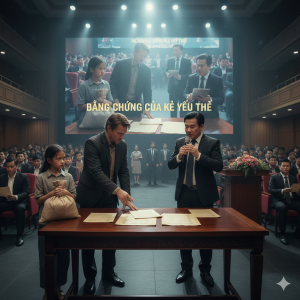
The day of the meeting arrived. Khang, calm and determined, arrived in an unassuming car. Linh stood on the sidewalk, the cloth bag clutched to her chest. Inside the packed hall, Chú Vũ confidently delivered a speech about stability and necessary changes to protect the collective honor. Linh saw the speech for what it was—a blanket over the truth.
As Chú Vũ finished, the hall doors opened. Khang walked in. Silence descended as the live camera feed shifted to him. Chú Vũ recovered quickly, forcing a cordial smile.
Khang ignored it, walking directly toward the stage. He admitted his six-year lapse in judgment—a moment of unexpected accountability that stunned the crowd. But he asserted that his mistake had been exploited to construct a setup, resulting in an innocent worker being imprisoned, and now being used to manipulate the public and replace him.
Khang signaled. Linh, the lottery ticket girl, walked onto the stage, holding the cloth bag with both hands. Khang pointed to the evidence: the stamped dispatch receipt, the separated case file, and the Responsibility Transfer Agreement Addendum—proof of the paper trail swap used to frame his narrative.
Chú Vũ reacted defensively, dismissing the documents as internal, claiming Khang was exploiting a child. His panic was palpable. Tuấn’s composure also dissolved.
Just then, the doors opened again. A group of formally dressed individuals entered, introducing themselves as representatives of the agency accepting the official complaint and initiating the review process.
Khang handed over the evidence according to protocol, clearly outlining the request for a formal investigation into the transfer of responsibility. He stated, “I did not willingly withdraw. I am not incompetent. I only trusted the wrong people, and I am ready to accept responsibility for my oversight, but I will not allow betrayal to be called the truth, and I will demand justice for the man who bore the consequences of that oversight.”
The arrival of the authorities, combined with Khang’s undeniable evidence and responsible confession, turned the tables. The hall was silent—a silence of realization. Shareholders and the media focused on the documents, not the rumors.
In that moment, Linh saw Khang not as the billionaire in the headlines, but as a man who had reclaimed his right to the truth. Khang looked at Linh, his eyes no longer tired, but filled with gratitude and a silent promise. Justice for him and justice for Linh’s father were now on the same path.
Linh stepped down from the stage. She knew the journey was not over, but a new chapter had begun. The evidence of the underdog, delivered by a lottery ticket girl, had put an end to betrayal concealed by power. Her father would be exonerated.
Would you like me to focus on a specific part of the story, or perhaps develop a short scene detailing the reunion between Khang and Bác Sáng after the resolution?
Disclaimer : This content may be created by AI for entertainment purposes. Any resemblance to real persons, events, or places is coincidental.