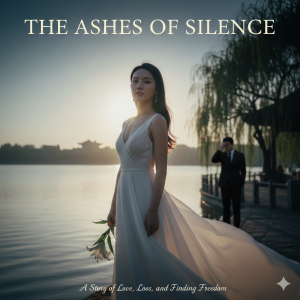
THE ASHES OF SILENCE: THREE YEARS AND A LIFETIME
The international arrivals hall at Pudong Airport, Shanghai, was a sea of sterile white light reflecting off polished marble. Amidst the bustling crowd, Lu Chiyuan stood like an immovable monument of power. Dressed in a flawlessly tailored charcoal suit, his cold, commanding presence—the hallmark of a “Total CEO”—usually kept people at a distance. But today, his gaze was restless, fixed on the sliding automatic doors. In his hands, he gripped a bouquet of white lilies, their purity a stark contrast to the transactional nature of his daily life.
As the doors hissed open, Tan Muwan appeared, pulling a silver suitcase. Her long hair cascaded over her shoulders, and her face bore the same gentle smile from his memories. When their eyes met, Chiyuan’s lips curved into a rare, genuine smile—a sight so fleeting it made passersby turn in wonder.
“Chiyuan,” she called out, her voice a soft echo of a past he had never truly let go.
“You’ve worked hard,” he replied, his voice dropping to a low, tender register as he took her luggage. In those three words lay a warmth that his wife, Jiang Nuan, had not received once in three years of marriage.
At that exact moment, twenty kilometers away on the 18th floor of a skyscraper in Huangpu District, the air was silent. Jiang Nuan sat across from Lawyer Minh Hao, her back straight, her hands resting calmly on a dark mahogany desk. Outside, the city was waking up, but the sunlight felt thin and distant.
“Miss Jiang, if you are certain, please sign here.”
Jiang Nuan looked down at the bold letters on the divorce papers. Three years of marriage, now condensed into a few sheets of white paper. She picked up the pen. Her fingertips were cold, but her eyes were unnervingly clear.
As she looked at the signature line, a kaleidoscope of broken memories flickered through Jiang Nuan’s mind. There had been no grand wedding, no vows of eternal love. On the day she entered the Lu family home, Chiyuan had merely said with icy indifference, “We are marrying for mutual benefit.”
For 1,095 days, she had been the “Mrs. Lu” who lived in the shadows. He never took her to galas, never introduced her to his circle, and never allowed her into his heart. She had lived in a magnificent villa that felt more like a hollow museum. She had thought that by being obedient, by enduring the silence, he might eventually turn around.
But this morning, a text message had shattered the last of her delusions: “I’m busy. Not coming home tonight.” He wasn’t busy; he was at the airport. She finally realized that some people could never be won over, no matter how long you waited. With a steady hand, she signed her name.
“It’s done,” she said softly. The lawyer looked at her, surprised. He had seen women wailing, begging, or trembling. Jiang Nuan was so calm it was heartbreaking.
As she walked out of the office and into the autumn wind of Huaihai Road, she remembered the beginning. Three years ago, her mother, Jiang Min, had been diagnosed with early-stage cancer. The medical bills were a mountain she couldn’t climb. That was the day she sat in the Lu Corporation boardroom and signed the contract.
“Three years. I will provide everything your family needs,” he had said, treating her like a business investment. She had agreed with a single word, selling her youth to save her mother’s life.
In that house, the rules were strict: No prying into his life. No interference with work. No public appearances. She followed them like a perfect employee. She learned his coffee preference, organized his shirts by color, and left medicine on his desk when his stomach acted up—all without a word. Once, she had dared to ask: “What happens when the contract ends?”
He hadn’t even looked up. “We go back to where we started.”
The news hit the social circles of Shanghai like a tidal wave the following morning. Photos of Lu Chiyuan shielding Tan Muwan from the wind at a five-star hotel were everywhere. The headlines screamed: “Lu Chiyuan Publicly Welcomes Old Flame: The Reunion of the Century.”
Jiang Nuan’s phone buzzed incessantly with mocking calls from socialites. “Three years as the wife, and you’re replaced in a single morning,” they laughed.
That night, Chiyuan returned to the villa. He saw her staring at the news on her phone.
“You saw it,” he said, his tone flat. No apology. No explanation.
“Do you have nothing to say?” she asked.
He frowned. “Muwan is just an old friend. You don’t need to pay attention to useless rumors.”
Jiang Nuan let out a fragile, bitter laugh. “Right. I’m just an outsider after all.”
The following evening, a torrential rain began to lash against the glass walls of the villa. Jiang Nuan lay in bed, her body racked with a sudden, violent fever. The years of emotional exhaustion had finally broken her physical defenses.
Gasping for air, she reached for her phone. She hesitated, then dialed Chiyuan. It rang until it timed out. She tried again.
This time, a woman’s voice answered. The background was filled with the clinking of glasses and soft music. “Chiyuan, do you want to try this wine?” Tan Muwan’s voice was intimate, close.
“What is it?” Chiyuan’s voice finally came on, sounding distant.
“I… I’m not well. I think I have a high fever,” Jiang Nuan whispered, her throat parched.
There was a pause. “I’m busy. Take some medicine yourself.”
The line went dead.
Jiang Nuan stared at the dark screen. The rain hammered the roof, counting down the seconds of her remaining patience. She forced herself up, took the medicine, and turned off the lights. For the first time in three years, she didn’t leave the porch light on for him. She didn’t listen for the sound of his car. She let the darkness swallow the room, and with it, her love for him.
Three days later, they stood at the Civil Affairs Bureau. The air in the car was suffocatingly silent.
“Are you sure?” Chiyuan asked, his voice tinged with his usual impatience. “Don’t make a scene over small things.”
“It’s not a small thing,” she replied, looking out the window.
Inside, the process was clinical. Chiyuan signed the final papers with a flourish, convinced she would regret this within a week and come crawling back. Jiang Nuan, however, moved slowly, savoring the feeling of the red seal hitting the paper. It was the sound of a prison door opening.
She moved out that afternoon with a single small suitcase. She left the jewelry, the expensive clothes, and the keys on the marble counter. She walked out without looking back.
The first three days, Chiyuan felt nothing. By the fourth day, he walked into the kitchen and found the fridge empty. No warm porridge. No lemon water. By the end of the week, his assistant informed him that Jiang Nuan had resigned from the planning department.
“She left a week ago, sir. Everything was handed over perfectly.”
Chiyuan began to notice the “gaps.” The vanity table was bare; the scent of osmanthus perfume was gone. The villa felt cavernous and cold. He tried to tell himself she was just sulking, but the lack of missed calls and texts began to gnaw at him.
One night, he found an old file in his office. It was her original employment application from three years ago. Tucked in the back was a hospital loan application for “Jiang Min—Mother.” The dates matched their wedding.
He flipped through the pages: stage-one cancer, astronomical bills, receipts of every penny sent to the hospital, and a handwritten note in the corner: “I will accept any condition as long as the surgery is paid for.”
The truth hit him like a physical blow. She wasn’t a gold digger. She hadn’t been a “replacement” by choice. She had sacrificed three years of her life to save her mother, and in return, he had treated her with nothing but coldness and suspicion.
He called his mother. “Did you know about her family?”
“She didn’t want you to feel pressured, so she hid it,” his mother sighed. “She is a very proud girl, Chiyuan.”
He sat in the dark, realizing that while he had been “protecting” his ego, Jiang Nuan had been the only one truly fulfilling the role of a partner. And he had driven her away.
Jiang Nuan moved to Hangzhou, a city where the pace was slower and no one knew the name “Mrs. Lu.” She started over at a small design firm. It was there she met Shen Yuhang, a man with a steady gaze and a calm soul.
Yuhang didn’t ask about her past. He didn’t demand obedience. When she worked late, he left a cup of tea on her desk. When her stomach hurt, he reminded her to eat without prying. Under his quiet gaze, Jiang Nuan realized she didn’t have to be “good” to be loved. She just had to be herself.
One night, Chiyuan found her. He stood outside her office in Hangzhou, watching through the glass as Yuhang draped a coat over her shoulders. Jiang Nuan smiled—a bright, easy smile Chiyuan had never seen in three years.
Jealousy flared, but when he confronted her, her response was a killing blow.
“Lục tổng,” she said, using his formal title.
“I misunderstood you,” he pleaded, his voice breaking. “I can make it up to you. Let’s start over.”
Jiang Nuan shook her head. “I used to love you with my whole life, Chiyuan. I waited for you in the rain with a fever. I convinced myself it was okay that you didn’t know how to love.” She smiled sadly. “But I don’t love you anymore. And I don’t hate you either.”
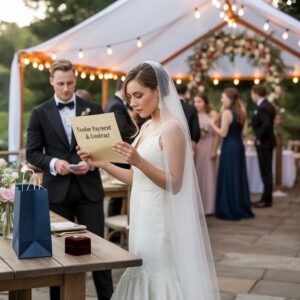
The wedding of Jiang Nuan and Shen Yuhang took place on a crisp spring morning by West Lake. It wasn’t lavish, but it was filled with warmth.
“I don’t promise you the world,” Yuhang said as they exchanged rings. “I only promise that from today on, you will never have to suffer in silence.”
Outside the fence, hidden by the willow trees, Lu Chiyuan watched. He wasn’t invited. He had no right to be there. He saw the woman who had once lived in his shadows now standing in the full light of happiness.
He turned away before the ceremony ended. In Shanghai, his empire remained, but his home was a tomb. Jiang Nuan had moved into a future where she was respected and cherished. Chiyuan remained in a past filled with “what ifs.”
Some marriages end in regret, and some loves only begin when you are brave enough to walk away.
Disclaimer : This content may be created by AI for entertainment purposes. Any resemblance to real persons, events, or places is coincidental.