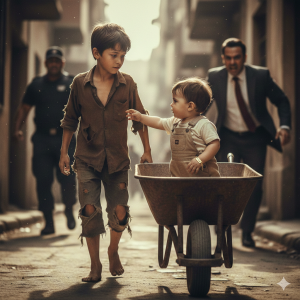
The morning heat had already turned the dusty alley into a boiling tunnel when a barefoot street boy stumbled through it, dragging an old sack almost heavier than his entire body. His brown, torn shirt clung to his skinny back, soaked with sweat, and the ripped pants slapped against his legs every time he ran. His stomach growled so loud it hurt—but hunger was normal to him. Hunger was routine. Hunger was the only thing that never left.
His name was Rafi, an eight-year-old who survived by collecting scraps—metal pieces, plastic bottles—anything he could exchange for a few coins. And today was already a bad day. The junkyard man had screamed at him for bringing useless trash and threw a broken chair at him. Another man shoved him off the sidewalk. A shopkeeper slapped his hand for getting too close. Everyone treated him like dirt, like something unwanted crawling through their perfect city.
Rafi didn’t cry. Crying didn’t help. Crying didn’t feed him. He wiped his dirty face with the back of his arm and kept walking.
Then he stopped. A sound cut through the entire alley—sharp, high, desperate. A baby’s cry. Not just a cry—a terrified scream. Rafi frowned, shoulders tensing. It wasn’t normal to hear a baby here. Poor families lived far from this road. And rich families? They never stepped foot in these narrow, dusty spaces.
Another cry came—loud, panicked—like the baby couldn’t breathe.
Rafi dropped his sack. He followed the sound behind an old concrete wall—and froze.
A white baby, around one year old, sat on the ground, red-faced from crying, dressed in clean beige clothes, chubby hands shaking. His little palms slapped the dirt as he sobbed like the world was ending. Rafi’s heart slammed against his ribs. A rich baby, here, alone. His eyes locked on the tiny gold bracelet on the baby’s wrist. The initials were clear even under the dust: A.M.
“Millionaire’s kid,” Rafi whispered under his breath, disbelief shaking his voice. Kids like him never got close to families like that. Guards usually shoved him away before he even reached the gate.
The baby let out another scream and reached both arms toward Rafi, begging for someone—anyone—to hold him.
Rafi stepped back. “Hey, hey, don’t do that,” he muttered, panic rising. “I can’t touch you. They’ll beat me if they see me near you.”
But the baby didn’t understand. Tears rushed down his cheeks as he cried harder—desperate, scared, helpless.
Rafi clenched his fists. He knew what people would think if they saw this: a dirty street kid next to a millionaire’s child. They wouldn’t ask questions. They wouldn’t listen. They’d assume the worst.
But he also couldn’t walk away. He didn’t have that kind of heart. He knew exactly what it felt like to be alone, crying, ignored.
He took a shaky step closer. “Okay. Okay, brother. Stop crying.” His voice broke. “I won’t leave you. I promise.”
He touched the baby’s arm gently, scared, trembling, like he was touching something forbidden. The baby instantly leaned into him, gripping his dirty shirt with tiny fingers, burying his face against Rafi’s chest as if trusting him completely.
Rafi swallowed hard. “Damn, you really don’t know who you’re holding, huh?” He looked around desperately. No guards, no nanny, no car, no footprints—nothing. Someone messed up. Someone from that rich family screwed up big time.
He needed to calm the baby down fast. He spotted an old rusted wheelbarrow leaning against a wall. Its metal was dented, scratched, but still standing. He hurried to it, wiped the inside with his hands—his palms bleeding from tiny cuts—and made a little space. He lifted the baby carefully, surprised by how heavy a well-fed child felt. “Man, you eat good food,” he muttered under his breath.
The baby looked at him with tear-filled eyes, then suddenly burst into the biggest smile Rafi had ever seen. And when Rafi placed him inside the wheelbarrow, the baby laughed, clapped, kicked his feet with joy.
Rafi blinked, stunned. “You like that?” The baby squealed happily.
Something cracked open inside Rafi’s chest. He hadn’t heard laughter like that in years. Not from himself. Not from anyone near him. No one smiled at a boy like him.
He grabbed the handles and pushed slowly. The baby laughed harder. Rafi pushed faster. The baby threw his head back, clapping wildly, his face glowing like pure sunshine.
Rafi started laughing too—real laughter, the kind he didn’t know he still had. For a moment, he wasn’t a starving street kid. He wasn’t unwanted. He wasn’t invisible. For a moment, he felt like a big brother.
He ran back and forth through the alley, dust kicking under his bare feet. The wheelbarrow rattled, the baby giggled uncontrollably, and the whole alley echoed with joy that had no reason to exist in such a broken place.
“Look at you,” Rafi whispered to himself, “laughing like I gave you the whole world.”
The moment didn’t stay safe. Heavy footsteps thundered at the far end of the alley. Shouting tore through the air. “Panic!” A man’s voice roared, “My son—find my son!”
Rafi’s blood turned cold. He knew that voice. Everyone in the city knew that voice—the millionaire himself.
If the man found Rafi pushing his son in a wheelbarrow, Rafi’s life was over. He felt it in the way his heartbeat slammed against his ribs, the way his breath caught, the way his hands tightened on the wheelbarrow handles. He didn’t dare move.
The baby sat inside the rusted metal tub, still laughing, still clapping—innocent, completely unaware of the storm closing in.
What Rafi didn’t know was that this chaos had begun twenty minutes earlier, when the millionaire’s luxury SUV stopped near the main road. The father and mother were shouting at each other about a business betrayal. Their voices shook the entire vehicle. The nanny, stressed and sweating, unbuckled the baby to adjust his clothes because he was overheating. She opened the back door for some air, stepped out for one minute to give the arguing couple space, and didn’t see the one-year-old crawl across the seat, slide down, and follow a pigeon out through the open door. It took him ten seconds to disappear around the corner.
When the parents finally realized he wasn’t strapped in, panic exploded. Guards scattered in every direction, screaming his name, tearing through streets they’d never walked in their privileged lives. And now all of them were closing in.
The shouting grew louder. “Check that side! He can’t be far! Find my son!” The father’s voice stabbed through the alley—desperate, furious, terrified.
Rafi trembled. He had seen how rich men reacted when they thought someone touched what belonged to them. Guards didn’t ask questions. They hit first, lied later. A dirty, barefoot kid with a millionaire’s child—they’d bury him alive.
“Please don’t cry again, little guy,” Rafi whispered. “Please don’t scream now.” His voice cracked.
But the baby stared at him with bright, trusting eyes, believing this skinny boy could protect him from anything.
That belief made Rafi do something stupid—brave, human. He grabbed the wheelbarrow and pushed it behind a broken wall, trying to hide them both. His heart thumped so hard he thought it would break his ribs. Sweat dripped down his face, turning dirt to mud.
Life didn’t give him time. A guard turned the corner and saw movement. “Hey—over there!”
Rafi froze. The guard charged at them, boots pounding. Rafi stepped in front of the wheelbarrow, arms spread wide, as if his tiny body could shield the baby.
The guard seized his arm so hard Rafi cried out. “What did you do to the baby?”
“Nothing! I didn’t take him! I swear he was alone—he was crying!” Rafi gasped.
The guard shoved him to the ground. His elbow scraped open, blood smearing the dirt. The wheelbarrow rattled. The baby whimpered, sensing fear.
“Don’t—please don’t make him cry,” Rafi begged, crawling up. “He laughs with me. Don’t scare him.”
The guard raised a hand to strike—but a deeper voice thundered behind them.
“Stop.”
Everything froze.
Rafi turned his head and saw the man from every news article—the millionaire. Tall, furious, breathing hard, eyes wild with fear. His expensive shirt was wrinkled, his hair a mess, his face drenched in panic. This was no polished public figure. This was a father whose world had been ripped open.
His eyes locked on the baby. Then the wheelbarrow. Then Rafi.
Rafi quickly lowered his gaze. “I didn’t take him, sir. I swear—I found him crying. He was alone. I just didn’t want him scared.”
The millionaire walked toward the wheelbarrow, staring at his son. The baby saw him—but didn’t laugh, didn’t reach, didn’t react. Instead, he stretched his arms toward Rafi.
The millionaire froze midstep. The guards exchanged confused looks.
“No, buddy. Not now,” Rafi whispered, but the baby leaned toward him, whining softly, wanting him.
A heavy silence fell. For the first time, the millionaire really looked at Rafi: the dirt on his face, the cuts on his arms, ribs showing through the torn shirt, bruised bare feet, trembling hands. Not guilt—fear.
The millionaire’s voice came low, rough. “What did you do with my son?”
Rafi swallowed. “He was crying loud. No one was there. I thought he was lost. I put him in the wheelbarrow so he’d stop crying. He laughed. I swear, sir, I didn’t mean anything bad.”
A guard stepped closer. “Sir, maybe he was trying to shut him up—”
The alley trembled with the weight of the millionaire’s scream. He lifted his son gently, but the baby twisted, reaching for Rafi. When he couldn’t reach him, he burst into loud, shaking cries.
The father’s jaw tightened. He looked at Rafi again. “Your name?”
“Rafi,” he whispered.
“You live here?”
“I live wherever people don’t kick me out.”
Something in the millionaire’s expression faltered. “You helped my son.”
Rafi nodded, scared. “You could have walked away. I know how it feels when nobody comes.”
The line hit the father like a blade to the chest. Behind him, the crying baby kept reaching for the boy who made him laugh.
The millionaire turned to his guards. “Who lost him?”
“The nanny, sir.”
“Fire her. Now.”
“Yes, sir.”
He stepped closer to Rafi. Rafi tensed. The millionaire pulled out a thick stack of cash. “Take this.”
Rafi didn’t move.
“Take it,” the man repeated.
Rafi clenched his fists. “No.”
Every guard stiffened. “Why not?” the father growled.
“Because if I take it, you’ll think I helped him for money. I didn’t. I’m poor, not a thief.”
The millionaire stared at him—anger, guilt, respect, confusion, all twisting together. Rafi looked at the baby. “If you think I’m bad, fine. But he laughed with me. That’s enough.”
Rafi grabbed his torn sack with his good arm. He prepared to leave—but the millionaire’s voice cut through the air.
“Rafi.”
He stopped.
“You’re coming with me.”
Rafi’s heart almost burst. “Why?”
“Not as a servant,” the millionaire said. “You kept my son safe. You gave him joy. And you deserve a life where people don’t treat you like trash.”
Rafi swallowed hard. The millionaire extended his hand. Rafi hesitated, then placed his tiny, trembling hand in the man’s.
For the first time in his life, someone didn’t pull away.
The baby stopped crying instantly and smiled.
Rafi exhaled shakily as a new life opened in the same alley where everyone used to walk past him like he didn’t exist.
One moment. One crying baby. One barefoot boy. And everything changed forever.
The city would remember how a millionaire’s son reached for a street child instead of his own father, and how that choice pulled a boy out of invisibility. If this powerful bond between a forgotten street boy and a millionaire’s son shook your heart, stay close—because there are stories that dig deep, break you, and lift you back up. More emotional, life-changing tales are coming.
Disclaimer : This content may be created by AI for entertainment purposes. Any resemblance to real persons, events, or places is coincidental.