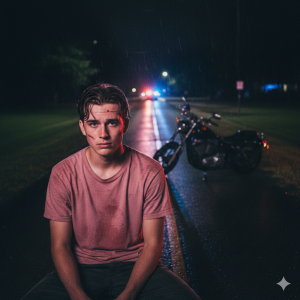
Late on June 24, 2023, a routine patrol in Holmen, Wisconsin turned into a tense chase. An officer spotted a speeding motorcycle, followed from a distance, and watched the rider cut through a parking lot, park, and walk into a gas station. While the rider was inside, the officer ran the temporary plates. They returned to a 19-year-old male named Isaac. Records also showed Isaac only had a restricted motorcycle permit—he was required to wear a helmet and ride during daylight hours. Despite that, he was riding helmetless, well into the night. The stage was set: a simple stop about speed and permit conditions was about to spiral.
– After a few minutes inside the store, the rider came back out, mounted the bike, and again sped through the parking lot.
– When the officer initiated a traffic stop, Isaac accelerated instead, topping out at around 80 miles per hour.
– The pursuit led to the end of a road. Isaac steered off into a grassy area. The motorcycle spun out, flinging him off—“yeeted him off into the abyss,” as the narration later frames it—and he bolted on foot into the darkness.
– Over the radio, the officer called it in: “It’s gonna be a 10-15 at the end of Viking—I got a white male, pink T-shirt, black pants, running into the woods.”
– The temporary tag (Minnesota temp tag 0221) was documented; the officer noted he “lit him up,” the rider took off, wrecked in the grass, then fled on foot.
– On scene, the officer secured what he could, asking bystanders to keep doors locked and offering a quick explanation: the stop was for speed and reckless driving, and the registered owner did not have a valid Class M license. He added that the rider’s restricted permit required helmet use and daylight riding—conditions clearly violated.
– The officer explained he had to stay with the motorcycle because the rider had taken the keys.
– Additional units arrived. Multiple agencies assisted with a search west of the scene and in the nearby woods. Despite coordinated efforts, they were unable to locate Isaac.
– The officer canvassed the area, briefly engaging with residents. One person had seen the rider run toward the woods. The officer mentioned he might retrieve camera footage and that Quick Trip (the gas station) had excellent cameras.
– He reiterated key points: he’d already run the plate before the rider even went inside the store, the crash happened at a dead end, and the wet grass made the spill nearly inevitable—especially for a newer rider. Despite the fall, there didn’t appear to be significant damage to the bike.
### Decision to Move the Search
– Having the registered owner’s identity, photo, and address from the plate check—and knowing Quick Trip would have clear footage—the officer decided to follow up at Isaac’s residence.
– At Isaac’s home, his mother answered the door, clearly puzzled. The officer identified himself and asked for Isaac. When told he had run from police on his motorcycle, she reacted with surprise and disbelief.
– Isaac appeared—changed clothes, seemingly trying to act casual. The officer started asking calm, direct questions:
– “Where’s your motorcycle?”
– “Have you been home all night?”
– “How did you get home?”
– “What happened to your face—how did you get scratched?”
– Isaac tried several explanations:
– He claimed he’d been home “since 11,” then corrected piecemeal details.
– He said he’d gotten the scratches at work.
– He mentioned a buddy, Gavin, then said he wasn’t at Gavin’s house but at another friend’s, then said he’d been dropped off.
– The officer pressed gently but firmly, noting he had been directly behind Isaac when the bike crashed, that Quick Trip had excellent cameras, and that he’d seen Isaac go inside before the flight. The reality was inescapable.
– Isaac relented:
– He said he’d ridden his newly purchased motorcycle to a friend’s house even though he wasn’t supposed to be out.
– When the officer lit him up, he panicked and ran—only “four houses down” to the friend’s place—sat there for about an hour, then came home.
– He acknowledged he had a permit.
– The officer explained the stakes:
– Riding with only a permit and violating conditions is a citation.
– Running from the police is far more serious—it’s a felony.
– The officer had Isaac turn around and place his hands behind his back. He asked if Isaac had been drinking. Isaac, 19, said no. The officer did not smell alcohol, but later Isaac admitted that after he got home, he had “like three beers.” The officer asked where the cans were and administered a breath test, instructing Isaac to blow steadily as if into a balloon. The reading process unfolded calmly and procedurally.
– The officer advised Isaac to apologize to his mother. He reminded him that at 19, he should know better, that running was dangerous, and that he was lucky he hadn’t killed himself—especially riding at night without a helmet.
– The officer explained the weekend timeline:
– It was Friday; Isaac might remain in custody until Monday when a judge could set terms, though a bond could come sooner.
– He could make phone calls from jail.
– Isaac’s mother asked for a case number and officer contact details. The officer thanked her for her help and professionalism.
– The officer spoke to Isaac more personally:
– He empathized as a former rider. Bikes are fast, fun, but unforgiving—particularly for new riders.
– He noted he’d initiated the stop because Isaac didn’t have a motorcycle license and was violating permit rules (no night riding, helmet required).
– He explained he would have found Isaac regardless—plates and riding behavior made identification easy. Isaac had turned on the wrong blinker and even hit the hazards at one point—signs of inexperience.
– He mentioned he’d owned an R6 and later a Victory Octane; a 650 is a good starter, but night riding without a helmet is particularly risky, with deer activity high and intoxicated drivers on the road.
– Isaac admitted he hadn’t known it was a dead end. The officer noted wet grass would be a problem for anyone, especially a newer rider.
– He reassured Isaac there wasn’t much visible damage to the motorcycle.
– Isaac worried aloud: after “all this,” would the permit be affected? Would it be at least a year? The officer answered that his license would likely be suspended—probably both motorcycle and driver’s licenses.
– At booking, the officer directed Isaac to the left, had him sit, and started typing paperwork. Isaac asked about his phone. The officer hadn’t found it in his pockets when searching; he promised to check before leaving and see if another officer had it.
– Restraints were adjusted, and Isaac was escorted further along the process.
– Ultimately, Isaac was charged with felony vehicle fleeing/eluding an officer.
– He also received numerous traffic citations totaling over $1,700.
– He was eventually released on a $1,000 signature bond.
– The incident, captured and narrated, closed with a reminder that a straightforward stop—speeding and permit violations—escalated the moment fear and flight took over.
– A minor traffic matter can become life-changing when someone decides to run.
– Helmets and permit rules exist for a reason; a split-second panic on wet grass can end in tragedy.
– The officer’s mix of firmness and empathy stands out: accountability paired with guidance—reminding a 19-year-old that even bad nights can teach hard, necessary lessons.
– In the end, Isaac walked away with charges, fines, and a chance to course-correct before the road takes something he can’t get back.
Disclaimer : This content may be created by AI for entertainment purposes. Any resemblance to real persons, events, or places is coincidental.