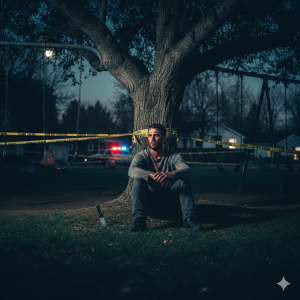
Just after a strange 911 call, officers arrive at a children’s park expecting to check on someone in need. Instead, they step straight into a scene so brutal it freezes even seasoned cops in disbelief: a man lies motionless in the middle of the road, his head completely severed from his body. The caller’s voice still echoes—he’d seen a body on the ground, the head beside it, and it looked fresh. Somewhere nearby, a man is acting suspiciously.
What the officers don’t yet know is that the man the caller spotted is still in the park, watching them. He is calm, detached, and soaked in blood. He is the killer.
Officers fan out, blocking off the east side of the park and calling for the south perimeter to be sealed. One officer points—someone is sitting under a tree. Another moves in, keeping his voice steady.
“Sir, put your hands up. Stand up. Come over here.”
He notices the man’s hands and clothes: wet with blood. A small knife lies on the ground nearby, its blade stained and dark. The suspect doesn’t resist; he’s eerily calm, almost indifferent, as if what sprawls across the park has nothing to do with him. They cuff him, search his pockets, tug on gloves, and direct an officer back to the intersection to protect the scene from contamination.
The quiet among the officers breaks with disbelief that bubbles into raw, unsettled talk:
“He cut his head off, dude.”
“We have a human head and a human body. Both parts. They’re just not connected.”
“There could be another head in that bag.”
They circle near a rock where the grass is soaked with a big pool of blood. They point out drag marks. Someone notices that the suspect had been sitting with bloody hands next to a bloody bag. Nearby, on the tree, there are fresh cut marks—exact, deliberate. The officers keep clearing the park, voice by voice, line by line, unsure if anyone else is out there. They search the playground, the west-to-east path, the camp up the hill. No other victims emerge, but the horror of the small knife keeps returning in their conversations.
“How do you hack off a head with a pen knife?”
“Spines are tough. You’d have to go to town on that thing.”
“An average male—several blows with an axe. And that’s meant for chopping.”
The shock is practical and visceral. The knife seems wrong. Yet the evidence around them is unflinching.
Near the body, an officer points out details: a tattoo—a scorpion on the victim’s back. Multiple stab wounds, more than a few, deep and definitive. Someone indicates shiny residue—maybe spit—glinting in the light. Drag marks trace across the grass to the roadway. A puddle of blood near a tree. Blood on a shoulder. In the chaos of movement, the head seems to have been carried or rolled, kicked even. A roll pattern in the blood suggests it.
Soon, the victim is identified: 51-year-old James Garcia. His head is found nearly 20 feet from his body. An autopsy will later confirm what the officers are already grappling with—more than 80 stab wounds. He was attacked, beheaded, and moved deliberately into the road.
Back at the patrol car, an officer checks the suspect’s identity, asking his name. A familiar recognition spreads among the team. One officer knows him: Joel. Eight weeks earlier, Joel had gone on a vandalism spree in Los Cruces—windows smashed at two local businesses, walls inside smeared with blood and scrawled with homophobic slurs and hate-filled messages. He was arrested, charged with multiple felonies, then released pending trial. He’d written “death to” in his own blood and signed his name. The memory lands with weight. The warning signs were there.
Joel is transported to the Los Cruces Police Station and placed in a booking cell. Detectives arrive and start the interrogation, aiming for a confession. But Joel stonewalls.
“What were you doing at Apodaca Park last night?”
“I don’t know.”
He denies knowledge of the park, the night, the blood on his hands. For thirty minutes, he gives them nothing. He’s practiced at deflection. The detectives step out, collect his clothing, take DNA samples, snap photographs, and dig into his past.
Years earlier, officers had responded to the Townhouse Motel after a shooting. Inside, they found 21-year-old Benjamin Montoya dead on the floor, a gunshot wound to the chest. The man arrested at the scene was Joel Arinega Sains, charged with first-degree murder. But the weapon was missing. Months later, the gun surfaced after a separate robbery arrest, but there was no way to prove who pulled the trigger on Benjamin. The case collapsed. Joel walked free.
Armed with his history, the detectives return with a new, unorthodox tactic. They press on the hate themes Joel had written before—suggesting James was his boyfriend, probing for offense, agitation, truth.
“Was he your boyfriend? Were you two dating?”
“Are you trying to insult me?”
“We’re not calling you gay. I asked if you were married to James.”
Joel flares—denies, accuses, calls the detective childish—and then, suddenly, he pivots. The detectives ask again: why is James dead in a park and why is Joel covered in blood?
Joel offers a story. He says James sexually assaulted his wife four years ago. He says James pulled a gun on him, and he stabbed him in self-defense. He says they were all homeless, their bags stolen, a chain of grievance spiraling into violence. He admits, plain and cold: “I cut his head off. I drag his body down. I’ll prove his head.” He describes playing soccer with the head, kicking it toward passing cars.
The detectives listen, steady. They will later confirm there was no weapon at the scene, no record of a marriage, no victim filed, no report of an assault. Joel’s account is a fabrication designed to justify what he did. For now, with the confession captured, the interrogation ends.
Joel is taken to the Doña Ana County Detention Center and formally charged with first-degree murder. In the years that follow, the case stalls. Joel is declared mentally incompetent to stand trial and placed under psychiatric evaluation. Investigators learn he has suffered from schizophrenia since age eleven and had been off his medication for years.
Time moves forward. In March 2025, nearly four years after the killing, Joel is ruled competent and brought before a jury. Over a week-long trial, the evidence is laid out—the call, the scene, the knife, the drag marks, the confession, the victim identified, the autopsy’s relentless tally of wounds. The jury finds Joel Arinega Sains guilty of first-degree murder. He now faces a life sentence in the New Mexico Department of Corrections.
The most tense moment unfolds in the interrogation room. After thirty minutes of silence, baiting, and denial, Joel shifts. He stops deflecting and spills the story: the alleged assault of his wife years earlier, the claim of a gun pulled on him, the knife in his hand, the stabbing, the beheading, the dragging of the body, the grotesque act of kicking the head toward passing cars. The room’s air thickens—not just with the weight of confession, but with the coldness of detail. It’s not rage. It’s not panic. It’s flat, almost casual.
Yet the detectives know how quickly stories can be crafted and how often they can fail the test of evidence. No gun at the scene. No marriage documents. No victim report. No corroboration. The narrative collapses, leaving only the brutality of the act, the blood, the head rolled twenty feet away, and a small knife that somehow did the unthinkable.
In the park, the night’s chaos finally settles. The officers seal the perimeter, the playground stands empty, the camp up the hill goes quiet. The head is recovered. The body is documented. The drag marks are mapped. The knife is bagged. James Garcia—51 years old—is taken from the place where his life ended.
The case will not move quickly. Joel’s mental health history—schizophrenia since childhood, years off medication—derails the swift march toward trial. He is declared incompetent, evaluated, and monitored, while the facts wait in their boxes, evidence sealed, statements preserved.
Four years later, in March 2025, the courtroom opens its doors. Jurors hear about the 911 call, the park perimeter, the man under the tree, the blood, the bag. They hear officers wrestle with the impossibility of a beheading done with a small knife, and they hear the detective recount Joel’s confession in careful, unflinching detail. The past murder charge that dissolved without the gun, the vandalism spree smeared in hate—each piece cuts a silhouette around the night in the park.
The verdict lands: guilty of first-degree murder. Joel Arinega Sains faces a life sentence in the New Mexico Department of Corrections. For James Garcia, the record stands—more than eighty stab wounds, a head carried or kicked, a body dragged into the road. For the officers, the memory remains of that first step into the children’s park, where a routine welfare check became one of the most vile discoveries the Los Cruces Police Department had ever made.
– The officers responded to a 911 call at a children’s park and discovered a decapitated victim in the roadway.
– A calm, blood-covered suspect—Joel—sat beneath a nearby tree with a small, bloodstained knife.
– The victim, 51-year-old James Garcia, suffered more than 80 stab wounds; his head lay nearly 20 feet from his body, with drag marks indicating deliberate movement.
– Joel initially deflected in interrogation; detectives leveraged prior hate-themed vandalism to provoke a reaction.
– Joel confessed, claiming a fabricated self-defense narrative involving a past assault and a gun that was never found.
– The case stalled for years due to Joel’s mental incompetence ruling and schizophrenia history; in March 2025, he was deemed competent.
– A jury convicted Joel Arinega Sains of first-degree murder. He faces a life sentence in New Mexico DOC.
Disclaimer : This content may be created by AI for entertainment purposes. Any resemblance to real persons, events, or places is coincidental.