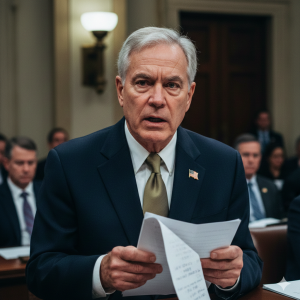
A senator steps onto the Senate floor with a mix of procedural calm and rising fire. He begins with a routine request—temporary floor privileges for two office colleagues, Colin Lori and John Tober, through December 4, 2025, and a belated nod to Grace Maccaffer—before shifting to a subject he calls “deeply disgusting.” He speaks to “Mr. President” (the presiding officer), invoking American generosity as his frame: in this country, he says, the hungry are fed, the homeless are housed, and the sick are treated even when they cannot pay. That compassion, funded by trillions in taxpayer dollars, is a point of national pride—and a potential point of vulnerability. What follows is, in his words, “clown world on steroids,” a story he says left him “slapjawed” and furious enough to “knee someone in the groin.”
The senator promises facts, not slurs. He insists he is not attacking an entire community, only recounting how federal prosecutors uncovered what he describes as a billion-dollar web of welfare fraud in Minnesota—centered, he says, largely within the Somali community in and around Minneapolis. He lays out numbers: 59 convicted so far, 86 charged, 78 of Somali ancestry—facts, he insists, not racism. He will tell it in three schemes. And he will explain, later, why he believes the fraud ballooned unchecked.
– A nonprofit called Feeding Our Future, led by people of Somali ancestry, applied to Minnesota’s welfare authorities (distributing federal funds) to feed hungry children in the Somali community.
– The model looked straightforward on paper: the nonprofit would receive federal taxpayer money, engage mostly Somali-owned businesses, and establish feeding sites where children would get hot meals.
– At first, the sums were small—just a few million dollars. As more businesses joined, Feeding Our Future kept requesting more money. At the height, the senator says, the program was spending about $100 million a year.
– The problem, as he tells it: the children weren’t fed. Money did not reach hungry kids. Instead, many participating businesses allegedly spent funds on yachts, vacations, jewelry, and home furnishings.
– In his words, this wasn’t merely fraud; it was stealing.
– A second nonprofit—again, the senator says, led by someone of Somali ancestry—approached providers who purportedly offered housing for the homeless and requested state-approved funds.
– It began in 2020 at $2.6 million. Then, the asks accelerated: $21 million in 2021; $42 million the following year; then $74 million; then $104 million per year—not cumulatively, but annually, he emphasizes.
– As with the child-feeding program, the senator claims the money never reached the homeless. Providers and the coordinating nonprofit pocketed the funds.
– The third scheme, the senator says, is the most stomach-turning: providers presented themselves as medical service organizations for autistic children and sought state approval for funding.
– Once approved, they began recruiting autistic children. When they couldn’t find enough, they allegedly approached parents in the Somali community offering bribes—$400 to $1,500 per child—if the parents would allow the providers to certify their children as autistic.
– The senator identifies a leader he names as Asha Farban Hassan, noting she was also involved in the feeding program scam.
– The requests scaled quickly:
– Year 1: $3 million (he credits them as “clever” for starting small).
– 2019: $54 million.
– 2020: $77 million.
– 2021: $183 million.
– 2022: $280 million.
– 2023: $400 million.
– He asserts the bribes targeted parents in the Somali community and says, again, that is a fact, not an accusation against an entire people.
– Across the three schemes, the senator tallies $1 billion in stolen taxpayer money.
– He then asks the obvious question: How did it go on so long? Why didn’t Minnesota’s Department of Social Services and other welfare authorities stop it?
– His answer: state employees tried. But according to him, they were blocked—by political threats and the specter of headlines accusing them of racism.
– He provides an example: when rank-and-file staff grew suspicious of Feeding Our Future’s escalating claims and warned of cutting off payments, the nonprofit allegedly threatened litigation and public accusations of racism if minority-owned business applications weren’t promptly approved.
– According to the senator, employees escalated concerns to higher-ups—“people with the flags in their offices”—and nothing happened.
– He cites the Minnesota Legislative Auditor, who concluded that litigation threats and fear of negative press influenced how state politicians used regulatory power.
– He quotes a fraud investigator in the attorney general’s office, saying there was a perception that tackling the issue aggressively would provoke political backlash from the Somali community, described as a “core voting block for Democrats.”
– He mentions another witness telling prosecutors that in Minneapolis, with its 80,000 Somali-ancestry voters, Democratic victory requires that constituency; and winning Minneapolis is vital to winning Minnesota.
– The consequence, he argues: politicians did nothing, even as employees tried.
– The senator reads a social-media statement attributed to several hundred Minnesota Department of Human Services employees, who administer the programs. He quotes them asserting:
– “Governor Tim Waltz is 100% responsible for massive fraud in Minnesota.”
– They warned early, sought partnership to stop fraud, and instead faced retaliation: monitoring, threats, repression, and efforts to discredit fraud reports.
– They describe the mainstream media as indifferent and the environment as isolating and frightening.
– He then mentions an unverified report in City Journal (of the Manhattan Institute), alleging that some of the stolen funds may have been diverted to the terrorist organization Al-Shabaab in Somalia. He emphasizes he does not know if this is true but says prosecutors are trying to get to the bottom of it.
– Anticipating accusations of bias, the senator reiterates that he is focused on “crooks,” not ethnic groups. He repeats his facts: the $1 billion in schemes, he says, were orchestrated by leaders within the Somali community; most participating businesses were Somali-run; parents who accepted kickbacks to label their children autistic were of Somali ancestry; and Minnesota politicians, not rank-and-file staff, allowed it to happen. It disgusts him, he says, that money meant for truly hungry children, genuinely homeless people, and children with autism was stolen—and possibly, as alleged, siphoned to terrorists.
The senator’s voice sharpens as he returns to the Senate chamber’s purpose: building a national budget. He contrasts the ideal—American generosity—with what he calls an unforgivable breach. Minnesota officials, he says, tolerated theft for votes. “These people ought to all be put in jail,” he declares, “including the politicians.” He paints a visceral image of frustration—wanting to “stick my head in another,” breaking off mid-phrase as if words fail him.
But he does not end the day with outrage alone. He pivots to the nightly worries of American parents: the cost of living, housing, insurance premiums—people “paying more to live worse,” joking darkly that families fear they’ll have to “sell blood to go to the grocery store.” He gives his quick economics lesson:
– Inflation reached 9% under President Biden.
– Now it’s about 3%—that is disinflation, not deflation.
– Disinflation means prices are still rising, just more slowly.
– Deflation would make prices fall, but often through painful recessions and high unemployment—he cites China’s youth unemployment, 25% for recent graduates, alongside falling prices.
– His solution: raise incomes instead—through tax reform, regulatory reform, and a health care system that looks “like somebody designed the damn thing on purpose.”
He laments that he does not control the floor; he is “labor,” others are “management.” Still, he lays out a path: if Democrats will not join, pass measures through reconciliation—“the one big beautiful bill,” as he calls a past success—two more times before the midterms, with a simple majority. He needles leadership with humor: a “pretty please with sugar on top,” out of cherries, and willing to toss in an old McDonald’s McRib coupon if that helps. The point is not the joke; it’s the plea: bring another reconciliation bill to tackle costs that keep parents awake at night.
The senator apologizes to a colleague—Senator Reid of Rhode Island—for speaking too long, but not for the urgency. He insists the media often won’t report this story for fear of being called racist, and he asks a simple question: what is racist about facts? He repeats his core message—America’s compassion is precious, paid for by taxpayers, and it must not be abused. The public deserves the truth. Employees who tried to blow the whistle deserve protection, not retaliation. Prosecutors must follow every lead, including the darkest ones. And the Senate must get back to work, not only punishing the guilty but raising wages and lowering burdens the right way, by growing incomes rather than courting deflation’s pain.
He yields with a final note of restrained optimism: he will be back on the floor. He has been before. And somewhere between fury and humor, between budget fights and bedtime worries, he believes the country can still do the serious, decent thing—protect the generous and hold the thieves to account.
Disclaimer : This content may be created by AI for entertainment purposes. Any resemblance to real persons, events, or places is coincidental.