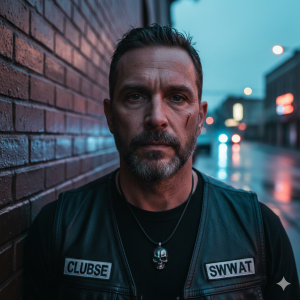
I used to measure time by the sound of doors closing—clubhouses, motel rooms, unmarked cars, basements where light and air seemed optional. My name is Scott Payne, and for 23 years I lived under other names, moving through outlaw motorcycle clubs, white supremacist crews, and accelerationist cells. I learned that trust is a currency spent with interest, that the most dangerous lie is the one you tell yourself, and that if you step into a hundred acres with trouble brewing, backup might only arrive in time to avenge you. Here’s how the life unfolded—case by case, test by test—where a story must be straight, a legend solid, and survival sometimes depends on remembering your own middle name.
– The assignment began from the Boston office, targeting the Outlaws Motorcycle Club around July 2005. The plan was simple: go in cold.
– Intel said the target liked being the center of attention, surrounded by big guys. That eased the approach—I could be me.
– The crew held weekly “church” meetings at a strip club—phones off, airplane mode, devices left outside to thwart infiltration.
– I scouted the bar when they weren’t there, learned the crowd, and waited for the right night. I’d assumed they couldn’t wear their colors inside. That intel was wrong. About a dozen Outlaws walked in fully patched and took the back of the bar.
– A direct approach was off the table. I played it slow—just a tattooed guy drinking, watching dancers, talking rock and roll. A large guy named Scott Town checked me in the bathroom—barrel-chested, serious, informed. He quizzed me on places—Macau, Brownsville, Greenville, Spartanburg—and knew them all. If I had bluffed, the case would’ve died that night.
– No gun. Probably not wired; I dislike wearing wires early. If a fight started, it was just me. The “cover team” was basically a minimal response core: me, the case agent (a friend), a Massachusetts State Trooper task force officer, a Brockton PD detective, and a DEA counterpart. For two years, mostly just those three and me.
– The Lobster Fest—a Northeast regional meet—came early. I returned, met more people, and built presence.
– My cover: a site survey specialist with a landscaping background; a believable trade I could discuss and perform. I let it slip, bit by bit, that I did legitimate work—and some crime.
– The jobs escalated: they reported cars stolen, collected insurance, and I “bought” those stolen vehicles to move south—supposedly to Mexico. As trust grew, they texted when they had “hot” carjacks that needed moving.
– I dropped breadcrumbs of a previous life in dope, cartel contacts, backing away because the heat was too close after friends got locked up.
– About 18 months in, we ran a transfer: 40 kilos of real cocaine, 1,000 pounds of real weed. The crew believed it was a drug team paying them for protection on a load moving between vehicles.
– There were traffic stops with Outlaws in my car while surveillance followed; I stayed in role under pressure. If arrested, I wouldn’t break cover. I’d go to jail, get bailed out later. Might even boost my standing.
– The night before the operation, the chapter president—Joe Dogs—called me to the clubhouse for “church.” The enforcer, my supposed friend, “Clothesline,” took me somewhere I’d never been: a tight cellar down a narrow stairwell.
– Weapons flashed. One Outlaw in front, one behind. I’m 6’4″; I couldn’t stand straight, walls within reach, air dead and cold.
– The demand: strip. Write down my full name, address, my kids’ names, my wife’s name. If you’re not wired, you’re just naked. If you are—big problem.
– I tried to write “Scott Callaway” and blanked on my middle name—an adrenaline dump. Auditory exclusion kicked in. Heart pounding; hamstrings rubber. Rolodex of aliases spinning. I finally remembered it and wrote it down.
– I used a trained distraction: “What else do you need?” A pause. Then they yelled to a probate: “What else do you need for that website?” Active listening told me they planned to Google me—back then, sites like whos.com tried to dox local narcs.
– I scanned for plastic sheeting. None. If I’d seen it, I might have tried to fight. But thirteen Outlaws, a fortified door, a cinder block wall—any move would have been suicidal.
– Clothesline threatened: if someone accused him of being a fed, he’d smash them. I told him I wasn’t happy. True. He relented: “I wouldn’t be either. I think we’re done.”
– He searched a piece of clothing with something inside it, kneading it, staring right at the spot—and missed it. I passed. We went right back to business.
– Later I learned the cover team—Higginbottom, a Massachusetts State Trooper known as Higgy, and Joe from Brockton PD—heard my first exchange at the door. Their instincts flared.
– They armored up with vests and planned to breach not the fortified door but the cinder block wall with a vehicle. They held off. They knew my voice; they trusted my control. It made all the difference.
– The case closed successfully with a reversal: I set up vehicle deals, and when undercover truck drivers working with me picked up vehicles, a target pitched them a 10-kilo deal. We delivered it (controlled), took down the players, and everyone pled guilty. The Taunton chapter, as far as I know, never revived.
– Three years at full tilt caught me. Antihistamines, decongestants, Hydroxycut, three coffees—a recipe for anxiety and a hard crash.
– I slept close to 20 hours for two days, then averaged 16 for a week. Not depression, not illness—just exhaustion.
– In domestic terrorism, white supremacists were, in my experience, the most violent. Militia groups talk big and, as ever, threaten Ruby Ridge or Waco if their guns are taken.
– In 2019, “the base” emerged—accelerationists who reject political solutions and want to hasten societal collapse. The name mirrored al-Qaeda’s English translation—maybe coincidence, maybe not.
– Tips flagged a user “TMBB” on Telegram—spewing hate, which is protected speech—but the network mattered. The leader, Ronaldo Nazaro (AKA Roman Wolf, Norman Spear), ran recruitment pipelines.
– I engaged: posted about training, signaled interest. Their recruitment invited an email to “the base_1.” I answered.
– Over one to two weeks, email vetting escalated: ethnicity, location, background, beliefs. Then I was instructed to download Wire.
– In July 2019, I did a 75-minute panel interview on Wire—about five voices, some very young, Nazaro included. Twenty-four hours later: “We’d like to have you.” I would be assigned to the nearest cell—three to five-man units waiting for the “boogaloo.”
– I met TMBB (the militant Buddhist, real name Luke Lane) and “Pestilence.” They ran tight tradecraft: told me where to park, photograph the Capitoline Wolf statue in Rome, GA, and send the proof.
– The case team installed a tracker on my truck to avoid losing me. I expected a search; they obliged. They had a wand I’d never seen—looked like a Geiger counter with lights and a triangular card. It flagged Bluetooth, Wi-Fi—everything—and lit up near the tracker.
– I was ready to fight. Then Pestilence wondered if power lines were interfering. He walked under them; the detector went crazy. “It’s the power lines.” We drove on.
– Luke’s father owned 100 acres outside Rome. That’s where we trained and identified more members. Semi-auto AR-15s, mag exchange drills, speed and accuracy. A 19-year-old ran the weekend firearms and tactical training—and it was solid.
– My marksmanship stayed ordinary by design—missed some shots, fumbled mag changes. Everyone was building kits: plate carriers, rifle plates, pistols, “battle rattle.” Only fleck camouflage—German pattern, a white supremacist tell.
– As casework scaled, predicate cases popped across states. LA had to open on LA subjects, New York on theirs. Mondays—the higher-ups’ sync; Tuesdays—U.S. Attorneys and locals across teams. Big, fast.
– They recruited online and via “stickering” or “postering”: “Save your race. Join the Base.” Swastikas, a soldiered figure, QR codes to BitChute propaganda.
– We filmed constantly in Rome. Heavy metal overlays, running, fighting, shooting. Magazine dumps to close. Every video had to top the last. A piece called “The Lion of Europe” was potent but quickly flagged by platforms; maybe only on Telegram.
– Mass murderers were “saints.” They kept a leaderboard of scores. The prompt: “What are you going to do to make the board?” Some members intersected with satanic groups like Order of Nine Angles, pushing mutilation, anti-human doctrine.
– Around 13 members came for a hate camp. That Halloween night, they stole a ram from nearby property and held a twisted pagan ritual—sacrificed it, drank its blood. Many dropped acid.
– The next day we trained again, then built a fire: burned Bibles and American flags while yelling “F your Jewish God,” “F America,” “F Jews.”
– Trust deepened. Murder plots surfaced. Luke had identified an alleged Antifa couple in nearby counties, intent on killing them. He began listing left-leaning journalists and TV reporters. He told me he wanted to start killing people in the media. I nodded like a criminal would: “Good thing we’ll practice on the family.”
– The Baltimore/Delaware crew looked to the January 2020 gun rights rally as a trigger for the boogaloo. Their chatter turned reckless: breaking “saints” out of prison, using 6.5 Creedmoor rifles with $6,000 thermals to shoot cops at night.
– We needed airtight cases, a timeline that captured all elements. I flew to Baltimore on a Friday, drove to Delaware, sighted weapons, hung out, ate, drank. Sunday: flew to Atlanta, drove to North Georgia, met the Georgia cell to finalize the murder plot.
– I picked up Luke for lunch, feigned truck trouble, pulled over. As I “worked” on my truck, a separate truck arrived; I chatted. SWAT’s Bearcat came over the rise. I jumped in and drove off. They grabbed Luke without incident and picked up Pestilence at his house.
– By Friday, word spread. I stayed silent in the main chat as speculation mounted: “There’s a federal agent infiltrated us.” “Who’s the Fed?”
– Nazaro pieced it together: “He attended every training—that should’ve been a red flag.” He knew it was me. At about 5:15 p.m., “Roman Wolf has removed you.” I screenshotted it for the teams: “And I’m out.” The case came down.
– Your story must be straight—your legend robust and touchable. If the backstopping isn’t real and suddenly you can go deep, the foundation crumbles and you’re done.
– Don’t bluff; you’ll get called. Know when a situation deteriorates and get out—or fake compliance to cool it down.
– I keep my covers tight to who I am: same humor, same instincts. Details flex—married or not, kids or not, college ball, musician, but I’ll always likely ride and lift.
– There’s risk in proximity to truth—someone might connect dots—but it’s steadier under pressure.
– No acts of violence unless in self-defense. Never lead or invent the criminal idea—avoid entrapment.
– No personal ties on you. Even a dry-cleaning tag with your real name can burn you.
– I swapped my cross for a skull at work; switched back at home—a mental toggle for role.
– Forget overly clever “safe words.” If I’m yelling “Help!” repeatedly, that’s the signal. Fancy signals get performed by accident. For quick go-phrases—say, confirming a prostitution sting—we might pre-agree on something simple like “bathroom.” Keep it simple.
– I’d loved undercover movies since forever—even the cheesy ones. Before the Bureau (’93–’98), I did uniform patrol and vice/narcotics; certified for state undercovers. Joined the FBI in ’98.
– Selection runs through undercover coordinators who should sanity-check your expectations and life situation. Certification includes psychological testing (Safeguard Unit), clinician interviews, and seasoned-agent counseling. Headquarters narrows to 40 candidates for a 20-slot course with alternates.
– I certified in 2002; role-played and taught at the school from 2003 until I retired in 2021. Never saw 100% graduation—credibility matters. Two weeks straight, sleep-deprived, testing for behavioral flags under alcohol and stress.
– Early narc days were clumsy: rolling into a heavy traffic corner with a $20 bill poked through a barely cracked window, buying what might’ve been soap. You learn.
– First office: New York City. 9/11 hit; I returned at earliest commercial opportunity, working leads up and down West Side and beyond—surreal days.
– A cameo in San Antonio led to a 30-day approval that made me primary, then a transfer: six and a half years on the border, working cartel cases. One case remains classified; it’s been outed, but I won’t put a bullseye on myself.
– A systemic public corruption target—more than one person—long rumored but unproven.
– I inserted with purportedly stolen cigarettes—red-hot demand in rural Tennessee where pills were easy but cigarettes overpriced. I sold cartons at $20, took payment in pills—two Oxy 80s per carton, $160 in narcotics for $20 in “stolen” goods.
– We netted a dirty constable and a reserve who became a cop. I’d seen one do cocaine, then keep buying “stolen” cigarettes and later “stolen” electronics—iPads, TVs. Charges were mostly drugs—pills and cocaine—with 51 indictments (mostly state-level).
– I broke my rule about sensing deterioration. At Mike and Sherry’s trailer, people drifted off until it was just us three.
– I had picked up cocaine earlier and complained like an experienced buyer—“stepped on,” low purity. Mike—mountain tough, drunk, pill-and-coke fueled—decided to prove himself. He set an open bag of cocaine in my face and said, “Do it. Do it. If you’re not a cop, do it. If I find out you the law, you a dead man.”
– A mean redbone hound growled in my crotch. Mike had a short-barreled, double-barrel 20-gauge with a hammer back. I leaned as far as the couch allowed, reading angles and wishing I’d seen this coming.
– I refused—heart issues, used to do it, powerlifter days, not anymore. Mike countered with anecdotes: a rescue-squad guy with a bad heart who did some that morning. He backed down to “just taste it.”
– I did a sleight-of-hand fake taste. That cooled things. Rule: don’t use drugs. If life is threatened and you must, you report, seek medical care immediately—especially with today’s fentanyl risk.
– Street-level narcs often aimed for three buys from a location to justify a warrant. You can dodge sampling once or twice, but not for months. Your story must sell—and sell long.
– A felon who had already done time showed up at a KKK rally so radical he frightened white supremacists. It came to us; I took the “closer” role: the guy who can get you the bomb, the gun—the means—if you’re set on harm.
– His name was Benji McDow. He lived near Myrtle Beach, in Conway.
– We met in a hotel. He’d scouted a synagogue with a Saturday family day. He said he had the heart but not the know-how. I refused to guide an attack but talked like a criminal: you’re too known here; radar is hot.
– That evening at the bar (equipment already turned in), my undercover phone rang. Benji: he’d go farther away to avoid attention and asked for a .40—preferred a Glock with hollow points.
– Being a felon, he couldn’t possess a gun. He said he was leaving for Alabama soon. The case team couldn’t risk him vanishing or hurting someone. I drove through the night back to Myrtle Beach.
– We picked him up. I sold him the requested gun at a fair price. It was inoperable. We were both “arrested.” A former NYPD officer on the team slammed me into the SUV for realism, then cracked, “Your friends from New York say hello.”
– I offered to stick around; the team cut me loose. On the drive back to Tennessee, they called within an hour: he confessed to everything.
– This unfolded while the Charleston church shooter with the bowl haircut represented himself at trial. I never name mass shooters—only victims. Benji said he wanted something “in the spirit of Dylan Roof, but on a grander scale.” We’ll never know the exact number saved that day—but it wasn’t zero.
– Undercover work is building relationships you may have to betray. You must make peace with that or it will wreck you. I bonded deeply with people like Scott Town—rocking his newborn at his house, lifting together, finishing each other’s sentences.
– The last night we spoke, he didn’t know I was FBI. I was in Nevada running undercover training. He called: “Your two truck drivers and Big Timmy got arrested.” I played it cool. He said, “I’m going to shower and find out. I’ll call you back.” His last words: “I love you, brother.” I said, “I love you, too.” Forty-five minutes later, SWAT hit his house. He’s out now. If he called, I’d answer. Maybe we’d fight; maybe we’d talk. I don’t hate him. He made choices. I hope he’s okay.
– I’ve seen the moment someone learns I was undercover. Often, during post-arrest interviews, the subject lies—then I walk in, flip credentials: Special Agent Scott Payne. A classic response: “I knew you was undercover.” But they still sold me cocaine for a year and a half. Sometimes they add, “Well, hell, I like you.”
– I ran multiple recorders. Audio/video fail often. Defense tries entrapment or character assassination; the evidence is usually overwhelming.
– Backup devices can all fail—sometimes three days later you discover every file corrupted. You document it. Despite everything, I never had to testify in an FBI undercover case. As a case agent, yes—but not as the undercover.
– I swore to the whole Constitution. If you break the law, don’t hate law enforcement for enforcing it. Adults make choices. Sometimes good people do illegal things. The facts remain.
– Headquarters can feel disconnected from fieldwork. We’re a law enforcement agency—we need to work cases. After Mueller, the shift leaned toward an intelligence model, bringing in top brass without law enforcement backgrounds—financial world leaders with limited case-handling experience. My opinion: leadership should be built on investigative depth.
– Louis Freeh, to me, was the last “real” director—an agent and an AUSA. That blend is rare. Rank accrues to those who stay in DC, but that can yield executives who never truly worked cases, leading to fiascos—not always out of malice, but out of inexperience.
– I retired in June 2021, after the Base case. In Phoenix, training online covert employees, I realized I was satisfied with my career.
– I still travel for conferences—civilian groups, citizen academies. I wrote a book: Codename Palehorse: How I Infiltrated America’s Nazis. Each case sharpened skills. My professional and personal lives overlapped—by necessity and by choice.
– I shared much with my wife (not classified material). Our marriage doesn’t follow the “disappear for months and say nothing” model. Two weeks gone is our limit; after that, we talk. Cops are taught to leave the job on the bush outside the house and pick it up in the morning. I tried. Some nights, I didn’t.
### The Call and the Prayer
– During the Outlaws case, after the basement test, I kept a burner phone for my wife. No matter the hour, I’d call after I cleared. One night I called; the first thing she asked was, “Is you okay?” She’d been driving with friends in McAllen, felt an overwhelming fear, pulled over, and prayed. We matched the times. It was the basement.
– Three moments cut the deepest:
1) The Outlaws’ cellar—stripped at gunpoint, a weapon hidden in clothing, an enforcer promising violence, and my middle name lost in a brain fog until it snapped back into place. One slip, one plastic sheet on the floor, and survival odds plummet.
2) Rome, Georgia—the detector screaming near my tracker, me ready for a fight, and power lines giving me the seconds I needed. A $500 piece of gear in the hands of a 19-year-old nearly ended the operation.
3) A couch, a shotgun, a dog, and an open bag of cocaine—one fake touch away from a shoot-or-die standoff in a trailer that smelled like cheap beer and fear.
– Each inflection point hinged on judgment: when to speak, when to distract, when to pretend to comply, when to hold a line, when to trust your team won’t come crashing through a wall and turn a test into a firefight. Adrenaline turns seconds into minutes. Training turns panic into a process.
– The cases ended the way they had to—arrests, pleas, a chapter defunct, a cell dismantled, a gun that wouldn’t fire and a confession that did. The ledger says: no innocents killed on my watch; a few days the world didn’t end because someone couldn’t get a working trigger.
– The rules stayed constant: don’t lead crime, don’t do violence except in self-defense, build legends you can inhabit, keep signals simple, record everything twice, and never bluff on facts you can’t carry through a storm.
– The people remain—my wife on a roadside in McAllen praying at the same hour a gun caught the light in a basement; a friend named Scott who told me he loved me right before the door blew; a young man in Myrtle Beach who wanted to be a “saint” and instead ended up in cuffs; a leader in Russia typing “removed you” as the last punctuation on a case.
– When I finally set it all down in Phoenix, it wasn’t triumph I felt. It was something steadier: the sense that, for twenty-three years, I tried to keep the blade between the face and the mask from cutting too deep—long enough to walk back into daylight and still recognize my own name.
Disclaimer : This content may be created by AI for entertainment purposes. Any resemblance to real persons, events, or places is coincidental.