Dusk Descends on the Old Cemetery
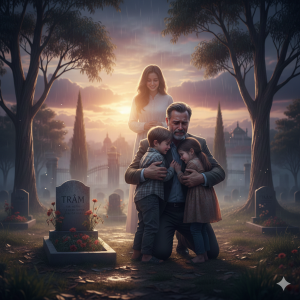
Dusk was descending slowly, stretching over the city’s outskirts. The sky was covered in a thin layer of mist, and the weak final rays of sunlight made the scene desolate, yet retained a fragile warmth. The road leading to the cemetery was long and winding, lined on both sides by tall eucalyptus trees; the wind whistling through them sounded deep and resonant, like the sigh of lost souls.
A sleek, black Maybach silently turned into the gate. It was the only luxury car in the area, and the man who stepped out was Mr. Minh, a billionaire famous throughout the country. But the Mr. Minh of this evening did not wear the cold, formidable, and powerful aura he displayed before the media or in billion-dollar deals. His posture was slightly stooped, his face haggard, and his eyes sunken from many sleepless nights.
Today marked the death anniversary of his wife—the only woman he had failed to make time to truly love over the years. He took slow steps, the sound of his shoes crunching on the dry leaves heavy, as if each step carried the weight of a regret.
Memories flooded back: the family dinners he missed because he was busy negotiating projects, the sudden business trips that left his wife lonely in their large mansion. And the last time he saw her in the hospital, her eyes weak but still trying to smile and comfort him. He had never forgiven himself for his neglect.
As he neared his wife’s grave, Mr. Minh suddenly paused. From a distance, he saw two small, solitary figures sitting close to an old tomb not far away. A boy of about 10 was holding a wilted bouquet of wild flowers, while a smaller girl leaned her head on his shoulder, her face smudged but her hands clutching an old pink handkerchief. Both wore shabby, worn-out clothes, and no adult was with them.
Mr. Minh frowned slightly. In the silent cemetery, the presence of the two children at this hour was truly strange, stirring an unnamed compassion. He hesitated for a few seconds, then decided to approach. But the closer he got, the more his throat constricted, for the children’s eyes held a transparent, absolute sadness and loneliness, unlike anything he had ever seen.
Development: A Fateful Encounter Under the Cold Sunset
He spoke in a hoarse voice, “What are you two doing here at this time?”
The children startled. The boy quickly stood up, shielding his sister as if afraid the man would harm them.
“We… we just came to visit our mother, sir.”
The sentence made Mr. Minh stand still. For a moment, he felt time stop. The wind blew through the trees, carrying the cold, damp smell of earth. And in that unsettling silence, his heart, which had hardened from years of solitude, trembled slightly. Although he hadn’t asked anything more, he knew that something deeply painful lay behind that simple reply.
After a few seconds, Mr. Minh looked closely at the two children. Their faces were gaunt, their noses still running slightly, their clothes faded from excessive washing. Yet, their eyes shone strangely, a mixture of fear and resilience. He forced his voice to be as gentle as possible: “Where is your mother buried?”
The boy did not answer immediately. He swallowed, looked at the little girl, then bowed his head and pointed to the cold, gray tombstone in front of them. “Here, sir.”
The grave was so simple that anyone would recognize it as the tomb of a poor person. No photo, no fresh flowers, no lights—only a small stone bearing the woman’s name and the date of her death, nearly a year ago. Mr. Minh slowly bent down to look. The woman was only in her early 30s, very young.
The little girl hugged the pink handkerchief to her chest, her round eyes welling up: “Today is Mom’s birthday, but we don’t have money to buy beautiful flowers. We only picked these wild flowers by the river.” Her voice choked.
The boy placed a hand on his sister’s shoulder, comforting her gently: “It’s okay, Mom loves us, she doesn’t need pretty flowers.”
Hearing that, Mr. Minh’s throat went dry. A cold wind blew through, making him shiver, not from the weather, but from the heartache swirling within him. He continued his inquiry, his voice low and slow, “Where is your father?”
The boy bit his lip hard. The girl burst into tears before her brother could answer: “Dad left us when Mom was sick. Mom is gone, and we only have each other.”
Mr. Minh stood frozen, unable to understand why this story caused him such pain. Perhaps it was because deep in his heart, there were still unhealed cracks—the cracks from the day he left his own wife alone in the hospital, with no one beside her.
He took a faint breath: “So where do you live? Who takes care of you?”
The boy stood tall, his gaze so determined it surprised Mr. Minh: “I take care of her. I wash dishes at a phở stall near the market. They let me work and give me a little money, just enough for rice.”
The little girl whispered: “And I collect cans to help my brother.” Her tiny hands were full of scratches.
In that moment, something collapsed inside Mr. Minh. He was a man who had once believed that money could solve everything, but now before him stood two children who had nothing but each other, and that very bond was the most precious thing.
He wanted to say something to comfort them, but suddenly realized he didn’t know how. The country’s richest billionaire, a man who could command the market, could not find a single consoling word for two orphaned children.
Finally, he could only utter a simple question: “Have you two had dinner yet?”
The boy shook his head. “No, sir, but we can eat later, we want to stay here a little longer.”
Seeing the children suppressing their hunger to sit beside their mother’s grave, Mr. Minh’s heart clenched. For the first time in many years, he clearly felt a familiar but long-lost sensation: pain for others. And he had a hunch that this encounter would not end here.
Climax: The Awkward Embrace in the Fateful Rain
The sun slowly disappeared behind the trees, leaving only a dark red sunset that cast a sorrowful pall over the cemetery. The wind began to strengthen, and darkness quickly set in. Scattered raindrops fell, cold and sharp. Mr. Minh looked at the two children trying to shelter each other from the drizzle, and his heart tightened. The wind lashed his face as if to remind him: if he left now, they might stay there until the rain intensified, shivering and unknown to anyone.
He slowly took off his expensive woolen coat and draped it over the two small shoulders. “It’s going to rain heavily soon, let’s go home.”
The boy backed away, looking at Mr. Minh cautiously. “Sir, we don’t have money, we can’t go with a stranger.”
The words made Mr. Minh stop. A ten-year-old child already had to be this wary of adults; what had he endured? He spoke softly: “I don’t want anything from you, I just want to take you home. Wherever that is, I’ll drive you there.”
The boy bit his lip. “We don’t have a home.”
The little girl tugged at Mr. Minh’s sleeve, her voice trembling, “Sir, we live in that old rental room behind the market. The landlord is about to kick us out because we don’t have money to pay the rent.”
Mr. Minh looked straight into the children’s eyes. In that moment, he realized something: they didn’t need pity. They needed someone to stand by them. He took a deep breath: “So, would you two like to come home with me, have dinner, take a bath, rest, and we’ll figure things out tomorrow?”
The boy stared at him intently, trying to discern if the man before him was genuinely kind or just an exploiter. After a long moment, he nodded very softly. “Yes, sir, if you promise not to hurt us.”
A sad smile flashed across Mr. Minh’s lips: “I will never hurt you.”
Walking up to the luxurious Maybach, the children’s eyes widened. The little girl whispered, “Is this your car?”
“Yes, it is.”
The boy awkwardly stood in front of the car door, quickly trying to cover a stain on his pants. “Sir, we’re very dirty, what if we get your car dirty?”
A seemingly ordinary remark, yet it choked Mr. Minh’s throat. The two children were so poor that they were afraid of staining something that did not belong to them.
He opened the door, bending down to the boy’s eye level: “Get in. This car was bought to carry people, not to be displayed.”
The rain began to fall heavily, the drops drumming on the car roof as the door closed, enveloping the space in a warmth that contrasted sharply with the storm outside. In the rearview mirror, he saw the little girl fall asleep on her brother’s shoulder from exhaustion. The boy, however, kept his eyes wide open, staring out the window, as if unable to believe that life could suddenly take a different turn.
Mr. Minh glanced at the two children, and a feeling he didn’t remember when he had forgotten surged within him: the urge to protect someone. As the car left the cemetery, Mr. Minh knew his decision to take them was no longer a temporary act of help, but a major turning point—not just for their lives, but for his own.
The glossy black car slowly turned onto the private road leading to Mr. Minh’s villa. A vast estate with white walls and neatly trimmed gardens, the warm yellow lights bathing every corner made the entire space feel like a world completely different from the one the two children had just left.
When the car stopped in front of the grand hall, the boy immediately woke his sister. “Wake up, I think we’re here.”
The little girl rubbed her eyes, looked up at the massive villa, her eyes wide and round. “Brother, is this his house?”
Mr. Minh turned on the interior light, his voice gentle. “Yes, this is my house, but from now on, you can consider this your home.”
The simple statement made the boy freeze. He said nothing, but his hands unconsciously gripped the hem of his old shirt, as if he dared not believe it could be true.
The first steps into another world.
Inside, the two children immediately stood frozen. The floor was so shiny it reflected their images. The faint, sweet smell of food wafted from the kitchen, and the soft yellow light made the place warmer than any room they had ever known.
The little girl asked nervously, “Sir, can we take off our shoes? In rich people’s homes, we’re afraid of making things dirty.”
Mr. Minh bent down and took off the girl’s tiny shoes. “This is your home now, just act as if you were at home.”
The boy hesitated: “What if we break something?”
“I don’t care about objects. I only care about whether you are safe.”
The words were enough to make the boy’s eyes redden, but he still tried to hold his head high to appear strong. Mr. Minh realized this boy had endured so much that he was accustomed to not allowing himself to be weak.
The most memorable dinner of the children’s lives.
The housekeeper quickly prepared a simple but hot dinner. When the plates of food were brought out, the little girl swallowed hard, and the boy subtly pulled her closer as if afraid this food was not meant for them.
“Eat, both of you,” Mr. Minh said, his voice soft but firm.
The boy bowed his head. “Sir, please just give us a little, we’ll be leaving soon, we won’t stay long.”
Mr. Minh put down his chopsticks and looked directly at the boy. “You are not going anywhere. You are staying here tonight.”
The little girl was bewildered. “Staying to sleep too, sir?”
“Yes. Tonight, and maybe many more days to come.”
Both children froze, as if someone had granted them something they had never dared to dream of.
Called by name for the first time.
After dinner, Mr. Minh asked, “What are your names?”
The boy replied, “Sir, my name is Khải, and my sister’s name is Mi.”
Mi held her brother’s hand and whispered, “Will you remember our names?”
Mr. Minh smiled faintly, a smile he hadn’t genuinely felt in a very long time. “Mi and Khải. They are beautiful names, I will remember.”
Both children looked at him, unable to believe that a man like him would remember their names.
The first night.
Mr. Minh took them to a clean, empty room with two small beds, the white blankets soft as clouds. Khải touched the blanket and quickly withdrew his hand. “This is too clean, if I lie down, I’ll get it dirty.”
Mi pulled her brother. “Brother, the sir said this is home now. He won’t be angry.”
Khải remained silent. In his eyes, the familiar feelings of poverty, fear of being kicked out, fear of bothering others, fear of making mistakes, still clung tightly. Mr. Minh looked at the two children and said softly, “From now on, you don’t need to be afraid of anything while you are here.”
As he left the room, Mr. Minh closed the door but stood in the hallway for a moment. Through the crack, he saw Mi hugging the blanket to her face, smelling the scent, and then giggling. Khải sat still, his eyes looking out the window, his face half-believing, half-doubting.
He understood that feeling, because many years ago, he too had lived a childhood yearning for safety like that.
And that evening, for the first time in many years, he did not drink, did not read reports, and did not review contracts. He sat alone in the living room, looking up at the second-floor staircase, where two children were sleeping. A feeling surged in his heart that he thought had died the day his wife passed: The feeling of having someone waiting for him to return.
The next morning, the sun had barely risen above the treetops when the villa was more lively than usual. Mr. Minh usually woke up early to jog around the garden, but today, as he stepped downstairs, he heard rustling sounds from the kitchen.
He approached. On a high stool near the kitchen counter was Khải, trying to stand up to reach the egg pan. Little Mi stood on the floor, holding a tiny bunch of herbs, her eyes wide as if she were a sous chef in a grand restaurant.
The housekeeper stood next to them, both amused and worried. “Let me do it, you’re too small.”
But Khải shook his head. “No, ma’am, I must help. In other places, people let me eat, so I have to wash dishes. Here, the sir lets me eat, so I must help in return.”
Mr. Minh stood stunned at the kitchen doorway. The sentence pierced his heart in an indescribable way. These two children had been accustomed since childhood to not receiving anything for free, used to paying their own price for existence.
The most warming, albeit imperfect, scrambled eggs.
“What are you two doing?” Mr. Minh asked.
Both children jumped and turned around. Khải stammered, “S-Sir, we’re making breakfast for you.”
Mi nodded vigorously. “I helped my brother pick herbs. I’m very good, sir.” Her voice was filled with pride, completely different from her shyness last night.
Mr. Minh let out a soft laugh, a rare genuine smile that he hadn’t truly felt in years. “Alright, let me see what Chef Khải and Assistant Mi are cooking.”
In the pan, Khải’s egg was half burned, half cooked. Mi’s herbs weren’t washed properly, still mixed with a few grains of sand. But as the two children placed the plate of eggs on the table, standing straight with expectant eyes, Mr. Minh felt his heart soften.
“It’s delicious,” he said, cutting a piece.
Khải watched him intently. “Really, sir? I think it’s a little burnt.”
“Slightly burnt, but delicious.”
Mi crossed her arms over her chest, imitating an adult. “You have to eat all of it, because picking the herbs was very hard work.”
The remark filled the dining room with laughter.
The scars not on the skin.
After breakfast, Khải was given a warm bath by the housekeeper. When the boy took off his shirt, she froze. On his back were old bruises, and several long scars, as if he had been beaten with a stick or electric cord.
She panicked. “Oh my god, Khải, what are these marks? Who hit you?”
Khải only bowed his head, his voice so low it was almost inaudible: “Dad hit. Mom covered me, so… so he turned and hit Mom.” The boy swallowed back tears.
The housekeeper turned pale, rushing out to call Mr. Minh.
When he walked in, Khải immediately retreated, pulling his old shirt to cover his back. “I’m fine, I’m used to it… used to it.”
Those two words stabbed Mr. Minh’s heart like a cold knife. He knelt down, slowly saying, “No one is allowed to hit you again. No one.”
Khải looked up, his gaze not of fear, but of disbelief. Like a little bird whose wings had been broken too many times. Now, even with the cage door wide open, it still thought that if it let down its guard for a moment, it would be harmed again.
After a long time, Khải finally spoke: “Mr. Minh, you won’t abandon us, will you?”
The question choked him. He placed his hand on the boy’s head, squeezing gently. “I don’t promise many things, but I promise this: As long as you want to be here, I will never abandon you.“
Khải bit his lip, tears falling. It was not the cry of a child; it was the sob of a person who had endured too much pain, so much so that now, when offered an embrace, he didn’t know how to receive it.
The first days full of wonder.
The whole day, Mi ran happily through the flower garden, occasionally picking a small bloom and running in to show it off. “Mr. Minh, look, I found this beautiful flower for Mom.”
Khải helped the staff with chores around the house, from sweeping leaves to helping wipe tables, although no one asked him to. The two children did not know that their presence had filled the void in the house that had been silent for many years.
Night fell, Mr. Minh sat alone in his study, looking at company files but unable to focus. In his mind, only Khải’s question echoed: “You won’t abandon us, will you?”
And in that very moment, Mr. Minh understood one thing: his life had taken a different turn from today. Not from a huge business deal, not from a billion-dollar investment, but from two children standing trembling beside an old tomb in the evening rain.
That afternoon, the rain drizzled, the sky was dull gray, as if sympathizing with the sorrow of the three small souls trembling amidst life’s upheaval. Đức (formerly Mr. Minh) stood before the two children (now Liên and Minh), his gaze heavy as he wrestled with something buried deep for many years.
“Children,” his voice hoarsened, “I have something to tell you.”
The two siblings held their breath, Liên unconsciously clutching Minh’s hand.
“I once knew your mother.” The sentence dropped heavily like a stone.
Liên looked up, her lips trembling. “What do you mean, sir?”
Đức sighed, his eyes red and teary—a sight no one had ever witnessed in the cold, undefeated billionaire. He raised a hand to his face and recounted: “More than 10 years ago, I had a relationship, but because of work, because of too many things in life, I let that woman slip away. I didn’t know she was pregnant, and I didn’t know I once had the chance to be a father.”
Liên froze. Minh stared at him without blinking.
“Your mother’s name was Trâm, wasn’t it?” Đức asked, his voice choked.
Liên burst into tears. “Yes… yes, sir! How do you know her name?”
Đức pressed his lips together, a tear falling. “Because Trâm was the person I loved the most in my life.” The statement left the two children stunned.
He continued, his voice trembling: “Your mother never told me anything. I searched for her for years, but I never expected to find her here, with only a cold grave remaining.”
Liên fell to her knees, her trembling hand placed on the edge of her mother’s grave. “Oh God, Mom…”
Minh sobbed, crying out desperately for the first time: “Mr. Đức, does that mean you are really our father?”
Đức knelt down too, hugging both children tightly, a clumsy, shaky but loving embrace. As if he was afraid that if he let go, everything would vanish.
“If you allow me, I want to make amends, I want to be your father, even if only from now on.”
Liên looked up, her face streaming with tears. “Mom always told us to believe in good things. If Mom were here, I think she would want this too.”
Minh nodded repeatedly, still sobbing. “I want a dad too.”
Đức hugged them tighter, his tears soaking into the children’s hair. “It’s Dad who apologizes for coming too late.”
Conclusion: Children’s Laughter in the Grand House
One month later, at Đức’s grand villa, for the first time in many years, the sound of children’s laughter echoed. Liên and Minh were back in school, eating meals that truly felt like family dinners, and sleeping without the fear of being separated or sent to an orphanage.
In the evening, Đức stood on the balcony, looking up at the sky, and softly spoke: “Trâm, I promise to take care of our children on your behalf. Thank you for sending them to save me from the loneliness I created for myself.” The gentle wind blew, the leaves rustling as if responding from heaven.
The ending that brings millions to tears.
A cold billionaire, who seemed to have everything, finally realized that the greatest fortune of his life was the family he had nearly missed. Two children who lost their mother finally found the love that life had owed them for so long.
And in the moment when the three of them held hands before the grave of the unfortunate woman, people finally understood: not money, but love is the only thing that can save a person from solitude.
Disclaimer : This content may be created by AI for entertainment purposes. Any resemblance to real persons, events, or places is coincidental.