A Shocking End for the Arrogant Police Officer in Broad Daylight.
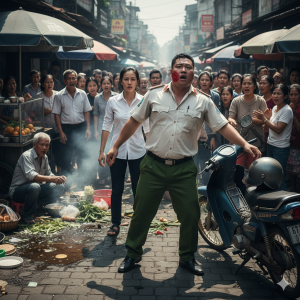
Have you ever seen it? A man in uniform, in broad daylight, publicly striking the face of a poor citizen, then laughing, defiant, as if the law were nothing but a toy in his hands? Have you ever seen someone dare to stand up and say, “Enough,” only to receive a slap of their own, this time inside the very station that represents power, before a man who declares, “I am the law here”?
That night, a text message: Don’t think you’ll live in peace.
This isn’t a movie. This is what crawls in the shadows—a filth more toxic and more dangerous than you can imagine. Are you sure you can handle the truth?
It was 10 AM, and the Hanoi summer air was thick enough to choke on. I pulled my medical mask up and buttoned my plainest shirt. No one here knew I was the Provincial Director of Police, a woman who had personally ordered the capture of dozens of dangerous criminals. Today, I wore no rank, had no motorcade, and no entourage. It was just me, moving through the crowd, needing to see how my people were living, underneath the shadow of the power I represented.
The chop of cleavers, the roar of motorbikes, and the stench of sweat and gasoline merged into the suffocating miasma of the central market. Amidst the chaos, I saw a small cart selling bánh gối—fried dumplings. An elderly man, well over fifty, his back permanently stooped and his hair thin, was nimbly folding the dough, his hands trembling slightly. The pop and hiss of the hot oil threw a warm, fragrant steam that pulled me back to my childhood, to the first dumpling my mother bought me as a reward for good grades.
I smiled and stepped forward. “Uncle, I’ll have a few, please.”
He looked up, his kind eyes crinkling. “Right away, miss. Just a moment.”
A screech of tires tore the air. A police motorbike skidded to a halt, boxing in the cart. A large man in a police uniform, unbuttoned and sloppy, swung his leg off. I recognized him immediately. Lieutenant Vinh. Notorious in the lower precincts for his arrogance and aggression. He tossed his helmet onto the seat and barked, his voice a gravelly command.
“Hey, old man! Give me one. Quick.”
The old man fumbled with the tongs, his hands shaking so badly he splashed hot oil on his own arm. He winced but didn’t dare make a sound. I stood right beside the cart, my blood beginning to simmer. Vinh took the dumpling, devouring it in two bites, grease dripping down his chin. He leered at me.
“What’s this, pretty girl? You hungry, too? You want one, just say the word. I’ll give it to you.”
I ignored him, my eyes fixed on his. He finished, wiped his mouth on his sleeve, and started his bike, the engine roaring. He hadn’t paid.
The old man’s voice was barely a whisper. “Sir… the money for the dumpling…”
The question was buried under Vinh’s roar. “What? You dare ask me for money?”
BOP!
The sound of the slap was as sharp as a whip crack. It echoed, silencing the market’s noise. The old man crumpled, landing on his knees. A bright red handprint blossomed on his cheek, and a trickle of blood ran from the corner of his mouth. He bowed his head, terrified, as if cowering from a demon.
I could no longer stay silent. I stepped forward, my voice cold. “Lieutenant Vinh, what do you think you’re doing? You assault a citizen after refusing to pay for your food.”
He spun around, not recognizing me. “Mind your own damn business, or I’ll shut you up.”
He slapped me.
The world froze. All sound died. I stumbled, tasting the salt of blood in my mouth. I looked him dead in the eyes, my gaze perfectly level.
“You are an officer of the law, and you are trampling on it. Stop now, or you will pay the price.”
Vinh laughed, a cold, sharp sound. “Pay the price? Who the hell do you think you are? I’m the police here. I could arrest you right now. Get lost!”
To punctuate his threat, he kicked the cart. He kicked it with all his force. The heavy vat of boiling oil overturned, flooding the pavement in a sizzling, smoking wave. The smell of burning dough and scorched plastic filled the air. The old man, trembling, crawled on the ground, trying to salvage a few blackened dumplings, his tears mixing with the grease. The crowd just watched, their heads down, their fear palpable.
Vinh sped off, leaving a cloud of exhaust and humiliation. I turned to the old man. His eyes were red. “Miss… don’t get involved,” he pleaded. “He’s dangerous. He comes by all the time, never pays. If anyone says anything, he threatens to arrest them.”
I looked at him, my voice as hard as steel. “It’s okay, Uncle. I will get justice for you. He won’t get away with this.”
I knew, in that instant, a game of power had begun. And this time, the arrogant would learn what it means to fall.
That afternoon, I looked in the mirror in my office. My lip was split, and the red outline of Vinh’s hand was still clear on my cheek. A Lieutenant had dared to strike his superior officer, in public, in front of civilians. Not because he was brave, but because he was certain he was untouchable.
The problem wasn’t just him. It was the system that made him feel invincible.
I decided to go to his station. Alone. I didn’t change. I wore the same simple shirt, the same dark skirt, my bruise on full display. I wanted to see how they would treat a regular citizen with a complaint.
The Thanh Xuan police station had a smell I despised: old cigarettes, stale sweat, and the foul odor of unearned confidence. Three officers were behind the duty desk, feet up, uniforms unbuttoned, laughing. They looked at me like prey that had wandered into a lion’s den. I walked past them, toward the office marked “Station Chief.”
Sơn. I knew the name. Internal reports flagged him for “soft settlements”—intimidating complainants into dropping their cases. He was the root.
He looked up, his eyes narrowing, sizing me up. He didn’t know who I was. Perfect.
I closed the door. “I am here to file a formal complaint against Lieutenant Vinh,” I stated, my voice level. “He assaulted an elderly vendor, destroyed his property, and refused to pay for goods. When I objected, he assaulted me in the middle of the market. I demand a report be filed and he be processed immediately.”
For a split second, I saw his eye twitch. Then it was gone. He leaned back, lacing his fingers behind his head, and smirked. “You talking about my Vinh?”
My Vinh. Not “our officer.” Not “our comrade.” My Vinh. His territory. His property.
“He assaulted a citizen and threatened illegal arrest,” I said. “This is a felony, not a minor dispute.”
SISTO, he slammed his hand on the desk, his face changing. “Over a damn dumpling? Over a few thousand bạc? You storm into my office and tell me how to do my job? Who the hell do you think you are?”
I didn’t flinch. “I am not giving orders. I am reporting a crime.”
He laughed, a cold, contemptuous sound. “Listen to me,” he said, jabbing his finger toward my face. “I am the commander here. I decide what is a crime and what isn’t. Here, I am the law. You understand?”
I spoke softly, my words like a razor. “You just said that in front of a witness.”
He hesitated. And then, without warning, he slapped me.
It was a full-forced, open-handed strike. It wasn’t about anger; it was a message. This is not your territory. You have no right to speak. My head snapped to the side, the smell of tobacco from his hand filling my nose. I knew the officers in the hall heard it. No one came. No one said, “Chief, calm down.” This was normal. This was systemic.
I turned my head back, my eyes locking onto his. “You just assaulted a complainant,” I said, my voice dangerously quiet. “Inside a police station. You also refused to accept a formal report. I am informing you that as of this moment, you and Lieutenant Vinh are under official review for suspension and investigation.”
He looked at me, a flicker of something new in his eyes—not fear, not yet, but… interest. Then he tried to cover it with his usual bravado. “You little bitch. You think you can threaten me? I’ll have you thrown in a cell right now, you hear me?”
I stepped back, my hand on the doorknob. “You don’t know who I am, Sơn. But you will. And by then, it will be too late.”
I walked out. The hallway was silent. I heard them whispering behind me. “Who the hell was that?” “Probably some high-level official’s kid.” “Nah, just posturing.”
I stepped out into the blinding sun, my face burning. In all my years, I’d faced down murderers and drug lords. But I had never felt a filth like the one I just walked out of. A place meant to protect people had become a fortress of arrogance. This wasn’t a case of two bad cops. This was a nest.
I pulled out my phone. I saved the audio recording I had secretly made of the entire encounter. The slaps. The threats. “I am the law.”
The game was over.
The next morning, the main auditorium at Provincial Headquarters was packed. Every station chief was there. In the back, the media had set up their cameras.
I walked onto the podium. I didn’t offer greetings or pleasantries. I plugged my phone into the main sound system and pressed play.
The audio filled the hall, crisp and clear. The sounds of the market. Vinh’s arrogant voice. The old man’s plea. The sharp, wet smack of the first slap. The second slap. Then, the recording from the station. Sơn’s voice, dripping with contempt: “Here, I am the law.” And finally, the sickening sound of the third slap.
The room was so quiet I could hear the air conditioners hum. I saw men shifting in their seats. I saw a colonel in the front row clench his fist.
I looked down at the two men I had ordered to sit in the front row. Vinh and Sơn. Their faces were sheet-white. The arrogance was gone, replaced by the raw, primal fear of men who had been caught.
“I believe,” I said, my voice ringing out, “that when an officer publicly threatens to arrest an innocent citizen, that is not a ‘conduct’ issue. It is the crime of abusing power. And when a station chief strikes a citizen who has come to file a complaint, inside his own office, that is not ‘internal discipline.’ It is a violent obstruction of justice.”
I held up a file. “Effective immediately, Lieutenant Vinh and Station Chief Sơn are suspended from duty. I am ordering you to stand.”
They rose, trembling.
“We… we just made a mistake,” Sơn stammered, his voice cracking. “We didn’t mean it…”
“A ‘mistake’ is when you drop a glass,” I cut him off, my voice like ice. “It is not when you methodically threaten, assault, and then cover up your crimes. That is not a mistake. That is intent.”
Two internal affairs officers walked up to them. The Provincial Colonel, my superior, gave a single, sharp nod.
“Hand over your badges and service weapons. Now.”
The sound of the badges being unclipped was the loudest thing in the room. I watched their faces. This was the moment of their unmaking. They were no longer the law. They were just two men, exposed and humiliated, their power stripped from them in front of their peers and the rolling cameras.
I stepped closer to them, speaking just loud enough for their ears and the podium mic. “You’re used to standing over people. From now on, you will stand before the law.”
Then, I addressed the entire room. “Let the record show: before the law, there are no exempt zones. Not for a lieutenant, not for a station chief, and not for a director. Not even for me. If we fail, we will be held accountable.”
The investigation began immediately. That evening, we brought the old man in. He was terrified. “If I tell the truth,” he whispered, “will I still be allowed to live?”
I looked him in the eye. “I give you my personal guarantee. You will be safe.”
And so he talked. He told us it wasn’t just Vinh and Sơn. He told us about the systemic extortion. How they threatened to confiscate his cart if he didn’t feed them. How they called it the “Sơn tax.” He told us about the name they all used for the station chief. Not “Chief Sơn.” They called him “Anh Sơn,”—Big Brother Sơn. The backer. The one who told them, “Go ahead, don’t worry about it.”
He wasn’t just a cop. He was a mob boss.
That night, I drafted the final resolution. This was not a suspension. This was not a “profound self-criticism.”
I signed the order: Permanent dismissal from the police force, stripping of all ranks and titles, and immediate transfer of the case to the Criminal Investigation Bureau for prosecution. No probation. No second chances.
The next morning, I did not wear my uniform. I put on a simple, red áo dài. I did not cover the bruise on my face. I wanted everyone to see it. I returned to the market.
The moment I arrived, the noise of the market died. The vendors stared, wary. I walked straight to the old man’s cart. He was there. He saw me, and his eyes, which had been so full of fear, filled with tears.
“You… you really came back,” he stammered.
I nodded. “Sell me a dumpling, Uncle.”
I took out my wallet and, very slowly, very deliberately, paid him. I spoke loud enough for the gathering crowd to hear. “This is for your labor. This is for your skill. This is money you have earned.”
A woman nearby burst into tears. “My god,” she whispered. “Someone finally said it.”
I turned to the crowd. “I have an announcement. The men who harassed you, who struck this man and destroyed his property, have been fired. They have been stripped of all authority. They have no power here anymore.”
A stunned silence, then a wave of whispers, of sobs, of disbelieving laughter. A man ran up, “Miss, is it true? They’re gone? They won’t come back?”
“They will never come back as police officers,” I said. “And if they come back as common thugs, they will be arrested like any other criminal.”
A little girl, no older than ten, stepped out from behind her mother’s stall. She looked at me, not with admiration, but with the weary, assessing gaze of a child who has seen too much.
“Miss,” she asked, her voice clear, “will they still beat my mom now?”
The question struck me harder than Sơn’s slap. I knelt to her level. “No,” I said, my voice thick. “If anyone in a uniform ever dares to hit your mom again, they will be led away in handcuffs. Do you understand what ‘led away’ means?”
She nodded. “I’ve seen it. I just… I didn’t know they could be led away, too.”
I stood up and faced the market. “The police are not a license to assault. And police who shame justice,” I said, my voice ringing out, “are no longer police.”
A smattering of applause started, then grew. It wasn’t cheering; it was a heavy, rhythmic sound. It was the sound of fear finally being buried.
As I drove away, I knew I hadn’t cleaned up the whole city. But I had planted a flag in the middle of that market. A flag that said: Do not touch the people.
Back in my office, I received a confirmation. The criminal prosecution was underway. The arrogant officers were, at this moment, being processed.
That night, I sat alone in the dark. My phone lit up. A new, unknown number. A single text message.
“You think you won? You only touched the outer layer. Don’t let more people get hurt.”
I read it, and a slow smile spread across my face. So. It wasn’t just a nest of two. I had just kicked open the door to a sprawling, hidden network, and now, they were scared. They were watching me.
The story wasn’t over. It had just begun.
Disclaimer : This content may be created by AI for entertainment purposes. Any resemblance to real persons, events, or places is coincidental.