The Billionaire’s Son Was in Danger and Everyone Stood By, but the Vegetable Seller Unexpectedly Rushed In to Rescue Him and Changed Her Life.
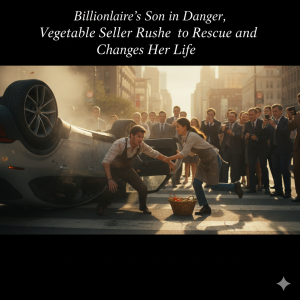
The air hung heavy with the mixed aromas of the late-day market: fish sauce, rice vermicelli soup, and the exhaust fumes of motorbikes. It was a chaotic symphony of farewell, a scramble of vendors packing up and hurried customers snatching the last bundle of greens for the evening meal. This was the backdrop to Mai’s life—a tireless existence spent selling vegetables on a precarious corner, her worn clothes and scarred hands telling the story of relentless struggle. She was a silent participant in the market’s hustle, asking for nothing more than a quiet, honest living.
Unbeknownst to her, a storm was brewing just beyond her little stall. It involved Khoa, the seven-year-old son of Mr. Lâm, a powerful local tycoon. The boy, small and frail, suddenly darted out onto the slick, narrow road, clutching a cherished plastic toy car.
In that instant, the market’s noise died. The screech of a heavy truck’s brakes, a visceral, agonizing sound, sliced through the momentary silence. Time seemed to stop as the colossal vehicle bore down on the child. The crowds froze—a hundred pairs of eyes locked in horror, a hundred voices choked by indecision. Everyone saw the danger; no one moved.
But in the heart of the chaos, Mai’s ingrained instinct for life, honed by years of hardship, took over. Without a thought for herself or the lingering pain in her old wounds, she flung her basket of water spinach to the ground. In a blur, she lunged onto the slick pavement, seizing the boy and pulling him to the curb just as the truck’s enormous wheels screeched to a halt mere inches from them.
They lay huddled together, shaken but alive, the scent of hot rubber and pulverized dirt swirling around them. The market found its voice again, erupting in gasps and cries of relief, but the relief soon curdled into something far more toxic.
The aftermath of the rescue was immediate and brutal. Mr. Lâm, the billionaire father, a man clad in a crisp white shirt, rushed out of his luxury car. His eyes, usually cool and commanding, were now bloodshot with panic. He swept his son into his arms, but when his gaze fell upon Mai—dirty, scraped, with blood welling on her arm—his relief was instantly overshadowed by a deep, ingrained suspicion.
“Why are you holding my son?” he demanded, his voice flat and accusing. “Are you trying to stage a heroic scene to gain fame?”
Mai, still breathless and shocked, was utterly blindsided. Her honest act was being twisted into an opportunistic plot. The crowd’s whispers, fueled by the cynicism of the modern age, rapidly turned the narrative on its head.
“Look how tightly she’s holding him! It must be a set-up.” “Everyone’s faking these days. She probably wants to snag the rich guy.”
These cruel words, echoing a past trauma where she was falsely accused and abandoned, stabbed Mai deeper than any physical scrape. Her heart, which had been open in a moment of pure humanity, slammed shut. She wanted to argue, but she knew the futility of it: when people want to believe the worst, truth becomes mere excuse.
The gossip exploded online. On the neighborhood chat groups, posts complete with highly edited, zoomed-in photos of Mai embracing Khoa circulated wildly, the captions mocking her as the “vegetable seller pretending to be a hero to hook a tycoon.” The accusations felt like tiny, ceaseless needle pricks, driving Mai to despair in the isolation of her tiny, damp rented room.
Despite the relentless slander, a fragile light appeared. A private message popped up on her phone from a kind market friend: “Don’t be afraid. Just believe. An upright tree doesn’t fear a standing death. Just be honest, and heaven will see.”
The next morning, Mai forced herself back to her stall, her heart sinking as customers avoided her gaze and whispered behind their hands. Her honest, fresh vegetables went untouched. Just as she was about to surrender to tears, a small, familiar figure appeared: little Khoa.
He stood silently by her stall, his white shirt crumpled, his eyes red. He gingerly placed a coin on her counter. “I bought vegetables to see you,” he whispered, his voice shaking. “I’m afraid my dad doesn’t believe you, but I do.” Then, with the innocence of a child, he pulled a dolphin-shaped band-aid from his pocket and pressed it onto her scratched arm.
His genuine trust was Mai’s lifeline. She gave him a sweet cake and a small bottle of water, reassuring him in a soft voice, “Your dad is just confused. Adults are sometimes afraid of being tricked, so they see things the wrong way. But one day, everything will be clear.”
Later that day, Mr. Lâm and his haughty sister-in-law, Mrs. Phượng, reappeared. Mrs. Phượng openly scorned Mai as a “market girl” trying to get near their respectable family. But the boy clung fiercely to Mai, crying out, “I don’t want to leave you!”
Back home that night, Mr. Lâm, drowning in suspicion and worry, was confronted by his son. Khoa, usually withdrawn, spoke clearly: “Because she loves me, she won’t abandon me… like Mom did.”
This simple, devastating sentence shattered the billionaire’s carefully constructed walls. He suddenly saw his son’s emotional emptiness, an emptiness he had failed to fill with his wealth. He realized that Mai’s compassion, dismissed by him as a ploy, was the one thing his son desperately needed. His heart finally developed a crack, allowing a sliver of doubt to creep in about his own rigid judgment. He gently sent Khoa to bed, then looked at the little bouquet of wildflowers the boy had carried from the market, a fragile but powerful symbol of the truth.
The storm continued to rage. The local gossip intensified, fueled by a sensationalist tabloid article and a new, maliciously edited video clip suggesting Mai had meticulously staged the rescue. Mai maintained her dignity, refusing to engage in the mudslinging, but she carefully collected every piece of evidence of the slander.
The turning point came one afternoon at the local café. While a group of gossips, led by the neighborhood manager, Mr. Lợi, were avidly watching the fake clip, a seemingly insignificant figure stood up: Mr. Tùng, a Grab motorbike driver.
“Wait a minute!” Tùng announced, his voice ringing through the room. “I was there! I rode past that day. She risked her life! That clip is fake. I know a reflex rescue when I see one.”
This testimony, though sincere, wasn’t enough to quell the tide. But later that evening, Tùng, overcoming his fear of the powerful Mr. Lâm and the influential community leaders, arrived at Mai’s meager room. He presented her with a worn USB stick, wrapped carefully in plastic: the original dashcam footage.
Mai, Ms. Sáu Hạnh, and Tùng watched the chaotic video. It was undeniable: the sheer speed of the truck, Mai’s desperate leap, the moment her body shielded Khoa—a pure, uncalculated act of sacrifice. The sight validated every ounce of Mai’s suffering.
Following the advice of the kind neighbors and the local security chief, Mai publicly shared the original, unedited clip online, carefully blurring Khoa’s face. The online world, momentarily silenced, quickly began to shift its allegiance. Apologies started to trickle in.
The final confrontation took place at the crowded Community Culture House. The local authorities presented their findings: the video was authentic. Then, Mr. Lâm, visibly aged by the ordeal, stood up. He not only apologized again but, using his company’s resources, produced damning evidence: Mr. Lợi, the seemingly respectable neighborhood manager, was the one who had fabricated and disseminated the fake photos and slanderous claims, fueled by an unknown malice.
The atmosphere exploded. Mr. Lợi tried to flee, but he was cornered, his web of lies shredded. Mrs. Phượng, now in tears, rushed to Mai to apologize. Mr. Lâm, standing tall before the community, his voice heavy with regret, stated: “I was wrong, too. Thank you for saving my son.
The cloud of prejudice was finally lifted. Mai’s vegetable stall became a beacon of honesty and goodwill. Customers flocked back, not just to buy, but to offer heartfelt apologies and support.
Mai, no longer merely surviving, started giving back. She placed a small, wooden charity box on her stall with the motto: “A bite when starving is worth more than a pouch when full.”
Then, Mr. Lâm arrived for the last time. He approached Mai, his eyes no longer cold, but filled with a humble tenderness. Khoa rushed out of the car, clutching a beautiful bouquet of white daisies.
“Ms. Mai,” Khoa whispered, his voice clear and resonant, “I have a mother now.”
The market stood still, many wiping away a sudden tear. Mr. Lâm stepped closer and spoke, his voice steady: “Ms. Mai, thank you for everything. I was wrong. I say my apology before the community, before you, and before my son.”
He then pledged to make substantial monthly contributions to Mai’s fund, dedicating his wealth to helping disadvantaged children—a genuine act of repentance. Mrs. Phượng offered to volunteer her time. Mai, her heart healed, smiled serenely. “I hold no grudges,” she said. “We shouldn’t strike the one who runs back. If we can love each other, let’s love a little more.”
As the market settled into its new, peaceful rhythm, Mai held Khoa’s small hand, their bond now recognized and protected. She led him through the familiar rows of stalls, stepping out of the darkness of false accusation and into the clear light of truth. Her final self-reflection echoed the core of the tale:
“There are times when we will be misunderstood, scorned, and even pushed to the brink. But if we maintain a pure heart, time will be the clearest answer. Wealth may only be external, but decency and humanity determine a person’s true value. Only by weathering the storm do we know who is truly by our side.”
Disclaimer : This content may be created by AI for entertainment purposes. Any resemblance to real persons, events, or places is coincidental.