When my son told me I wasn’t welcome for Christmas, the words landed with a strange softness, like snow falling on a grave you didn’t know had already been dug. I didn’t argue. I didn’t ask him to repeat himself or pretend I hadn’t heard. I didn’t raise my voice or let anger rush in to protect my pride. Instead, I smiled, nodded, picked up my coat, and walked out to my truck. At the time, Michael mistook that smile for acceptance, maybe even maturity. He didn’t understand that it was something far more final. That smile was the sound of a door closing quietly inside me, not in bitterness, but in clarity. It was the moment I understood that whatever version of fatherhood I had been clinging to no longer existed in the place I thought it did. As I drove away, Christmas lights blurred along the streets, glowing softly in windows that still belonged to families who wanted one another there. I felt no urge to turn around, no dramatic rush of regret. Just a deep, settling stillness, the kind that comes when denial finally loosens its grip. I had spent years adjusting myself to fit into a life that no longer had room for me, and in that instant, I realized how tired I was of shrinking.
The moment itself had arrived almost politely, dressed in calm voices and reasonable tones, which somehow made it worse. Earlier that afternoon, we had been sitting in the living room, sunlight slanting across the polished floors, when I made what I thought was a harmless offer. “I could cook this year,” I said. “My turkey. The one with sage stuffing your mother loved.” I hadn’t said her name in weeks, careful not to burden them with memories they preferred neatly packaged. The change in the room was immediate and unmistakable. Michael’s shoulders tightened. His gaze slid away from mine and settled on a decorative bowl that had never held anything real. When he finally spoke, his voice carried that careful gentleness people use when they believe kindness will make cruelty acceptable. “Dad,” he said, “you won’t be able to spend Christmas here. Isabella’s parents are coming. They’d prefer if you weren’t.” The words hovered between us, clean and devastating. I looked around the house—silk curtains, designer furniture, carefully curated details—and saw not luxury, but history. I saw the mortgage payments I had helped cover, the renovations I had quietly funded, the early mornings and late nights that had built the foundation under their comfort. “Then where should I go?” I asked, not because I didn’t know the answer, but because I wanted to hear what he thought my place was. He suggested other relatives, another weekend, another time, as if Christmas were flexible, as if belonging were something that could be rescheduled without consequence.
I stood without drama and walked through the house that no longer felt like mine, past framed photographs where my presence had slowly been reduced to background, past closets full of coats I had helped buy, toward a door I suddenly realized I had been standing outside of for years. “Tell Isabella’s parents something for me,” I said, my voice steady. “Feliz Navidad.” The cold December air hit my face when I stepped outside, sharp and bracing, like truth finally spoken aloud. As the door closed behind me, there was no slam, no raised voices, no theatrical exit—just a quiet finality that didn’t need punctuation. In my truck, as I sat with the engine idling, the numbers arrived uninvited, marching through my mind with merciless precision. Two thousand eight hundred dollars every month. Five years. One hundred and forty thousand dollars transferred quietly, consistently, so their life could begin without strain. Streets I had refinanced so they could travel. Savings I had loosened because I believed support was love. What was meant to be temporary had settled into permanence without gratitude, becoming an entitlement so ingrained it no longer registered as a gift.
I drove back to my own house, smaller, quieter, still filled with the presence of Maria in ways no renovation could erase. Her photograph sat on the mantel, her eyes forever gentle, forever watching me choose how to live without her. I set my coat down, turned on a single lamp, and let the silence settle. “I tried,” I said aloud, not in accusation, not in self-pity, but in simple truth. I had tried to be present without being intrusive, generous without being controlling, supportive without asking for recognition. I had tried to accept a diminished role because I believed love meant adaptation. Not long after, Isabella called. Her voice carried concern at first, the practiced tone of someone smoothing over discomfort. She spoke of misunderstandings, of cultural differences, of things said and not meant. When I asked her whose comfort mattered more than mine, the warmth drained from her voice. “This isn’t about race,” she said sharply. “It’s about class.” In that moment, the last illusion dissolved. I finally understood that my value had been transactional, my presence tolerated only when it funded their version of ease. I thanked her for her honesty and ended the call without another word.
That night, I sat at my dining table and opened the folder I had avoided for months—the statements, the transfers, the quiet record of years given. Canceling the mortgage payments took minutes. There was no confrontation, no announcement, no dramatic declaration of independence. I simply stopped. I fed the paperwork into the fireplace one sheet at a time, watching the flames curl around what had once felt like obligation. It wasn’t an act of revenge. It was closure. I poured myself a drink and raised the glass to the empty room. “Merry Christmas,” I said softly, not with bitterness, but with a sense of reclaiming something I hadn’t realized I’d lost. That night, I slept better than I had in years, the kind of deep, unbroken rest that comes when you are no longer negotiating your worth. There were no dreams, no regrets chasing me through the dark. Just quiet.
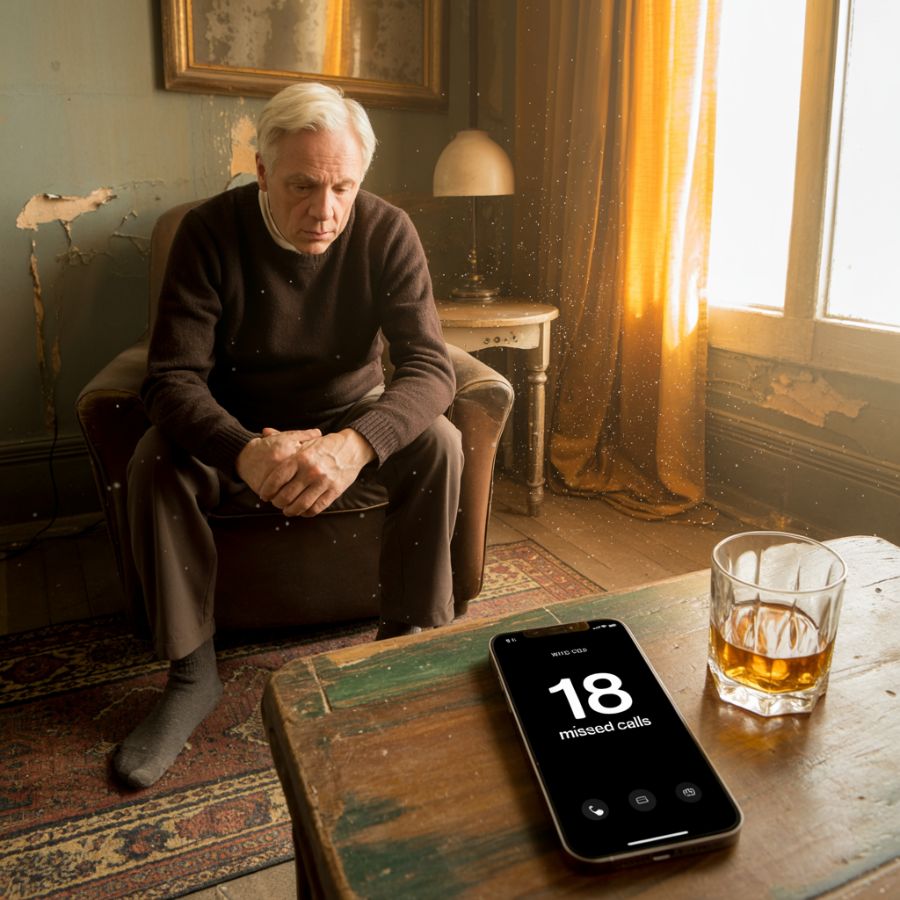
Within forty-eight hours, my phone would light up with missed calls—eighteen of them—messages layered with confusion, panic, and sudden concern. But even before that reckoning arrived, I understood something essential that no amount of family counseling or forced conversation had ever clarified. Peace does not come from being needed. It comes from knowing when to stop offering yourself where you are no longer welcome. There is a line that, once crossed, changes everything. Past it, explanations become unnecessary, arguments irrelevant. Silence, in those moments, is not cruelty. It is self-respect. And for the first time in a very long while, I felt something like freedom—not because I had been rejected, but because I had finally stopped begging for a seat at a table where I was only valued for what I brought, never for who I was.
Disclaimer : This content may be created by AI for entertainment purposes. Any resemblance to real persons, events, or places is coincidental.