THE UNTOLD SECRET
The air inside the courtroom was heavy and sterile, carrying the sharp scent of old paper and indifference. I sat at the defendant’s table, my fingers interlaced so tightly that my knuckles turned a ghostly white. Across from me sat Hảo, my husband of ten years. He looked impeccable in his tailored suit, his expression as calm and detached as a stranger watching a play.
His lawyer’s voice droned on, a rhythmic assassination of my character. To the court, I was being painted as a “failure,” an “unfit mother,” and a “parasite” who contributed nothing to the household. In the divorce papers, Hảo didn’t just want a separation; he wanted everything—the house, the savings, and most cruelly, the sole custody of our seven-year-old daughter, Chi.
I lowered my head, feeling each word like a slow blade cutting into my skin. Just as the judge was about to lift his gavel to deliver a verdict that would shatter my life, a small, trembling voice echoed from the doorway.
“Mr. Judge, may I show you a secret that my Mommy doesn’t know about?”
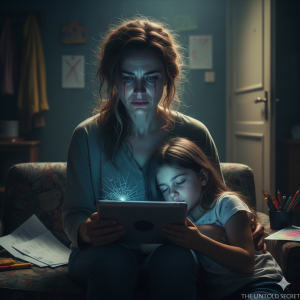
The room went silent. Every head turned. There stood Chi, clutching an old tablet with a cracked screen. Her dark eyes were fixed on the high bench. My heart constricted. In that moment of terrifying bravery from my child, I realized that despite Hảo’s claims, I hadn’t failed at everything. I had raised a daughter who knew the difference between truth and lies.
But to understand how we reached this desperate end, I must go back to a morning that seemed peaceful just a few months ago, in our three-story house in the heart of Hanoi.
Life in that house was a series of quiet rituals. I would wake up before dawn, the mist still clinging to the streets, to prepare breakfast. I lived like a ghost—walking softly, speaking in whispers—just to avoid “disturbing” Hảo.
“The coffee is bitter. Just like your mood,” Hảo snapped that morning, pushing the cup away. He didn’t look at me; his eyes were glued to his phone.
I remembered the early days when he held my hand at this very table and promised, “Just stay home, I’ll take care of you.” Back then, I thought it was a promise of protection. Only later did I realize it was a sentence of isolation—an invitation to surrender my career, my income, and my identity.
The breaking point arrived not with a shout, but with a yellow envelope. While Hảo was at work and Chi was at school, a courier delivered a summons. Hảo was suing for divorce. The grounds? “Emotional instability” and “failure to perform marital duties.”
When Hảo returned home that evening, he didn’t deny it. “You’re a failure as a wife, Mi,” he said, his voice cold and calculated. “The house is messy when you’re sick, the child cries, you’re weak. I need a different kind of woman. Just sign the papers, and I’ll give you a little ‘charity’ to get you started.”
I looked at the man I had loved and realized he was long dead. In his place was a strategist. He had emptied our joint savings accounts months in advance. He had taken photos of the kitchen on days I was bedridden with fever to prove I was “unfit.” He had stripped me of every resource before I even knew we were at war.
Desperate, I sought help from an old friend, Hạnh, who introduced me to Mr. Lợi, a lawyer known for defending vulnerable women.
“He has prepared a trap,” Mr. Lợi warned me after reviewing the files. “He’s painting you as unstable to take the child. Without an income or a home, the law often leans toward the ‘stable’ provider. We need the truth, Mi. But we need proof.”
But I had no proof. Only my word against his polished lies.
As the court date approached, Hảo began a psychological campaign. He bought Chi a brand-new, expensive tablet, promising her “trips and a big villa” if she lived with him. He told her I was “too tired” and “too sad” to look after her. He was grooming our daughter to choose him.
One night, I found Chi hiding her old, cracked tablet under her pillow. When I touched it, she jumped. “Mommy, don’t take it! Please!” she whispered. I thought she just missed her old toy. I had no idea that for months, this little girl had been a silent witness.
Then came the day of the trial.
Hảo’s lawyer presented “evidence” of my supposed instability—recordings of me crying, photos of a cluttered house. Then came the most painful question from the Judge: “Chi, who do you want to live with?”
Chi looked at her father, then at me. “I want to stay with Mommy,” she whispered.
Hảo’s lawyer stepped in immediately. “The child is young and easily influenced by emotion. Her father offers a superior environment, stability, and a future.”
That was when Chi stood up. That was when she asked to share her secret.
The Judge allowed the old tablet to be connected to the courtroom screens. A video began to play. The footage was shaky, filmed from a low angle behind the sofa. It was a recording from two months ago.
Hảo’s voice rang out, clear and chilling: “The lawyer has everything ready. Mi has no money, no house—the court will see I’m the better choice. If I have to, I’ll tell them she’s mentally ill.” Then, a woman’s voice—the one I had seen at our door—replied: “Make sure you cut her off completely. I won’t raise your child if she’s still in the picture.”
Hảo laughed. “Don’t worry. At most, she’ll see the kid once a month.”
The courtroom froze. The silence was absolute. Hảo’s face turned a sickly grey. The “perfect father” mask shattered into a thousand jagged pieces. He wasn’t trying to protect his daughter; he was using her as a pawn in a game of revenge and convenience
The Judge’s face was like stone. The evidence of Hảo’s deceit and the emotional manipulation of a minor changed everything. The court ruled immediately: temporary custody was granted to me, and Hảo’s financial records were ordered for a full investigation into the hidden assets.
We walked out of the courthouse into the pale afternoon sun. Hảo was left behind, a shadow of the man he thought he was, standing alone in the hallway as his mistress fled the scene.
I moved Chi into a small, sunlit rented room. It wasn’t a three-story house, but for the first time in ten years, the air was easy to breathe. I took a job at a local diner—hard, manual work that left my back aching, but my soul felt light.
One evening, as I was drying Chi’s hair, she looked at the window where a small pot of flowers sat. “Mommy, there’s a lot of sun here,” she said.
“Yes, baby. Every morning, the sun will hit your desk.”
Hảo eventually stopped trying to fight. The law and the truth had stripped him of his leverage. He was granted supervised visits, and during the first one, Chi didn’t run to him. She stood by my side, looked at him, and said, “Dad, please don’t make Mommy sad anymore.”
My marriage ended in a wreckage of lies, but as a mother, I did not fail. I lost a house, but I found my voice. And my daughter, the silent observer with the cracked tablet, taught me that even the smallest person can topple the tallest wall of lies.
We aren’t a “complete” family by the world’s standards anymore. But as I watch Chi sleep peacefully, no longer jumping at shadows, I know we are finally whole.
Disclaimer : This content may be created by AI for entertainment purposes. Any resemblance to real persons, events, or places is coincidental.