THE GIRL FROM THE FISH MARKET
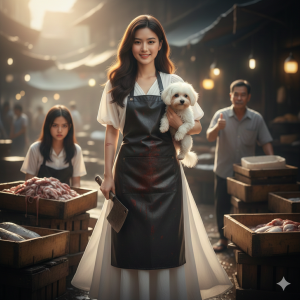
The sun was at its zenith, beating down on the bustling fish market. I stood behind my worn wooden stall, clad in a heavy, waterproof apron that had seen better days. The rhythmic thwack-thwack-thwack of my cleaver hitting the chopping board was the only music I knew. My hands were stained with a mixture of fish scales and dried blood, and the pungent, metallic scent of the morning’s catch clung to my skin like a second soul.
I was finishing a clean cut when I noticed them: a man and a woman who looked like they belonged in a glossy magazine, not this muddy alleyway. They looked at me with eyes full of a pain I didn’t understand.
“Want to buy a grass carp?” I asked, my voice raspy from shouting to customers.
Instead of haggling, the man lunged forward. He didn’t care about the slime on my apron or the stench of the market. He threw his arms around me, sobbing into my shoulder. “Ruou Ruou… you are our daughter. Dad and Mom have finally come to take you home.”
I stood frozen, the cleaver still in my hand. Home? I looked at my small, scruffy yellow dog, Hao Hao, wagging his tail at my feet.
“Can I bring my dog?” I asked simply.
The man pulled back, wiping his eyes. “Ruou Ruou, we can buy you a new one. A Poodle, a Maltese—anything you want.”
I shook my head firmly, clutching Hao Hao to my chest. “Then I’m not going.”
Seeing my resolve, they relented. As I climbed into their pristine, leather-scented car, the woman—my mother—flashed a look of concern. “Try not to get the seats dirty, dear,” she whispered.
I nodded, hugging Hao Hao tighter. Don’t worry, Mom. I’m a good girl. And so is Hao Hao.
When we arrived at the mansion, a girl my age was waiting at the gates. She looked like an angel in a snow-white dress, a delicate flower tucked into her hair. This was Nguyet Nguyet. My mother immediately rushed to her, embracing her with a warmth she hadn’t yet shown me.
“Nguyet Nguyet, Mom is home,” she cooed.
I shrank behind my father. I was a stain on this perfect picture. When Dad tried to introduce us, Nguyet Nguyet flinched.
“Is it because I’m dirty?” I asked bluntly.
My father’s eyes welled up again. He grabbed my fish-scaled hand. “You are not dirty, Ruou Ruou.”
Upstairs, I experienced my first bathtub. It was like a giant porcelain bowl of magic. As the maid, Auntie Truong, scrubbed Hao Hao, we discovered he wasn’t a yellow dog at all—under the market grime, he was pure white.
Mom entered with a dress. “This is Nguyet Nguyet’s. I’ll buy you new ones soon.”
When I stood up, she gasped, then broke into a fresh fit of crying. My body was a map of scars—knife slips from gutting fish and jagged marks from my foster father’s drunken rages.
“It’s okay, Mom,” I said, trying to cheer her up. “I’m really good at gutting fish now. I don’t cut myself anymore. See? I’m smart!”
But the more I tried to boast about my “skills,” the harder she cried. She told me I was too thin for a sixteen-year-old. I just felt lucky; I thought I’d look so ugly in a dress it would make people weep.
Downstairs, I met my older brother, Thanh Nghieu. He looked at me with pure disdain. “Where did this skinny monkey come from?” he muttered.
Dad whacked him upside the head for that. I immediately ran over to blow on my brother’s “injury,” telling him the pain would go away if I blew on it. He looked at me, caught between laughter and annoyance.
That night at dinner, the tension simmered. Nguyet Nguyet was the “perfect” daughter, but she seemed terrified. She kept crying, saying she didn’t want to go back to the fish market.
“Why would you go there?” I asked, confused.
“Because she is the biological child of the people who raised you,” Dad explained. “When you went missing, we found her. We thought it was fate, so we adopted her.”
It was a strange trade. I had her life; she had mine. Dad asked if I wanted her to leave.
“Can we keep her?” I asked. “If we have 3,000 cents a month, we can afford six people. I calculated it.”
Dad’s face crumbled. “Ruou Ruou, we are very rich. You can spend 5,000 a month just on yourself.”
My eyes went wide. 5,000? We could adopt a hundred sisters! Nguyet Nguyet begged to stay, and I agreed. But as she hugged Mom, a pang of something cold hit my chest. For the first time in ten years, my own eyes felt wet.
Life at school was a battlefield I didn’t understand. Nguyet Nguyet was in the honors class; I was in the remedial class. Every time I tried to be nice, she would make it look like I was bullying her. She’d drop food and claim I pushed her; she’d cry if I talked to our brother.
Thanh Nghieu saw through it. One night, he handed me a thick book: The Guide to Defeating Green Tea Bitches.
“Read it,” he said solemnly. “A ‘Green Tea’ is someone who acts innocent but is actually a snake. You’re too blunt for your own good.”
I studied that book like a scripture.
The conflict peaked when Nguyet Nguyet tried to get me kicked out. She cornered me at school, falling to her knees and wailing so the other students would think I was a tyrant.
Chapter 2: Beat them at their own game, I remembered.
I immediately dropped to my knees too. I wailed louder. I banged my head on the ground with the strength of someone who used to carry crates of ice.
“Why are you doing this, sister?” I sobbed hysterically.
Nguyet Nguyet was stunned. She couldn’t keep up with my “performance.” When our brother arrived and saw us both on the floor, I looked up and whispered, “Brother, I did exactly what the book said! Am I doing it right?”
Nguyet Nguyet fainted from pure rage.
The final straw came when she tried to have me kidnapped. She lured me to the old fish market, where my foster parents, the Truongs, were waiting with ropes.
“If I get rid of you, I can go back to being the only daughter!” she screamed, her mask finally slipping.
But I wasn’t the weak girl she thought. I had spent years wrestling slippery eels and heavy tuna. I made short work of the thugs she hired, knocking them flat before the police—whom my brother had already called—arrived.
As they were dragged away, I realized the truth: the Truongs had intentionally swapped us years ago. It wasn’t an accident. It was a cold, calculated theft of a life.
The Truongs and Nguyet Nguyet ended up behind bars for kidnapping and fraud. My father ensured they were “well-taken care of” in prison—which, in his world, meant they would never have a moment’s peace.
Three years have passed since I left the fish market.
I am not the smartest student—I attend a modest private university—and I still prefer the company of Hao Hao to high-society galas. But I am no longer the “skinny monkey.” My scars have faded, replaced by the warmth of a family that refused to stop looking for me.
My brother now runs the family company, often coming home exhausted only to have me “blow” on his forehead to make the stress go away. My parents take me traveling across the world, trying to show me everything I missed while I was staring at the scales of a carp.
On my nineteenth birthday, there was no fish, no blood, and no tears. Just a massive, multi-tiered cake and a family that finally felt whole. I realized then that while I couldn’t change the past, the “Green Tea” could never take my future.
I am Ruou Ruou. I am a daughter. And I am finally home.
Disclaimer : This content may be created by AI for entertainment purposes. Any resemblance to real persons, events, or places is coincidental.