THE INTERSECTION OF DESTINY
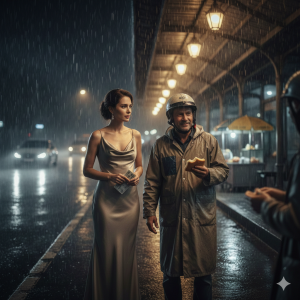
The sky didn’t just rain; it mourned. Massive droplets thrashed against the deserted pavement near the old bus station, as if trying to wash away the sins of the city. On a flickering electronic billboard, the digital clock blinked incessantly: 11:58 PM. The sickly yellow streetlights cast long, distorted shadows onto the flooded asphalt, illuminating a lone figure slumped over an aging motorbike.
His name was Tien Hung, 35. A ride-hailing driver by trade, his body was a map of exhaustion. His tattered raincoat, torn at the seams, failed to shield his shoulders, allowing icy rivulets to stream from his helmet down his weathered face. He had fallen into a heavy, bone-tired sleep right there at the station, where the only music was the rhythmic drumming of the storm and the distant, lonely wail of a train whistle.
A few yards away, a sleek, black luxury sedan glided through the puddles, slowing to a crawl before the station gates. The door opened, and a woman stepped out. As the headlights swept across her face, they revealed a profile of cold, regal beauty. This was Thao, 33, a billionaire real estate mogul known to the press as the “Iron Queen.”
Tonight was her birthday. She had just fled a gala filled with hollow toasts, sycophantic laughter, and expensive champagne that tasted like ash. Suffocating in her gilded cage, she had driven aimlessly until she found herself here—at the old station she used to frequent as a destitute student.
Her high heels sank slightly into a muddy puddle. The wind whipped her hair into a chaotic tangle. As she approached the gate, she spotted the man slumped over his bike. Her brow furrowed in irritation. Assuming he was a vagrant or a drunk blocking her path, she called out, her voice as cold as the rain.
“Hey, you! Move out of the way. I don’t want to run you over.”
Hung started awake, his eyes bleary and disoriented. He scrambled to steady his bike, bowing his head in immediate apology. “I’m so sorry, ma’am. I just… I was so tired I drifted off. Please, go ahead, I’ll move right now.”
Thao watched him, her eyes narrowing. “What kind of work do you do that makes you sleep in the middle of the road? It’s dangerous.”
“I drive a bike taxi,” Hung replied, offering a weary but genuine smile. “The rain killed the business, and my phone battery died. I just needed a dry spot for a moment. I have to be up early for the morning rush.”
Thao scanned him from head to toe: the shredded raincoat, the water-logged shoes, the calloused hands. He was from a world so far removed from hers that he might as well have been from another planet. She turned to get back into her car, but as she turned the key, the engine let out a pathetic sputter and died.
The wind howled, spraying rain directly into Thao’s frustrated face. Hung stepped forward tentatively. “It might be a wet spark plug or the battery terminals. Let me take a look.”
Thao looked at him with blatant skepticism. “You know how to fix a car like this?”
“I used to be an engineer,” he said simply, his voice calm. “I still have a feel for machinery.”
Without waiting for permission, Hung knelt in the mud. He popped the hood, his bare hands working deftly despite the downpour soaking his back. After several minutes, he stood up, wiping grease onto his already ruined sleeve. “Try it now.”
Thao turned the ignition. The engine roared to life, purring with rhythmic perfection. Stunned, she reached for her designer wallet and pulled out a stack of bills. “Take this. I don’t like being in debt to anyone.”
Hung shook his head, pushing her hand back. “No need. Helping others is helping oneself. Go home, ma’am. The storm is getting worse.”
In that moment, a flash of lightning illuminated the sky. Thao saw his eyes—they weren’t filled with greed or resentment, but a profound, quiet peace. For the first time in years, she felt a strange flicker in her chest. She watched him retreat to his corner, wrapping his torn raincoat around his shivering frame.
Driven by a sudden, inexplicable pang of guilt, Thao began to drive away, but her eyes remained glued to the rearview mirror. She saw him huddling under the eaves, a solitary silhouette against the cold. His words echoed in her mind: Helping others is helping oneself. She had managed thousands of employees and heard every corporate philosophy imaginable, yet this man’s simple gesture haunted her.
She returned to her mansion—a place of silk curtains and crystal chandeliers—but it felt like a tomb. The next morning, she couldn’t shake his image. Thao had been an orphan since ten, clawing her way up from poverty to become the city’s most powerful woman. She had built a fortress around her heart to survive. Why did this man, who had nothing, seem so much fuller than her?
A few days later, she sought him out at the station again. She saw him sitting on his bike, sharing his only loaf of bread with an elderly beggar. The sight was a needle to her heart. She invited him for coffee at a roadside stall.
Over plastic cups of cheap, bitter coffee, Hung told her his story. He didn’t complain. He spoke of his late wife, the debt from her illness, his aging mother, and his young son who loved comic books. “Life is hard,” he said softly, looking at his scarred hands. “But as long as we’re breathing, we have a reason to smile.”
Thao found herself addicted to his presence. She began making excuses to see him—hiring him for “errands,” pretending her car had broken down, or just sitting on the back of his bike as he drove her through the city’s hidden alleys.
“You have so much money,” Hung once joked. “Why do you look like you’re searching for something you lost?”
“Because,” Thao whispered, “some things can’t be bought back once they’re gone.
Their quiet bond was shattered by a brutal calculated strike. A rival corporation, desperate to topple Thao’s empire, leaked a fabricated scandal. Headlines screamed: “IRON QUEEN’S SECRET LOVER: A FRAUD WITH A CRIMINAL RECORD.”
Photos of them at the bus station were distorted and plastered across social media. Shareholders panicked; the stock price plummeted. To make matters worse, “evidence” emerged suggesting Hung was a corporate spy who had leaked Thao’s project blueprints.
Thao sat in her office, staring at the screen with bloodshot eyes. “I knew it,” she hissed, smashing her phone against the floor. “I knew I couldn’t trust anyone.”
When she finally confronted Hung, he didn’t beg. He looked at her with a deep, searing sadness. “I didn’t do it, Thao. But I know how the world looks to someone like you. If you doubt me, I will leave.”
He walked away into the rain, his thin frame stooped with the weight of her suspicion.
While Thao spiraled into a cold depression, Hung’s life grew even darker. His mother fell critically ill, and he spent every waking hour driving, desperate for medicine money. He never reached out to Thao for help. He simply endured.
The breaking point came on the day of Thao’s emergency press conference. She stood on a stage in a crowded hall, ready to defend her company. She didn’t know that her own Vice President had orchestrated the leak and had hired a driver to “lose control” of a truck outside the venue’s entrance just as she exited.
Hung, having discovered the truth through a former colleague who felt guilty, raced to the scene. As Thao stepped out of the building, the roar of a heavy engine filled the air. A truck hurtled toward her.
“Thao! Move!”
Hung leaped. He shoved her with all his might, throwing her onto the sidewalk. A sickening thud of metal against bone echoed through the street.
Thao opened her eyes to see Hung lying motionless in a pool of blood. She crawled to him, screaming for an ambulance, her designer suit stained crimson. For the first time, she stripped away her pride, sobbing like a child as she held him.
“I… I just wanted you to know,” Hung whispered, his voice fading, “I never betrayed you.”
The aftermath was a whirlwind. The evidence Hung carried in his pocket—a recording of the Vice President’s conspiracy—cleared his name and saved Thao’s company. The villains were arrested, and the public’s scorn turned into admiration for the “Hero Driver.”
But Thao didn’t care about the company anymore. She spent every night in the hospital, sitting by Hung’s bed, watching the rhythmic beep of the heart monitor. When he finally woke up, she didn’t talk about money or business. She took his hand and whispered, “I found what I lost. It was never about the world we live in, but the person we choose to be.”
A year later, on the outskirts of the city, a modest building opened its doors: “AN TAM GARAGE.” The sign underneath read: Repairing engines, and mending broken journeys.
The owner was Hung, now healthy and strong, though he walked with a slight limp. He hadn’t accepted a handout; instead, Thao had established a foundation in his mother’s name to provide micro-loans for honest workers to start their own businesses.
On opening day, Thao arrived not in a limousine, but in a simple white dress. She found Hung wiping grease from his hands. They didn’t need grand speeches. They sat together on a worn wooden bench as the afternoon sun bathed the garage in gold.
“Some wounds take time to heal,” Thao said softly, leaning her head on his shoulder. “But some people change your life with just one encounter.”
Hung nodded, looking out at the horizon. He took her hand—the billionaire and the mechanic—their two worlds finally, irrevocably, fused into one.
Would you like me to adjust the tone of any specific scene, or perhaps create a character profile for Hung and Thao to further explore their backstories?
Disclaimer : This content may be created by AI for entertainment purposes. Any resemblance to real persons, events, or places is coincidental.