The Fire Behind the Glass Cage
It was a scorching summer, yet a chilling cold ran down my spine, Giang Ninh, as I stood motionless outside the Intensive Care Unit (ICU). The cold glass separated me from my only son, Tạ Minh Vũ, who lay within, heavily bandaged after a horrific school bullying incident.
It was at that very moment that I overheard a conversation—a fateful dialogue, a knife thrust through the shell of my ten-year marriage. It was the familiar, deep voice of my husband, Tạ Phương Liệt, the high-ranking Commander always clad in the righteous aura of the military, speaking to his subordinate, Staff Officer Triệu.
“Do you really want to suppress Minh Vũ’s case? That’s your biological son,” Triệu’s voice was hesitant. “If you want to help Hạ Nhược, just tell your wife the truth. She’s not unreasonable; why the secrecy?”
Tạ Phương Liệt’s voice was cold, clear as ice: “Hạ Nhược is not just a martyr’s wife; she is my first love. I cannot let her lose another child. Giang Ninh has a strong personality; if she knows the one who injured Minh Vũ is Hạ Nhược’s son, she will definitely raise a fuss with the military district. It’s better to stall this until a mediation session while she’s busy tending to our son. Once everything calms down, she won’t make too much trouble.”
Everything shattered in that instant. My marriage, the reverence I held for my heroic husband—all reduced to a cruel farce. I had lived as a dutiful military wife, willingly putting aside my life, never daring to mention divorce for fear of tarnishing his image in our son’s eyes. Now, that hero was using his power and fake compassion to shield the son of his old flame, crushing his own flesh and blood in the process.
I returned to the room, silently swallowing the revulsion. When Tạ Phương Liệt appeared, he merely pursed his lips, his face stern. “The current evidence is disputable; the family council hearing has to be postponed. Being impatient won’t help.” Always the same excuse: ‘the greater good.’
I took a step forward, looking straight into his emotionless eyes, a cold smile on my lips: “If you agree to hold a public hearing, I will sign the divorce papers.”
He was stunned, but immediately his face darkened. “Giang Ninh, if every military wife blackmailed the organization with personal feelings, where would the discipline and dignity of the military stand? Minh Vũ’s fight was largely because of your poor upbringing, raising him to be weak and overly sensitive.”
That venomous accusation pierced my heart. He was blaming me and our son to cover up his own abuse of power. I had lost the last flicker of hope.
In my despair, I contacted lawyers, but one by one, they refused the complaint, their voices laced with difficulty. “Sister Giang, is someone in the military putting pressure on them?” It was clear. Who else in the entire military district held enough power to coerce everyone but Tạ Phương Liệt?
I changed tactics. “Lawyer Nghiêm, if the complaint is too inconvenient to take, surely you can represent me in a divorce case?”
When Minh Vũ woke, the multitude of injuries on his small body made him tremble, his eyes filled with terror. “Mom, is Dad gone?”
My assurance was interrupted by a soft, yet grating voice. Hạ Nhược, along with her son, Hạ Bác Văn, the boy who had pushed Minh Vũ down the stairs, entered the room. She carried a fruit basket and a bunch of white chrysanthemums, her tone gentle but her gaze filled with condescending pity.
“Sister Giang Ninh, I mentioned the idea of mediation between the children. Have you thought about it? Children clash sometimes; it’s normal. Why blow it up and make Commander Tạ uncomfortable?”
My sanity crumbled. Clash? My son had a fractured skull and broken ribs! Hạ Bác Văn peeked out and said something that stunned me: “Mom, Uncle Tạ said we don’t need to be afraid. He said he would protect us.”
Those three words—“Uncle Tạ”—made me lash out, slapping the boy. As his cry echoed, Hạ Nhược instantly flipped, screaming and lunging, grabbing my hair, tearing at my face. Exhausted, I collapsed, and Minh Vũ’s wounds ripped open from the sudden movement, blood soaking his white bandages.
For refusing to apologize to Hạ Nhược, I was detained for three days of disciplinary action. Three long days in despair, realizing that my marriage was just a carefully staged play, designed for me to be the backdrop to his flawless image.
The first thing I did after release was rush to the hospital. But Minh Vũ had been moved to the crowded general ward. He clung to me, sobbing: “Mom, Dad said I was badly behaved and caused trouble at school, which is why I was bullied. Mom, was I a good boy?”
The anger was uncontrollable. I stepped out, and the scene I witnessed in the special ward dealt the final blow. Tạ Phương Liệt was holding Hạ Bác Văn with familiar ease, while Hạ Nhược’s mother held his hand: “Phương Liệt, Nhược Nhược has had a hard life. We are lucky you care for her.”
Tạ Phương Liệt nodded, his voice soft: “Auntie, don’t worry. I also bear responsibility for what happened years ago. As long as I’m here, no one will bully them.”
Responsibility? What did he call the ten years he lived with me, the mother of his child? My heart felt numb. I stepped back, raising my phone to record this cozy, fake family moment.
Half a month later, Minh Vũ was again assaulted by Hạ Bác Văn and several boys in the restroom, forced to kneel.
I rushed to the hospital. Tạ Phương Liệt was on the phone, his back to the door: “Handle it as children playing too rough; don’t let it get out.”
Blood rushed to my head. “Slap!” I struck him hard across the face, the sound sharp and resounding.
“Giang Ninh, are you insane? This is a hospital.”
“Get out! I don’t need your pretense.” I screamed, embracing my trembling son on the bed.
I filed a complaint with the Education Bureau myself. Hạ Bác Văn was taken for investigation. Hạ Nhược and Tạ Phương Liệt rushed to the hospital. She knelt, weeping: “Sister Giang Ninh, please withdraw the complaint. Bác Văn is small; being interrogated will scare him.”
Tạ Phương Liệt pulled Hạ Nhược up, looking at me, his eyes cold: “Withdraw the complaint immediately.”
I refused to back down. He pulled out his phone. A minute later, I received a notice of suspension for “suspected misuse of welfare resources.” Meanwhile, Hạ Nhược was given a prestigious civil service job in the unit’s service center. I had been systematically stripped of everything.
In utter despair, I withdrew the complaint, but I messaged Lawyer Nghiêm: “Lawyer Nghiêm, this is Giang Ninh. All my evidence is ready. Help me with this divorce.”
On the day of the hearing, a maliciously edited video went viral: the frail Minh Vũ was twisted into the bully, falsely accusing the martyr’s son. Public opinion reversed. Neighbors shunned me, and our door was littered with trash.
Outside the military headquarters, Tạ Phương Liệt, in his immaculate uniform, naturally helped Hạ Nhược out of his official car. He glanced at the stain on my shoulder and the bruise on my forehead, his eyes icy, a look of cruel indifference, as if relishing my self-inflicted misery.
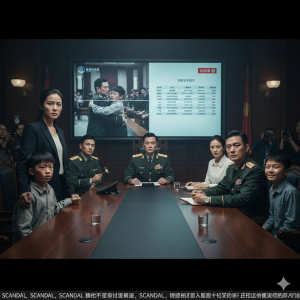
In the meeting room, Hạ Nhược wept, playing the edited video, demanding a public apology from my son and me. Tạ Phương Liệt sat upright, composed.
“Comrade Giang Ninh, do you have anything further to present?” the Chairman asked.
I gave a cold smile. “I would like to change the nature of this hearing. I wish to file a formal accusation.”
The hall fell into a deadly silence. Tạ Phương Liệt’s brows furrowed.
“Mr. Chairman, if we do not clearly investigate the source of the abuse of power, any discussion revolving around children’s conflicts will fail to reach the truth. I demand that the focus of questioning be shifted to Comrade Tạ Phương Liệt.”
Chaos erupted. Tạ Phương Liệt bellowed: “Giang Ninh, be mindful of the setting. This is a formal hearing, not a place for you to cause trouble.”
I looked straight at him, my words slicing through the air like blades: “Focus? You suppressed my son’s bullying case, you cost me my job, and you gave a good position to Hạ Nhược. Is this your discipline and fairness? Is this the explanation you promised?”
Tạ Phương Liệt’s face was ashen, his lips tightly sealed, unable to speak. For the first time, his mask of an exemplary officer cracked.
Lawyer Nghiêm stepped forward: “We are adding an accusation: Tạ Phương Liệt, during his marriage, violated military moral conduct with an improper lifestyle, abused his power to shield and condone a specific individual, and used his position to suppress the rights of his wife and biological son.”
Tạ Phương Liệt leapt up, overturning his tea cup: “Giang Ninh, this is serious! You will be held accountable for every word!”
“The person Tạ Phương Liệt maintained an improper relationship with and shielded for a long time is precisely Hạ Nhược.”
The evidence was displayed on the live stream screen:
-
Secretly recorded video: Tạ Phương Liệt reassuring Hạ Nhược’s mother he would protect them, intimate gestures.
-
Bank transfer history: Dozens of large transfers to Hạ Nhược over 3 years, notes: Living expenses, tuition, birthday gift.
-
Screenshots of vicious messages from Hạ Nhược: Phương Liệt always remembers me and my son; you are just decoration. Your son is hospitalized, and he finds it bothersome to even ask.
The concrete evidence, clear before everyone’s eyes. Silence, followed by an explosion of fury in the live stream. Tạ Phương Liệt froze, his face turning to ash. Hạ Nhược collapsed, weeping.
At that moment, the door burst open. A group of military discipline officers entered.
“Comrade Tạ Phương Liệt, this is a formal notification of investigation establishment. You are to come with us immediately.”
Tạ Phương Liệt was thunderstruck, his face pale, stumbling backward. The cold click of handcuffs locked around his wrist. As he was led away, he struggled to stop, turning back to look at me, his eyes a mix of rage, unwillingness, confusion, and perhaps a flicker of belated remorse.
Soon after, Tạ Phương Liệt was stripped of his rank, investigated, and sentenced to prison by the Military Court. His reputation and career were instantly ruined. Hạ Nhược was fired, then administratively detained and fined for perjury.
In desperation, Hạ Nhược came to my new apartment complex, kneeling and crying hysterically: “Sister Giang Ninh, I was wrong. Please forgive me. Help Bác Văn, don’t send him to the reform school.”
I pushed her away, my voice icy: “Begging? You should beg Tạ Phương Liệt in prison. Your debts, you pay them yourselves.”
Before his imprisonment, Tạ Phương Liệt asked to see me and Minh Vũ one last time. Separated by glass, he was in prison attire, his temples showing grey hair.
“Giang Ninh, I know I was wrong… I always had you in my heart. I just didn’t know how to express it.”
I remained silent. He turned to Minh Vũ, his voice hoarse: “Minh Vũ, Dad was wrong. When I get out, I will make it up to you, every day. Can you forgive me?”
Minh Vũ clung to me, his small face tense, clearly stating: “You are not a good dad. You made Mom cry and made me hurt. I don’t need you anymore.”
Tạ Phương Liệt was silent, the light in his eyes extinguished.
“Tạ Phương Liệt, this is the end.” I took my son’s hand and walked away, never looking back.
The sun shone brightly outside the detention center. I took a deep breath. The divorce was finalized. I sold the old house filled with cold memories and moved South with Minh Vũ, settling in a peaceful seaside town.
Our new home was small but bright and cozy. Minh Vũ quickly adapted to his new school, his smile growing brighter each day. After school, he would rush into my arms, sharing his happy stories.
I, Giang Ninh, was no longer the long-suffering “military wife.” I was Minh Vũ’s mother, the one who fought for and won our justice. I looked at my son, looked out at the sea, and knew that my life had finally been reborn.
Disclaimer : This content may be created by AI for entertainment purposes. Any resemblance to real persons, events, or places is coincidental.