The Betrayal and the Ballad of Justice
The night in Long An Industrial Park was a brutal dance of rain. Every deluge lashed violently against the corrugated iron roofs, sounding like whips striking life itself. The wind whistled through the cold factory buildings, carrying the mixed stench of rust and machine oil—a familiar odor to those with no sturdy shelter.
Minh Hai, an 11-year-old boy, huddled under the awning of a closed repair shop. His stomach was hollow with hunger, his hands clutching a sodden bundle of scrap. For Hai, the rain was just a part of life, sometimes roaring menacingly, sometimes sighing like an eternal lament. He only needed to survive the night, sell the aluminum cans in the morning, and visit his father in the back-alley rented room.
Then, a strange sound cut across the symphony of the rain. It wasn’t thunder, nor the usual roar of a container truck, but a dry, scraping sound on the wet concrete—the sound of desperate fingernails clawing. Hai looked up, his eyes squinting under the flickering yellow light of the lamppost. A black shadow darted past, disappearing behind the corrugated iron fence.
Hai had learned not to be curious, as curiosity often traded for trouble. But then, a soft, strangled “uh… uh…” sound, barely louder than the wind, rose again—a sound compressed, blocked, stifled in someone’s throat. The boy froze. He heard that sound as he heard his own on strange, hungry nights—wanting to cry out, but with no one listening.
An inexplicable urge pulled him forward. Hai quickly stepped through a puddle, following the iron fence. Behind it, an abandoned warehouse door was slightly ajar. A whiff of chemical fumes hit him when he pushed the door open. Inside the darkness, illuminated only by the faint light from the crack, a man lay on his side on the cold concrete floor. His hands were bound behind his back with new, stiff ropes, and his mouth was gagged with a thick white cloth.
The man’s eyes were bloodshot, full of pain and indignation, looking at Hai as if clinging to the last ray of light. Hai paused. This was no ordinary person. Despite the wrinkled shirt and pale, wet face, there was an air of luxury clinging to his every feature—one expensive leather shoe was kicked off, and his hands were large and firm, accustomed to holding power rather than being bound.
Just then, the sound of rapid, heavy footsteps echoed from outside the door. Someone was returning.
Without thinking, Hai rushed forward, kneeling to yank at the rope. It was stiff, tied with a professional knot. He bit his lip until it bled, his fingernails scraping raw against the twine. The man made a desperate, muffled “ooh-ooh” sound, his eyes pleading: “Don’t let them see!” The clinking of metal neared. Hai panicked, grabbing a sharp piece of metal next to a broken wooden crate and cutting the rope.
The twine ripped with a rustling sound. One of the man’s hands dropped free. Hai yanked the white cloth from his mouth. A long-held breath burst out, wheezing in pain, making the man arch his back. But Hai couldn’t celebrate; a shadow had fallen across the light strip outside the door.
With a strange reflex, the boy quickly stuffed the white cloth into a plastic bag. He didn’t know why, only that the cloth should not be left here. Pulling the man up, Hai whispered, his voice trembling but firm: “Can you stand up, sir? Go now, quickly.”
The man stumbled, his newly freed hand gripping Hai’s shoulder heavily, as if an entire life had crashed down. The warehouse door creaked. A man’s cold voice grated from outside: “Check again, just to be sure.”
The rain still howled, but inside the warehouse, the silence was compressed like a trap. And in the middle of that trap, a poor boy and a billionaire were dragging each other out of the darkness, surviving on a single, remaining breath.
The rented quarter, nestled behind the industrial park, was like a sloppy stitch in the city’s fabric. The rain had softened, but the air remained damp and cold. Minh Hai led the strange man through the dark alley, avoiding the lit drinking spots and the curious eyes of late-nighters.
Mai Lien’s rented room was tiny. Lien froze when she saw Hai supporting the tall, pale man in dirty clothes. Without asking, she drew the curtain, locked the door, and settled the man on the bed. The weak yellow light revealed his sunken eyes and the deep purple marks around his wrists. Lien silently washed her hands, wiped his scratches, and handed him a cup of warm water.
Hai sat on the edge of the bed, his heart still pounding. In his mind, the image of the white cloth flickered, refusing to settle.
The sound of a TV from the next room filtered through the thin wall—a late news bulletin interrupting an advertisement. The announcer’s voice was clear and cold: “Billionaire Quang Vu involved in an accident, temporarily unable to run the company. The family corporation announced urgently…” The familiar name startled Hai.
The man on the bed closed his eyes. A faint curl of his lip—not a smile—but as if someone had slapped away his last shred of faith.
“I’m not dead,” he said softly, his voice hoarse. “But they want everyone to think I’m finished.” He introduced himself as Quang Vu, the name dropping into the room like a block of stone.
Vu spoke slowly, his sentences fragmented, but enough for Hai to understand this was no accident. The order came from his uncle—Quang Huy, the one who managed the paperwork, the press releases, the “timely” phone calls. Vu recounted the closed-door meeting, the dizziness when he was declared incapacitated, the hands bound in the dark warehouse. Each sentence was like a knife twisting into shattered trust.
Hai’s insides burned as he listened. He thought of his mother, of the cold judgment she faced years ago. He looked at Vu and the TV repeating the same headline. If he helped this man, his life would take a much more dangerous path. But at the same time, another, stronger feeling welled up.
“It’s not a misunderstanding,” Hai said, his voice small but firm. “They planned it all.”
Vu opened his eyes, looking at the boy with surprise, gratitude, and the naked loneliness of one betrayed at his weakest moment. Both understood this was just the beginning of the storm’s true emergence.
The next morning, Hai decided to return to the most dangerous place. At the abandoned lot behind the factory, he stooped down and picked up a damp piece of paper clinging to the corner of a broken wooden crate. It had a red border and a blurred seal, looking more like a file cover than trash. Hai put it in his pocket, a heavy feeling settling in his heart.
The shift whistle blew. At the factory’s side gate, his father, Mr. Tu Nghia, stood smoking. Hai ran to him.
“Why are you here at this hour?” Mr. Tu spoke low and urgently, afraid of being overheard.
Hai told him everything about the rainy night, about the bound man, about the name Quang Vu. The cigarette fell from Mr. Tu’s hand. He looked around, pulling Hai against the wall where no camera could see. For a long time, he said nothing. When he finally spoke, his voice was choked with emotion.
“There are things I thought were buried and done with,” he said. “But they refuse to rest.”
Mr. Tu told him about Hai’s father, a skilled worker who used to work at this very factory. There had been a workplace accident years ago—faulty machinery, a death. The initial files recorded technical failure, but everything changed later. The accident was downplayed. Hai’s father was recorded as negligent. Hai’s mother went knocking on doors everywhere, then was arrested for stealing internal documents.
Hai’s ears rang as he listened. His father’s death, his mother’s sentence, the years of contemptuous stares. It all converged into a suffocating lump. Mr. Tu took a deep breath and continued: “The one who signed the final approval in that case, the one who nodded to have the files altered, was Quang Vu.”
Hai didn’t cry when he recounted the story to Quang Vu. He spoke as if reciting another cold, detached news report.
Vu sat still, hands clasped. “I know,” he whispered. “But I chose to be silent.” That silence was heavier than any apology.
That afternoon, Trinh Gia Khang—a former business associate of Vu’s who had been marginalized after a dispute—came to the rented quarter. Khang confirmed the dirty tricks of Quang Huy’s faction. He spoke of one place: the factory’s old archive warehouse, where paper files were forgotten but never destroyed. Where the truth, if still alive, lay covered in dust.
Night fell. Hai looked at the factory lights. The man he rescued was guilty in the past. The one in power was ready to crush anyone. But if he stopped, his father would forever be silenced, his mother forever branded a criminal. Hai gripped the red-bordered paper. For the first time, the boy didn’t just want to save a man; he wanted to pull the truth out from where they had buried it, no matter the cost.
Night descended, the industrial park swallowing all the familiar daytime sounds. Minh Hai stood against the peeling brick wall, his heart pounding hard enough, he thought, for anyone to hear. This time, he was with Quang Vu and Mai Lien.
The old archive warehouse. The iron door was slightly ajar. The smell of damp paper and old dust stung his nose. They split up. Vu opened cabinet drawers, his hands slightly trembling. Hai followed the markings on the file covers that matched the red-bordered paper he found.
He pulled out a thick, worn file, labeled with a workplace accident from over 10 years ago. This was it.
Just then, the sound of metal clinking echoed from outside the door. A flashlight beam swept across the gap. “Check the warehouse according to the new directive,” a low, urgent voice said.
All three held their breath. Lien pulled Hai towards the back of the warehouse where a low iron cabinet stood jammed shut. Vu strained to pull it open. A dry crack sounded, like an accusation. Hai thought his heart would drop out, but the cabinet door opened. Inside, besides old papers, was a thin, yellowed envelope hidden within another file cover. Vu touched the envelope, pausing, as if knowing the words inside would not allow him to return to his old self.
The footsteps drew closer. Lien quickly put the envelope in her bag. Vu clutched the file. All three slipped out the back door. But as they entered the dark corridor, a flashlight beam hit them directly. “Stop!”
Hai instinctively turned to run. Vu grabbed his hand and pulled. They dashed through the narrow passage between two factory blocks. The strong smell of machine oil hung in the air, the sound of pursuit and curses behind them. Lien stumbled, almost falling. Hai turned back and pulled her up.
Suddenly, a figure rushed out and blocked their way. Mr. Tu Nghia. His face looked decades older under the light.
“Go!” he fiercely urged, pushing Hai forward. “Go quickly!”
“Dad!” Hai cried out, but the sound was swallowed by the wind. Mr. Tu stood in the way, his hands raised, the flashlights converging on him. People shouted and shoved toward him. He didn’t run. He let them grab him, letting the questions and accusations pour down like hail. As he was pulled away, he turned back to look at Hai, his eyes showing no fear, only one message: “Don’t look back.”
Hai was pulled along by Vu in a daze. His father’s name wasn’t called, but the silence was more painful.
They managed to escape to the dark, thicket-covered lot behind the factory. When they stopped, Hai doubled over, choking back tears. He had just lost the only thing keeping him grounded. Vu stood silent, gripping the file until his knuckles were white. He looked at Hai, his remorse raw and cruel. If not for him, Hai and his father would not have paid this extra price.
They changed hideouts that very night. In a small, dilapidated warehouse near the river, Minh Hai huddled, the image of his father being dragged away refusing to fade.
Quang Vu placed the file on a distorted iron table. Lien carefully spread out the papers, noting the inconsistencies. The misaligned seal. The overlapping times. The repeated signatures. The anomaly was systematic.
Hai silently handed Lien the clean white cloth. The faint stain remained. Lien smelled it. “They didn’t want to kill,” she said slowly. “They wanted to exhaust you, so that when you spoke, everyone would doubt your sanity.”
The envelope was placed last. Vu looked at it for a long time before opening it. Inside was a handwritten letter, the firm handwriting immediately recognizable to Hai—his father’s.
The letter detailed safety violations in the workshop, pressure from superiors, and the fear of a repeat accident. At the end, one sentence silenced the room: “Quang Vu is not the mastermind, but he chose to be silent. That silence will kill more people.”
Quang Vu buried his face in his hands. His shoulders trembled faintly. For the first time, he didn’t offer excuses. He only admitted he was a coward, and that cowardice had become the foundation for all the subsequent betrayals. “If I had spoken that day,” he whispered, “maybe your father would still be here.”
No one responded. The admission was not enough to soothe the loss, but it was the first step away from deceit. Hai turned away. He wasn’t ready to forgive, but he no longer had the strength to hate as before.
Outside, strange sounds, not loud but regular—a car stopping, doors closing. Vu’s uncle’s faction was tightening the noose. Vu’s phone buzzed: a short message from an unsaved number. An urgent invitation to a meeting the next morning, a reminder of kinship and final responsibilities.
They decided to divert attention. Vu opened the back door, stepping out into the darkness, deliberately leaving traces toward the riverbank. Lien pulled Hai into a sealed compartment behind a pile of goods. Outside, people swarmed in, searched, and cursed. Hai gritted his teeth, clutching the envelope to his chest. He suddenly understood the greatest fear of the powerful was not being defeated, but the truth falling into the hands of those they could not control.
When the sounds faded, the warehouse fell silent again. Hai stepped out, his legs shaking, but his mind strangely clear. They had lost their sanctuary. But in return, they had enough pieces to expose a chain of betrayals spanning years. Only one thing was missing: a stage bright enough for justice to be forced to appear.
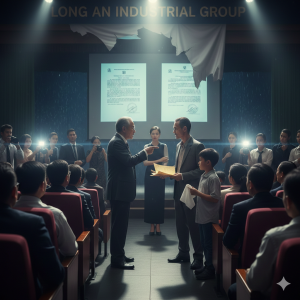
The corporation’s grand hall was brightly lit from early morning. The spotlights flooded the stage, a declaration of power. Banners hung high, the background music stately enough to convey solemnity. The seats were full: shareholders, partners, local reporters. Everyone waited for a definitive statement, an end to the name that had been sidelined for days. Quang Huy stood center stage, impeccably vested, his smile appropriate. He spoke of kinship, the responsibility to navigate the ship through rough waters, and necessary but difficult decisions. Under the auditorium, a few nods, a few suspicious glances, but mostly the silence of acceptance. Here, silence was always power’s ally.
As he began to announce the interim decision, the hall doors opened, not loudly, not dramatically, but with a sudden silence, as if someone had muted the room’s background noise.
Quang Vu walked in from the back, slowly but with a straight back. His face was thin, his complexion pale, but his eyes were unwavering. Beside him was Minh Hai, small among the expensive suits, clutching a plastic-wrapped file.
A collective gasp broke the silence. The billionaire, declared incapacitated, stood there in the flesh. Quang Huy froze for a fleeting moment, long enough for the smile to slip from his lips.
Quang Vu did not speak immediately. He walked onto the stage, facing his uncle, his once-solid pillar of support. Between them, the cold white light sharply defined every wrinkle, every trace of exhaustion.
“I am not dead,” Vu said, his voice not loud, but resonating. “And I have not lost my mind.”
A noise rose and then subsided. Quang Huy regained his composure, intending to interrupt, but Minh Hai stepped forward. The boy trembled slightly but did not retreat.
“I beg your permission,” Hai said, addressing the hall. “I only bring what the adults tried to hide.”
The white cloth was placed on the table before the microphone. Hai briefly recounted the rainy night, the abandoned warehouse, the binding and gagging of Quang Vu. Mai Lien stood up from the seats below, confirming the chemical smell that caused exhaustion. Not enough to kill, but enough to cast doubt on the victim’s capacity. The gazes began to change. Doubt shifted direction.
Hai opened the file. The papers were held up for comparison right there. Misaligned seals, overlapping times, repeated signatures. No expert jargon was needed; simply placed side-by-side, the abnormality was clear.
“This is the workplace accident file,” Hai’s voice was clearer. “The dead person was my father. And there are many others.”
Quang Huy sneered, attempting to refute with laws and procedures, but Hai placed the handwritten envelope on top. The old letter, yellowed paper, firm handwriting. Hai didn’t read the whole thing, only the final sentence, the one about the silence that kills.
No one in the hall laughed anymore.
Quang Vu stepped up. “I made a mistake,” he said, turning to the crowd. “I was silent when I should have spoken. I take responsibility for that.” He turned to Quang Huy. “But you chose to go further. You turned a mistake into a system. You staged my accident, ruined my health to seize power.”
Quang Huy exploded. He yelled about family, about sacrifice, about how everyone had to get their hands dirty to protect the legacy. He pointed at Vu, calling it betrayal. But his words no longer held sway. When the truth was laid bare in the light, empty morality only exposed more fear.
Representatives of the authorities appeared from the wings with an order for temporary suspension and investigation—not dramatic, just dry words, yet heavy as hammers. Quang Huy was asked to leave the stage. As they approached him, he turned to look at Vu one last time. In his eyes, there was no longer hatred, only the weary emptiness of someone who had believed they were right for too long.
The hall fractured into a mosaic of emotions: outrage, shame, and relief. Minh Hai stood motionless, his hands hanging loose. He didn’t feel victorious; he only felt a door had opened, letting in a cold wind that carried the faint hope that those who were gagged would finally be allowed to breathe.
Quang Vu bent down to Hai’s level. “Thank you,” he said.
Hai shook his head. “I just didn’t want anyone else to end up like my father.”
The lights still shone, but this time they illuminated not just power, but the raw, imperfect truth. And on that stage, a poor boy stood firm so that justice would no longer be an empty promise.
One Year Later.
Long An was in a mild, sunny season, without the torrential rain of that fateful night. The old rented quarter was still there, but less dark; a few light bulbs had been replaced, the muddy alley repaired. Small, quiet changes, enough for the residents to feel they weren’t forgotten.
Minh Hai stood before the gate of a newly painted low building, a simple sign above reading: “Light Class.” The boy was taller now, thin but strong. He still helped people collect scrap in the afternoons, but he attended class regularly in the mornings. Teachers knew Hai was quiet and often looked into the distance, but his eyes no longer avoided theirs as before.
In a small room at the end of the building, Quang Vu looked out the window. He no longer appeared in the news with glamorous titles. The investigation had not fully concluded; there were responsibilities he had to bear, old decisions that could not be erased with a simple apology. He accepted this. The only thing he kept was his promise: not to let silence create more victims. This room, once an old factory warehouse, was now converted into a consultation and support center for workers injured in accidents.
On the wall, a small framed picture contained a list of names of those who had died, without embellishment, only dates. In another corner lay the white cloth, neatly folded, clean, a silent reminder. It was no longer evidence, but memory.
Mr. Tu Nghia was partially vindicated. His health was weaker after the days he was held for questioning. His name was no longer associated with the crime of breaking and entering. He often sat on his porch, mending clothes for neighbors, his eyes calmer watching Hai return from school. He still coughed at night, still startled in his sleep. But he no longer carried the fear of having to bow his head for a lifetime. Hai’s mother had not yet returned home; her case file was reopened, moving slowly through cold bureaucracy. Justice did not run as fast as people wished, but it had begun to rise to its feet.
Quang Vu did not seek to return to his former peak. He chose to stay in Long An, close to the places he had once overlooked. Sometimes he came to the Light Class, sitting in the back, listening to the children spell. No one called him a billionaire. He found that relief. He learned to listen, learned not to shy away from difficult questions. Every time he looked at Hai, he saw an uncompromising, yet necessary, mirror.
Some afternoons, Hai and Vu walked along the riverbank, the water flowing quietly, indifferent to who was right or wrong. Hai asked childlike questions. “Why are adults afraid of the truth?” “Why are the poor easily doubted?”
Vu didn’t always have the answers. He said, “Because power is used to being shielded by silence.”
Hai was quiet for a moment, then said, “Then I will speak.”
One evening, after the class lights were turned off, Hai stood alone. He looked around the small room, where laughter and reading voices still lingered. He remembered the rainy night, the dark warehouse, the white cloth stuffed into a stranger’s mouth. He understood that some wounds never disappear; they only change the way they exist. But it was these very wounds that pushed him out of fear.
Outside, life still held many dark corners; bad news still traveled faster than the truth. The vulnerable still had to strain to prove their innocence. But Hai no longer felt alone. He had learned that sometimes, all it takes is one person daring to believe, daring to stand up, for the wheels of justice to begin to turn, however slowly and heavily.
Before closing the door, Hai turned back to look at the Light Class sign. He smiled very faintly. Justice may be late, but when it arrives, it doesn’t need glamour. It only needs little people brave enough not to look away anymore.
Would you like me to write another story based on a different plot, or perhaps explore a specific theme from this story in more detail?
Disclaimer : This content may be created by AI for entertainment purposes. Any resemblance to real persons, events, or places is coincidental.