FATE UNDER THE DRIZZLE
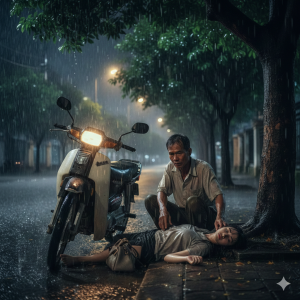
As the night deepened over Saigon, the persistent drizzle escalated into a torrential downpour, cold and chilling, drenching the city in sheets of white water that blurred the yellow streetlights. In that damp, eerily quiet space, Hoang Vinh, the poor motorbike taxi driver, his skin weathered and dark from sun and wind, pulled his old motorcycle to the side. With hands shaking from the cold, he removed his phone to turn off the ride-hailing app. It was past eleven, and the last ride had drained the last of his energy. Fortunately, he had earned enough for his rent and a small extra amount to send back home for his mother’s medicine.
He adjusted the collar of his thin, cheap plastic rain poncho, feeling the cold water seep down his spine. His simple dream at that moment was the warmth and dryness of his cramped rented room. But Fate, in a cruel twist, chose this night to tightly bind the destiny of a decent man to the fragile life of an affluent young lady.
Vinh restarted his trusty old Dream motorcycle, deciding to take a shortcut through the dark canal embankment area, a deserted road shaded by massive, gloomy trees. As he drove intently, his yellow headlight beam suddenly swept over an anomaly lying haphazardly by the roadside near a large samanea saman tree. The instinct of a man who had scraped a living on these streets for years made his heart skip a beat. It wasn’t litter. It was a person.
In the torrential rain, Vinh put down the kickstand. His initial caution against staged robbery traps instantly gave way to genuine panic when he realized it was a young woman. She was curled up, motionless, her long hair plastered over half her face. Her attire—a finely tailored dress and a small, high-end designer handbag discarded in the mud—betrayed her privileged background. A “golden branch and jade leaf” of society was gasping for air in the gutter.
“Miss, oh Miss!” Vinh gently shook her shoulder. Her body was limp, ice-cold. Her face was deathly pale, her lips blue with cold. He placed his trembling index finger near her nose: a faint, fragile wisp of breath, so weak it felt like it could extinguish at any moment. She was still alive, but her life hung by a thread.
The stark contrast between him—the poor, muddy motorbike taxi driver—and her—a symbol of wealth at the brink of collapse—created a tragic and poignant scene. The conscience of an honest man, the inherent goodness ingrained in the blood of the country boy, forbade him from leaving. Vinh dimly sensed that her presence here was no simple accident. She seemed like an expensive toy abandoned by someone, or someone who had fled a tragedy and collapsed from exhaustion. Fear crept in: If she dies in my arms, will I be blamed as the perpetrator? The line between doing good and suffering the consequences is dangerously thin in this society. But looking at her blue lips, the human part of him surged, crushing all calculations of self-interest. He knew he couldn’t leave her here.
Vinh jumped up, rushing into the middle of the road, his skinny arms waving desperately for help. A taxi, then a luxurious car, sped past. His pleas were met only with dismissive horns, blinding headlights, and cold indifference. They feared trouble, the police, or simply being lured into a robbery trap. In this vast city, indifference is often the necessary shield for self-preservation.
Vinh stood isolated in the junction, a bitter sense of helplessness choking him. His eyes caught sight of her small, pale hand, dangling and trembling in the frigid wind. That image pierced his wavering conscience like a needle. He remembered his mother back home, and how she too hoped for a helping hand when sick. If he left tonight, he might never find peace on a rainy night again.
The decent man’s conscience, though battered by poverty, flickered into a flame. In this moment of life and death, it roared to life, burning away all self-serving calculation. “The hell with it, even if I die, I have to save her first!” Vinh cursed under his breath to steady himself.
He couldn’t transport an unconscious person on a motorbike in this weather, and calling an ambulance would take too long. Vinh gritted his teeth and made a daring decision: to carry her on foot. The district hospital was only about two kilometers away; taking the shortcut through the maze of narrow alleys, a route only local motorbike drivers like him knew well, might be faster than waiting in vain. He parked his precious Dream motorcycle against a closed door, securing it with a thick chain lock to a nearby tree, silently praying to his ancestors to guard his only means of income. He took off his own soaking, rough jacket, covering the girl, then stooped down.
“Miss, hold on, I’m taking you to the hospital.”
Vinh hoisted her onto his back. She was lighter than he expected, but in her unconscious state, her body was strangely dead weight, like a sack of rice dragging him down. He started running. He plunged into the pitch-black alley, where the streetlights couldn’t penetrate. His bare feet in worn rubber sandals slapped and splashed on the waterlogged path. The rain lashed his face and stung his eyes. Vinh’s breath came in ragged gasps, mixing with the sound of the rain drumming on the corrugated iron roofs of the houses. He had navigated this shortcut thousands of times to avoid traffic jams, but never had it felt this long, this arduous.
Carrying a person while running in the rain was nothing like driving. The weight pressed on his spine, his tired legs—sore from pedaling all day—were now straining to endure. In some flooded sections, the water reached his calves, trash swirling and hitting his shins. He slipped and almost fell, but he braced himself, gripping the slimy cement ground with his toes to keep balance. He held onto her thighs tightly, gritting his teeth against the shooting pain in his lower back. He dared not fall. If he fell now, the girl on his back might never wake up.
Hold on, Vinh, almost there, almost there. He hypnotized himself. Sweat poured off him, mingling with the bitter rainwater flowing into his mouth. The girl’s faint, warm breath on the back of his neck was a reminder, an invisible rope pulling him forward. He felt her weak heartbeat against his back, so fragile that he feared if he paused even for a second, it would stop forever.
Finally, the bright white light of the high-pressure lamps and the red cross sign appeared at the end of the alley. The hospital. Vinh poured his last ounce of strength into his legs, racing toward the light, leaving behind the haunting darkness and the winding alleys.
The automatic glass doors of the emergency room slid open with a soft mechanical groan, revealing a world starkly different from the chaos outside. Vinh stumbled in, bringing with him the cold rain and the strong smell of mud and sweat that clashed with the sterile odor of disinfectant. “Doctor! Emergency! Someone fainted!” His hoarse shout tore through the silence of the corridor.
A gurney was quickly rolled over. The moment her weight lifted from his shoulders, Vinh felt his body go strangely light. He swayed, his knees knocking, then buckled, only managing to stay upright by bracing himself against the wall. He stared blankly as the gurney was rapidly pushed toward the resuscitation room. White-clad figures surrounded the girl, issuing sharp, concise medical orders. In that instant, Vinh felt like an intruder, a strange creature who had trespassed into a forbidden territory.
The cold white neon light of the emergency room shone mercilessly, exposing the pathetic, miserable appearance of the man who had just performed a noble deed. His old, sodden shirt clung to his skinny body. Rainwater dripped steadily from his pants onto the polished floor, forming dark puddles. His worn rubber sandals, caked with mud from the flooded alleys, left conspicuous dirty footprints on the pristine white tiles. A baseless sense of shame welled up. He withdrew his feet, trying to shrink his existence into a corner, so as not to further stain the clean, sanitized space.
The cold air conditioning chilled his soaking body, making him tremble uncontrollably. His teeth chattered. He hugged himself, trying to retain some fragile warmth. But the physical cold was less intimidating than the cold creeping into his mind. He began to feel the eyes—curious, pitying, and even disgusted—of a few other waiting family members. They looked at him like a homeless person, an addict, or a criminal on the run, not a savior.
A young female nurse, holding a clipboard, strode quickly toward him. She stopped a safe distance away, her eyes scanning Vinh from head to toe with undisguised scrutiny. The smell of mud and sweat seemed to make her wrinkle her nose slightly, a gesture subtle enough to sting Vinh’s self-respect.
“Are you the patient’s relative?” the nurse asked, her voice flat and professional, lacking warmth.
Vinh stammered, rubbing his hands together to stop the shivering. “N-no, miss. I… I’m a motorbike taxi driver. I saw her collapse on the road in the heavy rain, so I carried her here. I don’t know her.”
The nurse’s carefully shaped eyebrows rose. She looked at him, then at the blank admission form in her hand. Suspicion clouded her eyes. A poor man carrying a beautiful, well-dressed young woman to the hospital late at night, claiming “I don’t know her”?
Vinh suddenly remembered, his calloused, trembling hand reaching into the soaking shirt, where he had carefully guarded an object throughout the run. He pulled out a small black leather handbag, its shiny metal logo glinting under the lights. It was the girl’s bag, which he had picked up and kept tightly with him, afraid of it being stolen or lost along the way. “This, this bag was lying next to her, miss. Maybe her papers or phone are inside. You can check if you can contact anyone.”
Vinh held the bag out with both hands. The nurse looked at the luxury brand bag, then at Vinh’s dark hands, his fingernails still showing traces of dirt. She did not immediately reach for it, subtly taking a step back, her eyes narrowing in caution. That hesitation was like a splash of cold water in Vinh’s face. He understood that look. It was the way people look at a potential thief.
“Put the bag on that stainless steel table,” the nurse gestured with her chin toward a nearby table, her tone becoming noticeably colder and more defensive. “We will inventory the assets in front of a security guard to ensure nothing is lost.”
That phrase—to ensure nothing is lost—was like an invisible knife stabbing his self-respect. He swallowed, his throat dry and bitter. He wanted to explain, to say I guarded it more carefully than my own life. I haven’t even opened it. But faced with the cleanliness and authority of the white lab coat and the condescension of the world, his words seemed to catch in his throat.
Vinh silently placed the bag on the table, stepped back, his hands hanging loosely, awkwardly by his sides. He had saved a life, he had done a good deed. But why was his feeling not joy or relief, but anxiety and humiliation? It was as if he had walked into an invisible trap, and his poverty was the bait.
About 30 minutes later, the heavy silence of the hospital corridor was ripped apart by rapid footsteps and chaotic sounds echoing from the main entrance. A group of people stormed in like a whirlwind, carrying the air of privilege and upper-class panic.
Leading them was the middle-aged woman, the girl’s mother, heavily made-up but with her cosmetics smeared by tears. Closely following her was a young man, hair slicked back, his face flushed with anger and worry, wearing an expensive polo shirt. Trailing them, moving slower but radiating a subtle danger, was a man around 30, dignified in a sharp suit, but whose eyes behind gold-rimmed glasses were cold and sharp as a scalpel—the ex-boyfriend.
When the nurse pointed towards Vinh: “This is the man who brought your daughter in,” the atmosphere instantly froze.
“Who the hell are you? What did you do to my sister?” The younger brother aggressively rushed forward, his eyes bloodshot with ferocity. He looked Vinh up and down with undisguised contempt, as if viewing a lower life form that had just crawled out of a sewer.
“Motorbike taxi?” The mother hissed, stepping in front of Vinh. Her eyes scrutinized his ragged appearance, then fixed on his dark, calloused hands. A terrifying scenario instantly played out in her mind: motorbike drivers, vagrants taking advantage of the rainy night to rob or assault innocent girls. Societal prejudice was a firm wall, preventing her from seeing the simple truth of kindness. She didn’t believe, or rather, she refused to accept, that her cherished daughter could be saved by someone who looked this despicable without a dark secret behind it.
“You’re lying!” The younger brother grabbed Vinh’s soaking shirt collar and shook him violently, making him stagger. “My sister drives a car! How could she faint on the road for you to find? Did you block her way to rob her, or did you stage an accident to knock her down? Tell me, what did you do to my sister?”
“Who knows what he was planning,” the ex-boyfriend slowly stepped closer. He stood by, hands in his pockets, his face calm but his words added fuel to the fire. He knew better than anyone why the girl ran away. He knew about the argument in the car and her despair when she ran out into the rain. But he needed a scapegoat. He needed to divert the family’s attention from the true cause, which was him. And Vinh—this poor, lowly motorbike driver—was the perfect pawn.
“Auntie,” he turned to the mother, his tone feigning concern but laced with malice. “Times are dangerous. Look at him, shifty and dirty. It’s very possible he saw Lan alone and planned an assault, causing her to panic and run away, only to collapse from exhaustion…” He left the sentence unfinished, letting the silence sow fear and extreme disgust into the distraught mother’s mind.
The polished man’s words were like a fatal stab, triggering the mother’s deepest fear. She screamed, lunging to pound on Vinh’s chest. The blows were weak but contained absolute contempt. “You bastard! Give me back my daughter! If anything happens to her, I’ll make sure you rot in jail! You gutter trash, how dare you lay a hand on her!”
Vinh stood motionless, enduring the assault. The vicious insults like bastard and gutter trash stabbed painfully into his heart. He wanted to scream, I just saved your daughter! But his throat was choked. He realized that to these people, his poverty was a crime. The crime of being poor, of looking disreputable, had stripped him of the right to be believed, the right to explain.
“I swear, I swear to God…” Vinh stuttered, tears welling up in his red-rimmed eyes. “I didn’t take anything. I gave the bag to the nurse. I only wanted to save her.”
“Save her?” The younger brother sneered, a bitter, contemptuous laugh. “Someone like you trying to be a hero to save a beauty, huh? Look at yourself, filthy and stinking. Only God knows where your dirty hands touched my sister when you carried her!” That insult hit the absolute limit of his self-respect. Vinh glared at the young man. He was poor, yes, he did manual labor, yes, but he had never sold his conscience. He had carried the girl with the utmost respect and care, as if she were his own sibling. Yet, that act was now twisted into lecherous depravity through the lens of the rich man’s prejudice.
The chaos peaked when the hospital security guards rushed over to intervene. The younger brother still wouldn’t let go, pointing directly at Vinh and yelling: “Hold this guy! Call the police! I suspect him of assault and robbery! Don’t let him escape!”
Vinh was pinned between two large security guards, as if being escorted as a criminal. He didn’t struggle, letting his arms hang loose, his eyes fixed blankly on the emergency room door. An immense bitterness rose in his heart. He remembered running desperately in the rain, the girl’s weak breath on his back. Then, he only thought of snatching a life back. Now, facing the cold judgment of humanity, he felt so small and isolated.
The ex-boyfriend stepped back, a subtle, cold smile playing on his lips. His plan had succeeded in the first step. All suspicion was directed at the poor motorbike driver. No one remembered to ask why the girl was on the street alone at that hour. The truth was being obscured by the fog of prejudice and malicious calculation.
Vinh stood there, surrounded by suspicion, swallowing his tears, becoming the culprit in the very fairytale of kindness he had just woven. The two security guards pulled out handcuffs. The sound of metal clanking was dry and chilling, like an invisible sentence being passed.
Just as the cold metal was about to touch his wrist, a soft sound came from the girl’s state-of-the-art phone on the nurse’s desk. The screen lit up. A message unsent.
“I’m sorry. I can’t take it anymore. If anything happens to me, know that it’s all because of him…”
Everyone held their breath. The mother rushed to grab the phone, her face pale with horror. The ex-boyfriend’s face turned ashen, his eyes behind the gold-rimmed glasses revealing uncontrollable panic. He knew the name in that message wasn’t the motorbike driver.
And then, the emergency room door opened. The girl, still weak but with open eyes, was being wheeled out on a portable bed. She looked directly into Vinh’s tormented, humiliated eyes, held tightly by the two guards.
In the deathly silence of the hospital corridor, amidst the unfinished accusations and the suspended handcuffs, the girl spoke softly, her voice weak and breathless, yet clear as an alarm bell:
“Mom… Don’t hurt him. He… he saved me.” She paused, her gaze shifting to the ex-boyfriend, who stood frozen, trembling with unconcealed fear. She uttered a second sentence, the one that salvaged the decent man’s honor and exposed a deeper tragedy: “The one who hurt me… it wasn’t him.”
That weak whisper hit like a lightning bolt. The mother let go of the phone. The handcuffs fell to the sterile floor with a dry, cold clink. The ex-boyfriend took a step back, his face drained of all color.
Hoang Vinh, the man stained with mud and poverty, stood upright. He had not touched the girl with any ill intention. He had simply carried a life through the rainy night, shouldering a human soul and his own goodness against the doubt of the entire world.
He didn’t utter a word. His eyes held no resentment, only exhaustion and the relief of vindication. He understood: his kindness had been proven, not by his own defense, but by the life snatched back from the brink by the girl herself.
Vinh quietly turned and walked away, leaving behind the chaos of the elite, the mother’s regret, and the ashen face of the dignified man. He walked toward the exit, where the cold of the night still lingered. He needed to return to his trusty Dream motorcycle, to his hot instant noodles, to the simple dream of a poor working man.
Disclaimer : This content may be created by AI for entertainment purposes. Any resemblance to real persons, events, or places is coincidental.