Beneath The Cold Light of Betrayal
The torrential July rain lashed down on the city, splattering against the reinforced windows of the Military Hospital, creating a cold, tapping sound like the wails of despair. Yet, the chill outside was nothing compared to the freezing atmosphere in Colonel Tran Phong’s luxurious office. The dense, pungent smell of antiseptic stabbed at the senses, overwhelming any remaining human warmth, transforming the room, adorned with glittering medals, into a dark, psychological prison.
The sharp thwack of paper hitting the wooden desk shattered the false silence. Tran Phong stood there, his tall silhouette in the olive-green military uniform that should have signified protection and trust. Instead, it exuded a suffocating, suppressed murderous intent. He didn’t sit; he lunged, seizing the collar of the white blouse worn by the woman standing opposite him, slamming her against the cold wall. His fingers were taut with strain, squeezing until his knuckles were white, showing no mercy, though the woman in his grasp was the wife he had shared a bed with for three years.
Bich Ngoc did not struggle. Her back struck the wall sharply, but her face remained as calm as a dead lake. Her once-sparkling, gentle black eyes were now dry, without a ripple, without a single tear. She stared straight into her husband’s eyes, a look so piercing that for a moment, Tran Phong felt stripped bare, which only intensified his rage. He spoke in guttural bursts, the sound rasping through clenched teeth, carrying the ruthlessness of a man who had discarded his conscience:
“Sign it. Don’t force me to resort to stronger measures. You know very well that in this hospital, my word is law.”
Bich Ngoc glanced at the Organ Donation Commitment form resting prominently on the desk. The bold, black words “Voluntary Organ Donation” pricked her like needles. Three years of marriage—she had retreated to the background, forsaking the glory of a legendary battlefield surgeon to be an ordinary nurse, cooking, washing, and waiting for her husband every night. Today, the reward was a paper compelling her to give up a part of her body to save An Ha—her husband’s mistress.
In Tran Phong’s eyes, An Ha was a fragile glass flower, needing to be cherished and protected at all costs. She was clinging to life in the intensive care unit, breathing only with the aid of machines. Bich Ngoc, in his view, was weeds, a resilient cactus that could survive anywhere. Cutting a piece off wouldn’t kill her. He leveraged the very strength and tenacity she had honed in the military to be cruel to her, assuming she had an obligation to sacrifice herself.
He leaned close, his hot breath against her face, but his words were cold as thousand-year ice: “An Ha can’t wait any longer. She is weak, unlike you. You can live perfectly well with one kidney, but she will die without it. Bich Ngoc, consider this either my plea or my command. Sign it immediately.”
Bich Ngoc remained silent. Her silence made the air so thick that the ticking of the clock on the wall sounded like a hammer against a ribcage. She remembered their wedding day, when this man had sworn eternal vows, promising to protect her forever. At that time, she believed him—the faith of a military woman, once given, was complete and absolute. But now, looking into his bloodshot eyes, red with anxiety for his lover, she grasped the price of blind sacrifice. She did not cry, for tears were meaningless now. Why cry when the man before her considered her life lighter than a feather?
She slowly raised her hand, not to push him away, but to adjust the collar of her crumpled blouse. This strange, composed gesture was like cold water thrown onto Tran Phong’s rage, causing him to pause. She spoke softly, her voice neither high nor trembling, yet possessing the weight of a thousand pounds, drilling deep into his mind: “You say she is weak and needs to live. What about me? I am your wife, your legal kin. Aren’t you afraid this surgery will kill me?”
Tran Phong froze. He loosened his grip but his gaze was still full of menace and calculation. He turned away, walking toward the window, looking out at the white sheet of rain, avoiding his wife’s knife-like gaze. He knew the risks, he knew Bich Ngoc’s health hadn’t been good lately, though she never complained. But the image of a frail An Ha, tearfully grasping his hand and pleading for life, overwhelmed everything. He had sold his soul to the devil and had to fulfill the bargain.
He turned back, his face hardened, without any trace of hesitation: “You are a military officer; you have the physical strength. Your test results are completely compatible. Do not try to delay or make excuses. Her life is more important than your ego right now.”
Bich Ngoc smiled, a bitter, bleak smile that concealed profound sorrow. So, in his eyes, her life was merely her “ego.” Three years of her youth and devotion were worth less than a single frown from that other woman.
She walked slowly towards the table, where the commitment form lay like a foretold death sentence. She picked up the pen, her slender fingers lightly tracing the cold barrel. Tran Phong’s eyes lit up with hope. He thought his intimidation had worked, that this taciturn wife would finally submit to his authority.
But Bich Ngoc looked up, staring directly at Tran Phong one last time as a wife looking at her husband. Time seemed to stop. She asked, each word clear and measured, nothing extra, nothing missing: “Tran Phong, just one question, think carefully before you answer. Are you certain you want to use your wife’s life to buy breath for her?”
The question was as gentle as a breeze yet as sharp as a scalpel, tearing open his chest to expose the dark heart inside. It was not a plea for mercy, but the cross-examination of a soul standing at the abyss, wanting a clear view of the real face of the man who pushed her down.
Tran Phong looked at her. He saw that in the depths of her eyes, his image was gone, replaced by an endless, dark, cold void. A fleeting moment of hesitation crossed his eyes, but it was quickly covered by ruthlessness and lust. He said nothing, no explanation, no apology; he only stared at her, and then he nodded. A decisive, casual nod, yet powerful enough to crush the last sliver of fragile hope in Bich Ngoc’s heart.
The world did not end with a bang, but with that silent nod. He chose his mistress, and he chose to kill his wife, not with a knife, but with the cruelest form of betrayal.
Bich Ngoc closed her eyes for a second, taking a deep breath of the cold antiseptic air. When she opened them, the pain had vanished completely, replaced by a terrifying determination. She had the answer she needed. She would sign this document, not because she feared him, nor because she wished to save that girl. She signed to put an end to this deceitful marriage and to open the curtain on a tragedy that he would be the one to regret most bitterly.
The pen tip touched the paper, creating a sharp scratching sound, like a knife being sharpened in the dark. The pen left the paper, leaving behind a hasty but decisive signature, like a wound just carved into her life. Bich Ngoc set the pen down, the small clatter swallowed by the rain howling outside the window.
She turned and walked out of her husband’s office, leaving behind the man who was rejoicing, holding the donation form as if it were a transit ticket for his ambition and his sinful love.
The hospital corridor was deserted, stretching deep and long like a tunnel with no exit. The blinding white neon lights shone down on the cold tiled floor, reflecting Bich Ngoc’s frail, solitary silhouette. She dragged her heavy steps, not from physical exhaustion, but because her soul was being pulled back to a distant memory, a place where she had lived most brilliantly, most proudly, utterly unlike her current silent shadow.
Seven years ago. The name Bich Ngoc was not associated with the title “wife of Colonel Tran Phong,” but as The Legend of Forward Military Medical Station No. 7.
At 25, the most beautiful age for a woman, instead of silk and glamour, she wore a white blouse perpetually stained with jungle mud and dried blood. She was called the “Fire Rose”—a wild flower growing from stone, which grew more radiant the stronger the storm, thorny, but carrying an intense life force to save others.
Memories rushed back, vivid as a slow-motion film. It was a night of heavy jungle rain, lightning tearing across the border sky. Artillery fire shook the ground beneath their feet. The makeshift medical station, nestled deep in the forest, swayed like a small boat in rough seas. The wounded poured in, their agonizing cries mixing with the commanders’ shouts, creating a chaotic symphony of life and death. In that hell on earth, Bich Ngoc stood firm like a pine tree. Her eyes, the eyes Tran Phong now dismissed as soulless, were then blazing like the night stars, filled with intense concentration and extraordinary courage. Her hands deftly wielded the scalpel, clamped vessels, stitched wounds, snatching every heartbeat for her comrades from the grasp of the Grim Reaper.
No one counted how many young soldiers she had pulled back from death’s door. They only knew that whenever they saw her small figure in the makeshift operating room, even the most agonizingly wounded soldiers felt reassured.
Then destiny came in the form of a life-and-death surgery. That night, a special reconnaissance team was ambushed. Among them was a young man, his face caked with mud and blood, a shrapnel shard deeply embedded in his chest, his breathing a fragile thread. All the doctors at the station shook their heads—equipment was scarce, anesthetic was running out, and, more importantly, the shrapnel location was too perilous; the slightest slip could cause an uncontrollable hemorrhage.
“This is too difficult. We won’t make it to the rear line in time, Ngoc!” Her colleague’s voice choked up.
But Bich Ngoc would not give up. She looked into the closing eyes of the young man, seeing in them a never-extinguished, fierce thirst for life. He was the only son of the General of the Military Medical Corps—a identity she would only learn much later. At that moment, to her, he was just a comrade, a life that could not be abandoned.
“I will do it.” Her voice rang out forcefully, cutting through the nearby explosions.
Under the flickering light of a broken generator, amidst the tremors that shook the bunker, Bich Ngoc performed the fateful operation. Sweat poured down her back, stinging her eyes, yet her hands remained steady, precise to the millimeter. She was like an artist dancing on the edge of a knife, separating muscle fibers, extracting the shrapnel from the mortal spot right next to the aorta. The moment the heart monitor—a crude, old machine—emitted regular beeps, the entire makeshift bunker erupted in relief. The young man lived. Bich Ngoc had won her gamble with death.
She emerged from the operating room as dawn broke, the faint sunlight piercing the jungle canopy, illuminating her exhausted but radiantly serene face.
With her talent and merits, her future should have been a path of glory, glittering medals, and a deserving leadership position in the Military Medical Corps General Department. But tragically, at the zenith of her brilliance, she chose to dim her light… because of Tran Phong.
Tran Phong was also there back then, but not in the operating room. He was a logistical officer—eloquent, bookish, and always immaculate, even in the war zone. He saw her brilliance, but instead of admiration, he felt a mixture of envy and possessiveness. He knew a woman who was too strong, too talented, would be hard to subdue, so he set the sweetest trap in the world—the trap of peace.
When she collapsed from exhaustion after endless surgeries, it was Tran Phong who offered his shoulder for her to lean on. He whispered sweet words into her ear about a protective home behind a closed door, about children, about dinners without the sound of gunfire.
“Ngoc, you are a woman. How long will you hold a scalpel and bathe in blood? Your hands are meant to be cherished by me, not calloused by weapons. Come back with me; I will build a fortress of peace for you. You just need to be a wife; let me bear all the storms outside.”
That promise of a Fortress of Peace struck down the Fire Rose. Deep down, she was also just a woman, beneath her tough exterior, she had a tender heart yearning for love and protection. She believed that her sacrifice of stepping back would exchange for complete happiness. She gave up a chance to study abroad, refused promotions, took off her surgical gloves to wear a wedding ring, becoming an ordinary nurse in the city hospital to care for her family, acting as a stepping stone for her husband’s advancement.
The reality came back harsh and cold. She was wrong. The fortress Tran Phong promised was, in fact, a prison for her soul. The peace he painted was only a velvet curtain concealing betrayal and exploitation. He did not love the vibrant Fire Rose of the past. He only wanted to break her wings, turning her into a compliant ornament in his collection of power. And when the ornament lost its utility, he was ready to smash it and replace it with a fresher piece—An Ha.
A single, rare hot tear rolled down Bich Ngoc’s cheek, dropping onto the cold tile floor. It was not a tear of weakness, but a tear mourning her past self. The resilient girl of those years had been buried under the dust of time and deceit, yet deep within the ashes, the fire of self-respect had not entirely gone out.
Bich Ngoc lifted her head, took a deep breath, and wiped the tear away. The glorious past was forgotten, but this painful present, she would not let it continue on his terms.
She continued walking towards the operating block, not to sacrifice, but to confront. If he wanted her to be a sacrificial lamb, she would show him how this sacrificial lamb could bring down his entire temple of ambition.
The heavy pre-op room door closed, separating Bich Ngoc from the noisy world outside, trapping her in an unnervingly sterile white space. The surgical lamp on the ceiling cast a cold, emotionless light down on the stainless steel instruments lying dormant, waiting. The clinking of metal as the nurse arranged the scalpels sounded like the grinding of the Grim Reaper’s teeth. Here, the smell of alcohol and antiseptic was no longer the scent of healing, but the thick stench of separation and death.
Bich Ngoc stood alone in the center of the room, her long shadow cast over the pale blue tiled floor, a sight that tugged at the heart. The young nurse named Lan, whom Bich Ngoc had once painstakingly guided through needlework and IV lines, now nervously approached, holding a flimsy blue and white patient gown. Lan didn’t dare look directly into the eyes of her respected senior. Her hands trembled as she offered the gown, her voice barely a whisper: “Sister Ngoc, please change. It’s time to prepare.”
Bich Ngoc looked at the gown in Lan’s hand. It was not just a piece of fabric, but a symbol of her dispossession. By taking off her regular clothes and putting this on, she would officially be stripped of her identity, becoming merely a “case,” an object on the operating table whose fate would be decided by others.
She slowly reached out, her finger lightly brushing Lan’s hand. The girl flinched as if touching hot coal, quickly withdrawing her hand and stepping back a few paces. In the wary, sorrowful eyes of Lan and the other medical staff in the room, Bich Ngoc read sympathy, but above all, fear. They knew exactly what was happening. They knew this was not a voluntary, humanitarian organ donation as the records stated. They knew the woman before them was being forced onto the operating table by her own husband, but Colonel Tran Phong’s power in this hospital was like a thick, black sky covering every ray of justice. Who dared to speak out? Who dared to defy his command when their livelihood and their families’ safety lay in his hands? Their silence was not complicity, but the helplessness of pawns on a chessboard of power.
Bich Ngoc did not blame them. She walked silently toward the curtain, pulling it shut with a sharp whoosh. In that cramped space, she shed her last layer of clothing, revealing skin pale from long sleepless nights. She put on the patient gown, the rough fabric cold against her skin, as if she were putting on a shroud while still breathing.
She walked out and sat on the edge of the gurney, her hands clasped in her lap, motionless as a stone statue.
The door burst open again. The atmosphere in the room instantly solidified. Tran Phong entered. He had changed out of his uniform into surgical green, his face covered by a mask, revealing only cold, calculating eyes. He did not approach his wife to hold her hand, offer encouragement, or utter any false words of comfort, as normal husbands do when their wives are about to face death. No. He walked straight to the vital sign monitor, his finger scrolling over the touchscreen, checking Bich Ngoc’s blood pressure and heart rate with the attitude of a merchant inspecting the quality of goods before shipment. Seeing that the indices were stable, he finally turned to her. His gaze rested on Bich Ngoc’s pale face, but there was no ripple of conjugal affection. In his eyes now, she was not Bich Ngoc, the devoted wife who had stood by him through difficult times, but merely a biological storage unit preserving the kidney he craved for his mistress.
He leaned down close to her ear, his voice low but every word was clearly and brutally spoken, chilling the listener: “All your indices are good. Be obedient and lie still. Don’t pull any tricks now. The anesthetic will put you to sleep quickly.”
Bich Ngoc looked up, deep into the eyes of the man she had once loved more than her own life. She asked softly, her voice ethereal yet containing profound sorrow: “Tran Phong, if… just if… something goes wrong with this surgery, if I don’t wake up again, will you be sad?”
It was the final question from a woman’s heart, still clinging to a faint hope of finding some scrap of humanity left in this demon. But Tran Phong crushed it instantly, most cruelly and harshly. He stood up straight, adjusted his rubber gloves, his gaze icy, devoid of emotion, skimming over her face: “Don’t ask such stupid and sentimental questions. Your job is to lie still for the surgical team. Whether you live or die? Frankly, it doesn’t matter. The only important thing is that your kidney must be viable and highly compatible with An Ha. As long as it works well in her body, your sacrifice will have some value.”
“Whether you live or die, it doesn’t matter.” The phrase echoed in her head, a sharp knife slicing the last thread of hope. It shattered every illusion of love, of marriage vows, of three years spent together. It turned out her value was confined to a single organ. It turned out her death was more useful to him than her life.
The excruciating pain should have made her scream, struggle, or break down crying. But no. When pain exceeds the human capacity for endurance, it becomes numbness. Bich Ngoc felt as if her heart had been ripped from her chest, tossed into the darkness, and crushed underfoot. Empty. Completely empty.
Then she smiled, a bleak smile that only slightly curved the corner of her lips, but it made Tran Phong instinctively shiver. It was not a smile of resignation, nor one of madness. It was the smile of awakening, of utter contempt for the man standing before her. It was like the sharpest scalpel, cutting into his dark conscience, signaling something amiss that he couldn’t yet name.
Bich Ngoc uttered a single, curt, dry word: “Fine.”
She lay down on the operating table herself, without assistance. She closed her eyes, shielding them from the blinding surgical light, and also concealing the revulsion welling up inside her for her wicked husband. The moment she lay down was the moment the docile, resigned Bich Ngoc of the past three years died. Instead, the Fire Rose, thorny and sharp from the past, was rising from the ashes, carrying the smoldering fire of vengeance.
Tran Phong watched his wife lie still, her chest rising and falling regularly, and he sighed with relief, believing everything was settled. He turned to signal the anesthesiologist to proceed, a triumphant smile briefly touching his lips. He had no idea that his ultimate cruelty today had just activated a time bomb, and its ticking was beginning right now in this frightening silence.
The squeaking sound of the gurney wheels rolling across the polished tile floor echoed in Bich Ngoc’s ears like the grinding teeth of a predator. She lay still on the narrow stretcher, her arms hanging by her sides, eyes fixed on the white ceiling. The neon lights flashing past her view, alternating between bright and dark, seemed like the final fast-forward of her life story. But no. This was not the end. This was only the beginning of an endgame she had been silently setting up, piece by piece, through sleepless nights.
People often say that when a cornered animal is pushed to the wall, it becomes the most ferocious. But for Bich Ngoc, her resistance was not loud, not clawing or gnashing. Her resistance took the form of water—soft, silently seeping into every crack, yet powerful enough to sink an entire ship.
In the dead, silent time before the anesthetic was pumped into her vein, Bich Ngoc’s mind was strangely alert. She was not afraid, despite the look of resignation Tran Phong was seeing. He thought her silence was despair, acceptance of her low status. He was wrong. Bich Ngoc’s silence was the stillness of a gun barrel before the trigger is pulled, the bated breath of a hunter when the prey has stepped into the trap.
Her hand subtly touched the edge of the patient gown. Few knew that before she was forced to change, in the brief moment in the changing room, she had completed the most crucial move. Her mobile phone—a relic Tran Phong had never paid attention to—had sent a fateful message. Not wordy, not tearful, just six words sent to a strange number she hadn’t dared to contact for seven years, though it remained silently in her contact list like an unhealed scar: “It is time to settle the debt.”
Sending that message meant she had officially activated the slow-motion bomb buried beneath the foundation of her husband’s empire of power.
Bich Ngoc recalled three days ago, when she accidentally discovered An Ha’s real medical records hidden in Tran Phong’s personal safe, a place he carelessly assumed his naïve wife would never know the code to. It turned out An Ha wasn’t near death; she wasn’t suffering from end-stage kidney failure as he claimed. The tests showed her renal function was only mildly impaired, completely treatable with conservative therapy. But An Ha, accustomed to a lavish lifestyle and afraid of lifelong dieting and medication, wanted a completely healthy new kidney to continue her endless partying. And Tran Phong, the blind lover, didn’t hesitate to devise this plan to kill his wife and save his mistress. He and An Ha’s private doctor had forged all the records, turning a routine case into a life-threatening emergency, legalizing the coercion of Bich Ngoc’s organ donation.
That night, Bich Ngoc didn’t sleep. She sat in the dark, her hands clutching the photocopied medical files, tears flowing inward. The intense pain subsided, leaving only cold hatred. She had secretly installed a micro-recorder, the size of a shirt button, onto her blouse collar this morning. All of Tran Phong’s threats—from the chokehold in the office to the brutal words, “Whether you live or die, it doesn’t matter,” in the pre-op room—were all perfectly and clearly recorded, not missing a single breath. That was not just evidence of abuse; it was steel-hard proof of the crimes of forced organ donation and abuse of power, charges sufficient to strip him of his rank and send him to prison for life.
Now, lying on the cold operating table, Bich Ngoc sensed the presence of that recorder, safely tucked into the pocket of a trusted colleague outside, to whom she had secretly passed it in the hallway.
Everything was in place. The net of heaven is large and wide, and it lets nothing through.
Tran Phong stood at the corner of the room, arms folded, eyes fixed on the monitor. He watched the steady, regular heart rhythm waves of his wife, secretly pleased. He thought he held the power of life and death, the lord of this hospital. But then, like the instinct of a wild animal sensing danger, he suddenly turned to look at Bich Ngoc.
He met her eyes. It was not the gaze of a lamb waiting to be slaughtered. Her eyes were wide, dark, and deep as an abyss, without any fear or pleading. Instead, in their depths, shone a hint of mockery, a silent pity for him. She looked at him as if he were a defeated man, a clown prancing in his own pathetic drama, unaware that the curtain was about to fall.
Tran Phong felt a pang of fear. A cold rush ran down his spine, raising his hairs. Why was she so calm? Why wasn’t she crying, wasn’t she begging at the last minute? This silence was too unusual, too frightening. It was like the flat surface of the sea before a tsunami swallows everything. He was about to step forward, about to question her one more time to dispel the invisible anxiety creeping into his heart.
But the inherent arrogance of a man who had never tasted failure stopped him. He reassured himself, ‘She’s just pretending to be strong. A weak woman, without money, without power, without relatives—what can she do to me? As soon as the anesthetic takes effect, everything will end. Her kidney will belong to An Ha, and this secret will sink into oblivion.’
The anesthesiologist, a middle-aged man with tired eyes, approached Bich Ngoc. He held up the gas mask, his voice even and emotionless through the surgical mask: “Patient, breathe deeply. Count down from 10.”
Bich Ngoc did not resist. She took a deep breath, but not to embrace sleep, but to savor the last moment of mental freedom. She looked at Tran Phong one final time, the corner of her mouth curling into a cryptic smile. Defiance. In her head, the countdown began, not for the surgery, but for his downfall: “10… 9… 8…”
The cold, sweetish vapor of the anesthetic began to fill her lungs, seeping into her brain. Her eyelids grew heavy, and Tran Phong’s image blurred, distorted, and warped. But before darkness completely swallowed her consciousness, Bich Ngoc still managed to hear another sound. Not the clinking of metal instruments, nor the hum of the air conditioner. It was footsteps.
The heavy clatter of military boots on the tiled floor, rhythmic, decisive, and authoritative. The sound echoed from afar, but it was approaching rapidly, carrying the force of justice, of thunder. She knew the recipient of her message had arrived. It was time to settle the debt.
She closed her eyes, sinking into darkness with absolute peace. Her move in the game was complete. Now was the time for the hidden Queen to overturn the board, and the Pawn that crossed the river would transform into a Dragon.
Tran Phong stood there, still unaware of the disaster rushing toward him from behind. He only saw his wife lapsing into unconsciousness and smiled the smile of a foolish victor. He had no idea that the operating room door behind him was vibrating violently, about to be broken down by the storm named Truth.
The heart monitor continued its steady, monotonous ticking, like the Grim Reaper’s knock. But precisely at that moment, another sound rose up, drowning everything else. Initially, it was just a slight vibration transmitted through the tile floor, making the medicine vials in the cabinet clink. But within seconds, it turned into a real earthquake—it was the sound of military boots. Not the rushed, chaotic steps of doctors during an emergency, but the heavy, uniform, thunderous steps carrying the power of an entire battalion.
The sound echoed from the end of the corridor, hitting the chests of those in the operating room, making the air, already thick with anesthetic, suddenly tense as a snapped wire. Tran Phong frowned, whirling around to look at the door, anger surging within him. Who dared to cause a disturbance here? Who dared to break the historic moment when he was about to save his beloved mistress? He was the Colonel, the highest authority in this area right now. He was about to open his mouth to shout, to use his power…
Just as Tran Phong opened his mouth to utter a threat, the door of the operating room, a heavy, sterile barrier, burst inward with a deafening crash that shook the entire room. It wasn’t kicked or pushed; it was seemingly hit by a wave of raw authority.
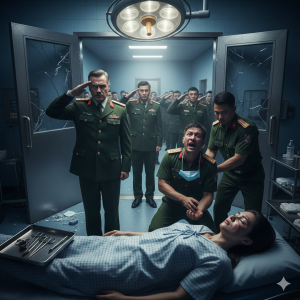
Standing in the doorway was a sight that instantly froze the blood of everyone inside. A man in the uniform of a General of the Military Medical Corps, his face carved with the severity of years on the front lines, stood amidst a throng of high-ranking military police officers and doctors from the General Department. His eyes, sharp as eagle talons, scanned the room, ignoring everyone until they landed on the frail figure lying motionless on the operating table.
The General was the very man whose son Bich Ngoc had saved seven years ago—the life that had cost her everything. He had been relentlessly searching for the legendary “Fire Rose” surgeon, whom he knew held the key to the future of the Corps, only to find her now, on the verge of being butchered by a corrupt Colonel.
The moment the General saw the unconscious Bich Ngoc, his eyes narrowed, transforming the sorrow in the room into lethal fury.
His voice was a commanding roar, a force of nature that rendered Tran Phong’s authority utterly meaningless. The General took one powerful stride forward. The General’s Chief of Staff, a stern-faced Major General, pointed an accusing finger at Tran Phong.
“Tran Phong! Đại tá (Colonel) Tran Phong! You are under immediate arrest on charges of abuse of power, forging medical records, and coercing a subordinate into illegal organ donation! Furthermore, you are being charged with attempting to murder the very person who saved the life of the General’s son!”
The words hit Tran Phong like a physical blow. His face, still half-covered by the mask, drained of all color. He staggered backward, clutching the scalpel tray for support. “General? General, sir, this is… a misunderstanding! This is a voluntary procedure! My wife… she signed the papers!”
The General didn’t even look at him. He walked straight to the gurney. The attending surgeon and the anesthesiologist, utterly terrified, scrambled backward, dropping their instruments with a metallic clatter. The General placed a massive, yet gentle hand on Bich Ngoc’s forehead. He turned his head slightly, his gaze finally meeting Tran Phong’s, and his voice was low, cutting, and full of profound disappointment.
“Voluntary? You threatened the life of a hero who was once the pride of the entire Corps. Your pathetic ‘Fortress of Peace’ was nothing but a cage of deceit. The papers she signed were the final act of a woman seeking to expose your monstrosity, not a plea for death.”
He then gave a quiet order to his Chief of Staff. “Secure the electronic records. We have the audio confirmation. And bring in the General Department’s top surgeons. Stabilize Lieutenant Colonel Bich Ngoc immediately. We are aborting this illegal procedure.”
Lieutenant Colonel Bich Ngoc?
Tran Phong’s eyes widened in horror. Lieutenant Colonel? The wife he dismissed as a mere civilian nurse, a powerless homemaker, was in fact a high-ranking military officer whom the General Department had only temporarily placed in this hospital under the guise of an ordinary nurse to facilitate her post-war recovery and “normal” life—the life he had asked her to live. He had been blind to the star he had married. The reason they were searching for the “Fire Rose” was not just to award her; it was to promote her. The message she sent was not to a friend, but to the General’s personal encrypted line—the ultimate lifeline given to her as a national asset, which she had never used until her life was on the line.
The General took a step back from the gurney. He looked around the room, then at the unconscious woman. He straightened his uniform. With the General’s Chief of Staff, the military police commander, and the head of the General Department’s Surgical Unit standing rigid behind him, the General performed the most profound gesture of respect.
He slowly brought his hand to his brow and rendered a full, military salute to the unconscious Bich Ngoc.
The hundreds of soldiers and doctors who had followed him into the hospital, now lining the corridors, saw this salute and instantly understood. The legend was not a pawn; she was a superior officer, a hero who was being betrayed.
Tran Phong collapsed onto his knees with a loud thud, his mind shattered. The knife that he intended to use to carve out his wife’s kidney was now pointed directly at his own throat. In one single, terrifying moment, his entire world—his rank, his power, his reputation, and his life—had crumbled into dust. He, the man who held the power of life and death moments ago, was now a kneeling criminal, stripped of everything, facing the judgment of the very military justice he swore to uphold. The tables had been turned completely and mercilessly.
The General lowered his hand, his eyes burning with cold vengeance, looking down at the man kneeling in shame. He spoke the final, damning words: “Take him away. Let him contemplate in solitary confinement the true meaning of ‘sacrifice’ and ‘value.’ Lieutenant Colonel Bich Ngoc’s life is more valuable than your entire wretched existence.”
As Tran Phong was roughly dragged out, hearing the thunderous, unifying sound of boots on the hospital floor—the sound of his demise—Bich Ngoc remained still on the table. The General stayed by her side, monitoring the team as they gently withdrew the remaining IV lines.
The doors to the operating room were secured, not to begin a surgery, but to protect a hero.
The legend was finally home.
Disclaimer : This content may be created by AI for entertainment purposes. Any resemblance to real persons, events, or places is coincidental.