The Hundred Billion Lesson
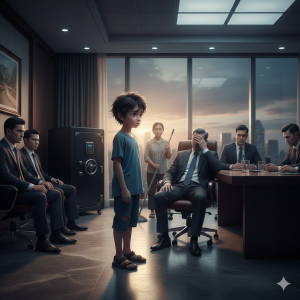
Opening: Laughter on the Upper Floor
“One hundred billion Vietnamese Đồng (VND), all you have to do is open this safe.”
The cold, authoritarian voice of Mr. Trần Hữu Lâm, Chairman of Hưng Lâm Real Estate Group, echoed in the luxurious 50th-floor conference room in the heart of Saigon. Every square meter of imported Italian marble here was more expensive than the annual income of the poor.
Mr. Lâm’s contemptuous gaze fixed on the skinny, ragged boy standing next to his mother. Around the billion-VND walnut conference table sat five wealthy businessmen, the self-proclaimed “elite” of the business world. They burst into boisterous, uncontrollable laughter, as if they had just heard the best high-brow joke.
“Lâm, you are truly a master of entertainment,” said Mr. Phan Văn Huy, owner of the largest private hospital chain in the South, wiping his eyes. “A barefoot kid trying to open a billion-dollar safe. If I film this for a reality show, it’ll be hotter than Rap Việt!”
Facing them was Minh Quân, about 12, with messy hair and a faded, torn T-shirt. His large, unblinking eyes stared at the massive, black, polished safe—an exclusive import from Japan, featuring advanced, never-before-breached biometric security.
Beside him stood Ms. Nguyễn Thị Lan, the building’s janitor, her hands tightly gripping a still-dripping mop. She bowed her head, desperately pleading for mercy.
“Please, sir, spare my son and me. We won’t bother anyone; he won’t touch anything.”
Mr. Lâm’s voice cut across her like a sharp knife: “Do you think you have the right to speak? Please be silent. After over a decade of scrubbing my company’s toilets, you finally dare to open your mouth in this conference room. I am teaching your son a lesson. The first lesson on social stratification.”
Amidst the jeers and contemptuous glances, Minh Quân looked up at his mother, then at Mr. Lâm. His eyes changed, shifting from confusion to a strange calmness. He took a step toward the safe, his face covered in dust and sweat, quietly observing.
Mr. Lâm laughed even louder: “Yes, come closer. Do you know how much this is worth? 70 billion VND. The security software alone cost over 2 billion. Do you think you can open it? If you do, 100 billion is yours. I guarantee it in front of the board of directors.”
The laughter erupted again, accompanied by claps and cheers, as if they were watching a cheap carnival trick. None of them knew they had just pushed a child into a game where they would soon pay the price, and this public humiliation of the poor was, in fact, the beginning of a bitter reversal.
Development: The Unveiling of Intellect
Minh Quân did not touch the safe or try to input a code. He simply looked up, his voice soft as the wind but sharp as a blade: “Are you sure you want me to try, sir? Because if I actually open it, will you be willing to lose 100 billion? Or are you just playing a trick to mock my mother and me?”
The room fell silent. The laughter died in the throats of the supposed superiors.
Minh Quân was not supposed to be there. This space was not for the son of a cleaner. But that morning, his school had an unexpected closure due to electrical repairs. His mother, Ms. Lan, couldn’t find anyone to watch him. Since her husband—Minh Quân’s respected father—died two years ago in an industrial accident for which the company denied responsibility, Ms. Lan became a full-time janitor, shouldering everything alone.
She worked at this building, earning a low wage, scrubbing toilets and wiping windows. She tried to keep her son in the ground-floor hallway, but a child’s curiosity led him out, and at that exact moment, Mr. Lâm appeared.
They saw Minh Quân as a small, insignificant pawn. They had money and power, and they used the boy for amusement, a rare opportunity to assert their dominance. They didn’t care that his mother was once a teacher, nor did they care about the family’s plight. They only saw a low-class person daring to trespass into their high-class domain, an unforgivable disruption.
In the conference room, laughter resumed, though more strained after Minh Quân’s question.
“Can you read? Can you calculate? Can you count to 100?” Mr. Lâm asked mockingly.
“Yes, sir,” Minh Quân replied softly, his voice even.
“So, do you know how much 100 billion VND is?”
Minh Quân looked at his mother, then back at Mr. Lâm: “Yes, sir. It is an amount of money that my mother and I, perhaps even my children, might not be able to earn in our entire lives.”
The answer stopped the room cold. It was a stark, freezing truth. Laughter quickly broke out again, but laced with discomfort.
Mr. Lâm continued the humiliation, turning his focus to Ms. Lan: “Ms. Lan, how long have you worked here? Seven years scrubbing this building’s toilets. Seven years, and no one knows your name. Seven years, and today you dare to speak up in a conference room. Do you see, gentlemen? We live in an era where even a janitor thinks she has the right to speak in a corporate meeting.”
Ms. Lan’s face was pale, her hands tightly gripping the mop.
“Tell your son the truth about his mother’s value. How much do you earn a month cleaning for me?”
Ms. Lan managed to speak: “Sir… 6.5 million VND a month.”
“6.5 million?” Mr. Lâm sneered. “That’s less than one dinner for me and these gentlemen. A premium buffet for eight costs more than your entire monthly salary. You are clearly living beyond your station by stepping into this conference room.”
Minh Quân clenched his mother’s hand and stepped in front of her, his bright eyes losing all timidity: “Sir, please do not speak about my mother that way. She works hard. 6.5 million VND is clean money. She doesn’t cheat or steal from anyone. My mother may not be rich, but she has value.”
The whole room was stunned. They were used to measuring value in money. But here, a child began to shatter that definition with love, dignity, and the courage to stand up when adults failed to be human.
Climax: The Blow of Truth
“Well, kid?” Mr. Lâm smiled faintly, stepping closer. “All you have to do is open this safe, and 100 billion is yours. Let’s start, try your luck. No one is stopping you from touching the safe.”
Minh Quân remained still, his eyes slowly scanning from one man to the next.
“Mr. Lâm,” he said, his voice quiet but clear, “May I ask one question?”
“Go ahead,” Mr. Lâm, intrigued, crossed his arms.
“If this safe is truly impenetrable, as you said—with biometric technology, auto-changing codes every hour, and military-grade protection—why would you offer 100 billion for me to open it?” Minh Quân asked, without any challenge, just pure logic.
The air in the room froze.
“If you knew for sure I couldn’t open it,” Minh Quân repeated slowly, “then the 100 billion offer is not an opportunity, but a joke. It’s so you and the gentlemen here can laugh at me, isn’t it?”
The question was a mirror smashed into the faces of those who thought they were playing a harmless game.
“I just want to understand the real reason,” Minh Quân continued. “Because I think when adults use words to shame others, especially in front of their children, that is not power—that is weakness.”
The devastating blow landed squarely on Trần Hữu Lâm’s armored arrogance.
Minh Quân looked at him decisively: “I don’t think this is a game, but a deliberate humiliation. The rich set up an impossible challenge and then laugh when the poor fail. It’s like a swimming competition where the participants are tied up from the start.”
“This is not a morality class,” Mr. Lâm tried to recover. “Do you think you know more than they do?”
“I don’t think I know more than anyone. But there are things you, Mr. Lâm, do not understand because you have never lived like me. And the things I do understand are thanks to my father.”
“Your father?” Mr. Lâm raised an eyebrow. “The man who left his wife and child in such poverty?”
“My father is gone,” Minh Quân answered, his voice firm and clear. “Two years ago, in an industrial accident. My father was a security engineer who designed protection systems for banks, financial firms, and major commercial centers. Before he passed, he often brought work home and taught me little things about codes, lock mechanisms, and how the human brain chooses passwords. To him, it was both his profession and his passion.”
“I don’t care what you know!” Mr. Lâm snapped, his breathing now irregular.
“You should care.” Minh Quân calmly replied, then turned and pointed at the safe. “This safe is a Japanese product, second-generation biometric security. But most models, if the default code isn’t changed during installation, retain a master code based on the manufacturing series number structure. If one is not careful, the outer security is just a cloak, while the inner core is easily exposed to anyone who knows the structure.”
“Master Code?” Mr. Huy leaned forward.
Minh Quân nodded: “Yes. Like a spare key. My father always said that any system created by humans has a flaw. The key is who sees it, who knows how to exploit it, and who has the ethics not to take advantage of it.”
No one was laughing now. Mr. Lâm wasn’t either. The room was tense.
“I am not here to break the safe,” Minh Quân continued. “But if you, Mr. Lâm, think being the son of a janitor means I know nothing, then you have forgotten that knowledge does not discriminate based on income, and a person’s true value is not in the money they possess, but in what they are taught and how they use it.”
Mr. Lâm stared at Minh Quân.
“Are you saying you know how to open my safe?” Mr. Lâm asked again, his voice hoarse.
“I am not. But if you ask me what the current master code is, I can tell you.”
Minh Quân walked slowly toward the safe, pointing at the small metal plate near the base: “The series number is 84710.”
He paused: “Reverse it, and you get 01748. The default master code is often the first four digits and a slight variant on the last. In this model’s documentation, the variant is to multiply the last digit by 3, which is still 0. The default master code, not changed, is 01748.”
As the number was uttered, Mr. Lâm froze. His body seemed to turn to ice.
“How? How do you know?”
“Because you didn’t change the factory default code,” Minh Quân took a step back. “My father said 70% of clients don’t change the master code. And for those with a big ego, who like to show off their safe and think technology alone is security, it happens even more easily.”
Mr. Lâm stumbled backward, his face drained of color. He mumbled something unintelligible. The other men began exchanging glances, no longer complicit in the fun, but witnesses to the collapse of a monument. The safe, which Mr. Lâm had boasted about in countless articles on supreme security, was exposed by a 12-year-old boy in less than three minutes. No tools, no touch, just the knowledge from his deceased father.
“I did not intend to violate your privacy, sir,” Minh Quân said softly, his eyes still direct. “Nor do I intend to take the money. I just wanted you and everyone here to understand that the game you played was not a game, but a test. And sometimes, the one being tested is not me, but you.”
Conclusion: True Value
Mr. Trần Hữu Lâm slumped into his leather chair. The luxurious conference room, where he had commanded authority for years, suddenly felt small and stifling. The eyes of the other businessmen had changed, devoid of excitement, laughter, or the usual indifference. Everyone looked as if they had just witnessed a silent coup, where the winner was a child in worn-out sandals and a dusty face.
Mr. Lâm rubbed his face, trying to regain composure. “If you know the code and do not open it, I consider myself indebted to you for a thank you. And as I said from the start, you are entitled to the 100 billion.”
Minh Quân slowly shook his head. “I do not need the 100 billion.”
The whole room was shaken again.
“I don’t need the money,” Minh Quân declared firmly, “but I need you to do three things if you truly want to make amends.”
Mr. Lâm was silent, forced to listen.
“First,” the boy said, “I want my mother, Ms. Nguyễn Thị Lan, to be given a job worthy of her true abilities. Before she had to quit teaching to care for me after my father’s accident, she was a High School Literature Teacher, with a university degree, experience, and passion. Instead of having her scrub toilets every day, I hope you can give her a position that matches her capacity, not out of pity, but because she deserves it.”
Mr. Lâm looked at Ms. Lan, who was standing frozen against the wall, tears streaming down her face.
“Second,” Minh Quân continued, his gaze still holding incredible composure, “I want you to publicly apologize to my mother and all workers like her for the disrespectful words you and the gentlemen here used toward their work. They are not poor in character, unlike what you displayed today.”
“And third,” the boy looked directly into Mr. Lâm’s eyes, a look never seen in children raised in luxury. “I want you to use a small part of that 100 billion to establish a scholarship fund in my father’s name—Engineer Nguyễn Văn Bình—for the children of janitors, security guards, and maintenance staff. Knowledge does not discriminate based on income, and they deserve the opportunity to learn, not to become rich, but to never be humiliated by people like you again.”
The room fell into absolute silence.
Mr. Lâm said nothing. He covered his face with his hands, perhaps to hide his shame, or perhaps the belated tears of regret. He knew 100 billion could not buy decency, but the three things the child demanded were things money could not measure. They were character, respect, and the memory of a father who used knowledge to teach his son the true value of a human being.
This time, no laughter was heard. Only the steady hum of the air conditioning, and the heavy truth they were forced to bear.
Disclaimer : This content may be created by AI for entertainment purposes. Any resemblance to real persons, events, or places is coincidental.