The Poor Student and the Dream of Saving Lives
That afternoon, Hanoi was draped in the chill of an early autumn wind. Yellow leaves drifted scattered on the steps of the Medical University, like fragments of sad memories dissolving away. Standing silently at the university gate was Lan, a poor student with thin shoulders, clutching a flimsy expulsion letter.
The letter, with the stark words “Violation of regulations, unauthorized use of medication,” felt like a deep cut into her lifelong dream. Lan’s dream of medicine wasn’t for fame or fortune, but because of the childhood days watching her mother, Mrs. Hoa, struggle to earn every penny for medicine whenever she was sick. Poverty had taught her to cherish life and the moments of saving others.
A few days prior, at the practice clinic, a frail old man clutched his chest and collapsed. Amidst the smell of disinfectant, Professor Tu Hong coldly commanded: “No authorization, do not touch him.” But Lan couldn’t just watch. Ignoring the professor’s icy stare, she trembled but quickly took a small dose of medicine to save him. The old man survived, his dim eyes expressing gratitude.
But the price was this letter.
Professor Tu Hong had sternly declared: “This profession does not tolerate rule-breakers.” Lan wondered: If obeying the rules meant letting someone die, what was the meaning of this noble profession?
She sighed, slowly walking away from the gate. The clinking of bicycle bells and vendor calls reminded her of the everyday life outside. Arriving at her small house tucked in an alley near Buoi Market, the scent of rice rolls couldn’t lift her heavy heart.
Mrs. Hoa, her mother, was wiping old bowls, preparing to go street vending. Seeing the letter in Lan’s hand, her eyes paused. After reading it, she suddenly snatched the letter and tore it to shreds: “So much money spent on school, and now we’re left with nothing! What are we going to do?”
“I told you, this job is unstable. Just quit, stop dreaming!” Her mother’s harsh words blew through the house like a cold wind, leaving Lan numb.
Lan stooped to pick up the torn pieces, thinking of the old man at the clinic who had whispered his thanks. She went inside and gently touched the old Blue coat hanging in the corner. Her mother had suffered for her, she knew. But abandoning medicine was like abandoning a part of herself.
She stood under the eaves, clutching the old Blue coat, whispering to herself: “I wasn’t wrong, was I?”
That evening, the Hanoi air was cool, carrying the fragrant smell of bún chả (grilled pork and noodles) from the nearby night market. Inside the small house, the flickering oil lamp illuminated Mrs. Hoa cleaning up after her vending trip. Exhausted, she sat on the old wooden chair: “Listen to me… I used to have dreams too, but life is harsh. I struggled to raise you, and now you have nothing. Are you going to make me suffer more? Medicine is not stable. Find another job, anything else…”
Lan lowered her head, understanding her mother’s hardship, but every word felt like salt rubbed into her long-cherished dream.
Just then, Mai—Lan’s former roommate—entered, carrying a small bag of old books. Slim, quick-witted, but pragmatic, she said: “I heard you were expelled. Who remembers those you save now? Think about it. Don’t dream anymore, no one pays back favors in this life.”
Lan took out her old diary and slowly wrote: “But I believe medicine has meaning. If no one helps, what will happen to them?”
Mai scoffed and left. Mrs. Hoa stood up, her voice suddenly sharper: “Mai is right. Listen to me. When you run out of money later, don’t blame me.” She slammed her hand on the table, the thud making the oil lamp sway. Startled, Lan looked at her mother’s thin back, her heart tangled. Abandoning medicine meant giving up the belief that she could contribute something to the world.
Under the dim moonlight, Lan walked past the rows of red lanterns at the small night fair in Hanoi’s Old Quarter. She wanted to lose herself in the crowd, letting the laughter sweep away her worries.
Suddenly, Bé Tí, a playful boy, dashed past and collided with an old man leaning on a wooden cane, dressed in a worn brown tunic. The old man stumbled, lost his footing, and fell to the ground. The dry sound of the cane hitting the pavement echoed.
The old man clutched his chest, his breathing shallow and rapid, his face pale under the lantern light.
The onlookers stirred, staring but no one dared to approach. “What’s wrong with him? What does that girl know to dare touch him?” Whispers arose.
Lan didn’t hesitate. She rushed over and knelt beside the old man. Her hands trembled slightly as she realized he was having trouble breathing—probably high blood pressure, something she had learned in medical school. Ignoring the whispers and the torn expulsion letter in her heart, she focused only on the life in front of her. She quickly used the old man’s fallen handkerchief to tightly wrap his neck to keep him warm, pressing gently on his chest to maintain his breathing rhythm.
Time passed slowly. The old man’s breathing gradually stabilized. Mr. Bay Thang (the old man’s name) opened his eyes, grasped her hand, and said faintly but clearly: “Thank you, little girl.”
Lan sighed in relief. She helped him sit up, leaning against a nearby tree. The crowd began to disperse. Just then, Bé Tí shouted: “Grandpa, who is she?”
An ambulance siren wailed, followed by Lan’s worried gaze. A tall, weathered-looking man—Mr. Ca Tung, Mr. Bay’s eldest son—ran over. He knelt beside his father, then looked at Lan: “Did you save my father? He used to be a health official here. If it weren’t for you, I might not see him again.”
Lan only hesitated, replying softly: “I’m Lan, please don’t worry about it.”
Mr. Bay Thang, now more conscious, held her hand, his voice weak but distinct: “Little girl, I will find you.”
His eyes were kind and meaningful, hiding a great plan. Lan felt an invisible thread connecting her to something bigger.
The next morning, the early sun cast faint golden rays. Lan was sweeping the yard, still pondering the previous night’s events. Suddenly, a deep, steady engine sound came from the end of the alley.
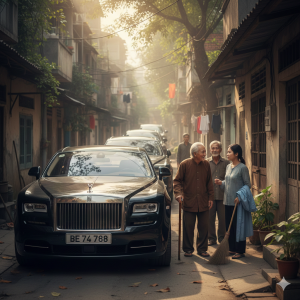
Lan looked up, her eyes widening as she saw ten luxurious cars—the first being a Rolls-Royce, followed by cars from Mr. Bay’s friends and former colleagues—quietly driving into her alley and parking tightly in front of her house. They lined up neatly, the black paint reflecting the morning sun.
The neighbors peeked out, whispers erupting: “Whose cars are these? How did Lan’s poor family get involved with such rich people?”
The first car door opened. Mr. Bay Thang, in his familiar worn brown tunic, leaning on his cane, stepped out, followed by Mr. Ca Tung.
Mrs. Hoa rushed out, alarmed: “Who is looking for my daughter? What’s going on?”
Mr. Bay walked over, his voice deep and warm: “I am Bay Thang. Last night at the fair, this young girl saved me.” He paused, looking at Lan: “I came here to thank her, and to ask her for a great favor.”
Hours later, inside the small room, Mr. Bay shared his dream: “When I was a health official, I saw so many poor and sick people with nowhere to turn. I always wanted to open a free clinic for the community. But I’m old now. Last night, you saved me selflessly. I believe, if anyone can fulfill this dream, it is you.”
Lan looked up, her voice trembling: “What are you saying? I was just expelled. How can I manage a clinic?”
Mr. Bay smiled: “I trust you because you dared to do what I once didn’t. You possess the heart I have sought my whole life.”
Mrs. Hoa sharply interrupted: “Don’t lead my daughter astray! She just lost her schooling, and now you ask her to do something so big? We’re poor, we can barely survive. Don’t drag her into this.”
Mr. Bay nodded: “I understand your concern, but I’m not misleading her. I will take care of everything. The little girl only needs her heart.”
He patiently waited. Later, Lan met the poor old woman again, who tearfully thanked her for the rice. Mai’s cynical words echoed: “No one remembers your kindness,” but looking at the old woman, Lan’s heart warmed: “If no one helps, what will happen to them?”
A decision took root in Lan’s heart. Her medical dream could not be extinguished. “I have to decide. But what will Mom think?”
The next morning, Mr. Ca Tung arrived with his father’s message: “My father trusts you more than he trusts me. That kind of heart is rare.”
Lan looked at Mr. Tung, her eyes alight with a rediscovered determination. She looked at the old Blue coat in the corner. It was all she had left. She walked over, grasped the worn coat tightly, then turned back to Mr. Tung.
She smiled, a bright smile after days of gloom, and her voice rang out, resolute:
“Tell Mr. Bay: I agree. I will fulfill his dream.”
Disclaimer : This content may be created by AI for entertainment purposes. Any resemblance to real persons, events, or places is coincidental.