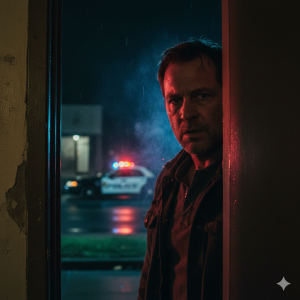
On a cold January night in White Bear Lake, Minnesota, a routine knock turned into a siege. It was about 9:30 p.m. on January 24, 2023, when officers arrived at a home on Karth Road looking for 33-year-old Daniel Lauren Holgrren, a man who had missed a court appearance tied to a domestic assault charge. They knew he was inside. They did not know how it would end. At first, the approach was gentle—familiar even. An easy greeting at the door, a soft tone with the woman inside—“Meeting Mom,” the moment hovered somewhere between neighborly check-in and official business. The officers asked for Dan. They said they just had a quick question about an old case to clear up. He hadn’t done anything wrong right now, she said. He was doing really good.
But the word “warrant” changed the air. The officers kept their voices calm, even friendly. They wanted to handle it themselves, they said, before someone else came to pick him up. A felony warrant, they finally clarified. Failure to appear. A bench warrant. He didn’t have to open the door, the woman lamented. But the door was open, and now officers were inside. That thin line—what counted as welcome—was already in dispute. And it would only grow louder.
“You’re not an officer. You’re a Nazi,” Dan told one of them. “If you want a war, I’m going to give you a war.” The night slipped into something none of them could politely talk their way out of.
The officers tried to keep it orderly. They said his name. They reminded him: you have a warrant, you have to take care of it, you’re under arrest. The tone shifted by degrees—calm explanation, then firmer phrasing, then the logistics of control. Dan’s mother—Vicki—floated between them, anxious, pleading, sometimes protective, sometimes accusing. She argued the entry wasn’t legal. She reminded them her son wasn’t violent in that moment. She worried about getting evicted if this turned into a scene. She insisted she hadn’t known about a warrant. She kept saying he didn’t need to open the door.
Officers countered: they were there to address an active felony warrant. It was current. It was live. They had to take care of it. They hadn’t forced entry; they were speaking with her at the threshold. They didn’t want to turn this into more than it needed to be.
Dan’s accusations escalated. He called the officers pedophiles. He said they strip people naked in jail and laugh. He accused them of taking advantage of a “vulnerable adult schizophrenic”—his mother—to gain access. He revisited old wounds: being abducted into foster care. He framed the entire encounter as an attack, a setup, an illegal intrusion. He described himself as ready for war. “Come and get it,” he said. “We’re going to have fun tonight, aren’t we?”
The officers tried to steer him back to something procedural: come out, get booked, get it over with. He refused, dug deeper. He said he wasn’t going anywhere. He said he was prepared to die.
The apartment became cramped with presence and tension. Seven officers by someone’s count. The hallway tight. The bedroom door a boundary line. The officers called for equipment—a shield, then a pepper ball gun. Sergeant Eric Gados arrived with it while Sergeant Sandell stepped away to grab the shield. Someone asked who had lethal, who had Taser. Someone asked if Dan had any weapons. His mother insisted he didn’t have anything. But the officers heard movement behind the bedroom door. He was “around.” Something rattled. And nothing felt certain.
Dan’s mother tried to step into the breach. She said she would bring her son out. The officers refused to let her into the bedroom. She insisted he would never hurt her. She begged them not to hurt him. They gently but firmly moved her aside—“Please don’t make me force you along”—out of the immediate line of fire, worrying she’d get caught in the door, the threshold, the cross of it all.
The officers kept negotiating. “Are you ready to end this calmly?” they asked. “Come on out then.” Dan refused. “We’re talking right now,” he said. “What do you got to say?” He dared them to come in. He mocked the pepper ball gun. He pushed further into the idea that the only way out was confrontation. The officers arranged positions. Lethal, less-lethal, shield. They tried again to get his mother to leave the apartment altogether. She hesitated—embarrassedly explaining she wasn’t dressed properly, asking for a jacket. They waited while she collected herself. Even then, every footstep echoed.
Inside the bedroom, the soundscape sharpened—movement, muttered declarations, the thud of readiness. Dan said he was defending himself. He said any aggression would be on them. He told them again to leave. The officers gave commands. They warned. They tried to position rescue and extraction plans. They monitored batteries and radios. They urged Dan to come out with his hands up. They asked each other where the Tasers were, who had lethal, who had the door.
And then, all at once—everything happened.
“Shots fired.”
The bedroom exploded with sound—applause-like cracks of gunfire mixed with the pop and scatter of pepper balls. An officer went down. “I’m hit, man. I’m hit.” The room scrambled into motion—“Get out! Get out! I need the door open!”—and officers dragged their partner away. “Where are you hit?”—“Upper left leg, abdomen, pelvis,” would later become the clarifying truth. Right now, all anyone knew was that he was bleeding and they needed to get him out now.
They pulled him into the hall, out of the apartment, toward the squad. “Get a tourniquet on him.” “Where am I?” he asked. “Right there,” someone said—feeling for wounds even as they moved. “Let them know we’re self-transporting!” a voice barked over the chaos. They raced the squad car to meet the ambulance, lights and urgency flaring across the winter night. The officer—Ryan Chic—was still conscious. The team was all adrenaline and practiced care: “Take a breath. We got it.” They found fire en route, flagged emergency personnel, and handed him off into the bright glare of trauma care.
Back inside, the stand-off tightened. Dan shouted that he’d been hit too. He wasn’t in custody. He still had a weapon. He said he was ready for war. He told them they could shoot from where they were. He goaded, threatened, refused. They deemed him still a threat. SWAT converged. The yelling shredded the night: commands from the hall, retorts from the bedroom. Gas cannisters and chemical irritants eventually filled the air. The room became unlivable.
And finally—crawling, unarmed, choking on the chemicals—Daniel came out of the bedroom and surrendered.
Once the scene was secure, officers searched the apartment and recovered a Smith & Wesson 9mm handgun. They booked Daniel Holgrren into Ramsey County Jail. The charges matched the violence of the night: first-degree attempted murder and four counts of first-degree use of deadly force against a peace officer. The original domestic case—whose missed court date had drawn them there—hung in the background.
Months later, the courtroom wrote the final lines. In August 2023, one count of first-degree assault and the entire case file for the original domestic incident were dismissed as part of a plea deal. Holgrren was sentenced to 19 years in prison with credit for 213 days served. Under Minnesota’s sentencing guidelines, he could be released in September 2035 to serve the remainder of his term on supervised release.
Officer Ryan Chic survived. He underwent surgery and recovered. About seven months after the shooting, he returned to active duty—and his colleagues welcomed him back with open arms. The night that began with a polite knock ended with scars—legal, physical, and otherwise—that would take years to fade. But the ledger was written. The charges were entered. The cells and schedules were assigned. And the building on Karth Road, once bright with shouted recriminations, went quiet again.
– The encounter began as an effort to address a missed court appearance tied to a domestic assault charge, with officers confirming an active felony bench warrant for failure to appear.
– Entry hinged on a contested threshold: the officers spoke with Dan’s mother at the doorway and moved inside; Dan repeatedly claimed illegal entry and exploitation of a vulnerable adult.
– Escalation moved from verbal defiance to tactical preparation: calls for shields, pepper ball deployment, and positioning of lethal and less-lethal options.
– The critical moment: gunfire from the bedroom wounded Officer Ryan Chic in the upper left leg, abdomen, and pelvis; officers evacuated him under fire and self-transported toward medical aid before handing him off to emergency responders.
– Resolution: SWAT deployed gas and chemical irritants; Daniel surrendered unarmed, and a Smith & Wesson 9mm was recovered inside.
– Legal outcome: charges included first-degree attempted murder and four counts related to use of deadly force against a peace officer; a plea deal in August 2023 resulted in a 19-year sentence with 213 days’ credit, potential supervised release beginning September 2035.
– Aftermath for law enforcement: Officer Chic recovered and returned to duty approximately seven months later, welcomed back by his department.
This is the story as it unfolded: a door opened to a conversation that could have remained procedural—and instead became a siege, a shooting, and a reckoning that will outlast the winter night it began.
Disclaimer : This content may be created by AI for entertainment purposes. Any resemblance to real persons, events, or places is coincidental.