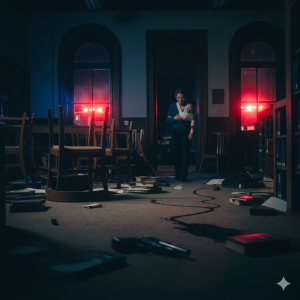
A quiet afternoon at the Clovis-Carver Public Library shatters beneath brutal, echoing gunfire. Ordinary moments—books, whispers, children at computers—are thrown into chaos as a deranged teenager, dressed in black, unleashes violence with no comprehensible motive. People scatter. Some freeze. Others plead. Police race toward the unknown, prepared to face the same threat themselves if it means stopping the carnage. Within minutes, the building becomes a maze of terror and decisions that no one should ever have to make.
– It’s the afternoon of August 28, 2017. In Clovis, New Mexico, a lone figure in black approaches the library’s front doors. He doesn’t enter immediately. Instead, he circles back to the restroom, his movements quiet—at least now.
– Minutes earlier at home, he recorded an ominous message: by the time anyone watched it, “the deed” would be done. He apologized in advance to those affected. He spoke to his family, asking them to remember happier times, telling his girlfriend he loved her and wanted to marry her. He insisted the plan was his alone: “No one made me do this,” he said. “It’s just me being mad.” He took a last picture for Snapchat.
– In the final seconds before the shooting, everything looks ordinary enough to be chilling. Then the sounds erupt. The doors. The confusion. The stampede. At least one camera captures the scene, blurring the violence but not the terror.
– A few manage to escape through a side door. One woman turns back just long enough to rescue an oblivious bystander before fleeing.
– Inside, others are trapped. Panic floods the stacks. Someone begs, “Papa, please save me.” A family huddles behind the information desk, deciding they cannot wait out the nightmare any longer.
– A man outside—the husband and father of two trapped inside—calls 911 as he walks into the library to rescue his wife and child. He sees multiple people down. He tells his loved ones to stay alive. He moves toward them anyway.
– Police race to the scene. The shooter roams, hunting victims from room to room. Officers enter to a dread thick enough to choke on—every corner, every door conceals possibilities: victims, suspects, or the gunman himself.
– The commands are sharp and relentless: “Put the phone down!” “Hands up!” “Step away from the door!” No one is beyond suspicion. Officers briefly detain even frightened patrons, handcuffing some—an unusual sight, but with so little known, they can’t afford assumptions.
– Officers corner groups and sweep spaces with methodical caution. Witnesses point out a skinny suspect. One officer brings someone over: “Is that him?” “Yes, sir.” They move to secure the area.
– The shooter is soon found handcuffed on the floor near the information desk. Before police arrived, he had approached a man, Lupe—who had called 911—with a slight smile and told him to hang up. Lupe said the cops were right behind him. The shooter then walked back to the main room to surrender.
– Less than five minutes pass between the first shots and the capture. Still, chaos lingers. At the building’s rear, officers don’t know if there’s another shooter or if the right suspect is in custody. Outside, they push bystanders across the street, establish perimeters, and block sight lines.
– Inside, the sweep continues. Officers coax out survivors. A woman, wounded in the shoulder—Jessica Thrasher, an assistant librarian, married to an officer—emerges from a back closet. “Is she all right?” “She’s hit in the arm, but she’s fine right now,” someone answers. “Fine” is not accurate, but she will survive.
– In a back area, officers identify the fallen: circulation assistant Wanda Walters and children’s librarian Christina Carter. Both are dead.
– A boy is carried out: 10-year-old Noah Molina, who had been in the restroom at the same time as the suspect, moments before Noah and his big sister were shot. More victims appear: library patron Howard Jones and circulation assistant Jessica Thrasher among the wounded. Officers, shaken, mutter about nearly firing through a door earlier, uncertain who was behind it.
– Two guns are found: .380 shell casings, another pistol nearby. Police drag the suspect outside to the front lawn to transfer him. He is oddly calm, asks about his pants, mentions peppermints, allows his pockets to be searched. Officers don’t trust the calm.
– He’s transported to the police station. Back at the library, first responders tend to victims while investigators map blood trails and collect evidence.
– At the station, police identify him: Nathaniel—he goes by Nathan. He’s advised of his rights. Officers ask if he’s injured; he complains of ear pain and says he can’t hear well. He asks where he is—told, again: the Clovis Police Department.
– He blurts out strange logistics: “I have church tonight at 6,” he says, and mentions he has to get there. Then, evasively: “Nobody got hurt, right?” Officers don’t give details but believe there are wounded people.
– Nearby, a lieutenant cautions others about speaking within earshot. Nathaniel interrupts to ask about a jacket, then corrects himself—it was a hat. His words drift, disconnected from the gravity of what has happened.
– On a phone call, an officer reassures loved ones: “I’m safe. I love you.” The strain in his voice betrays the day’s toll. This trauma is not confined to victims and families; it ripples across first responders too.
– Nathaniel is examined. He discusses alcohol use—tequila—and admits to recreational use of pills; the extent of his substance abuse surprises the medical staff. He says he has depression, had been in counseling, but quit. He bears marker drawings from his girlfriend across his face and stomach.
– Later, in a lawsuit filed two years after the shooting, victims accuse Nathaniel’s psychiatrist of failing to act despite knowing his violent mindset and access to firearms.
– Minutes after the shooting, Nathaniel’s father returns home, finds his son missing. He searches Nathaniel’s room, finding pocket knives and razor blades. What truly alarms him is a $2 bill on the desk—he keeps such bills in his gun safe. He checks the safe and realizes two semi-automatic pistols are missing.
– In conversations with investigators, Nathaniel becomes hazy. He remembers being in the bathroom, then coming out, getting mad, pulling the trigger. He thinks he hit someone, then alarms blared, and cops arrived. He thinks he yelled, but can’t recall what. “Did I hurt someone?” he asks. Yes, he is told. He hurt several people.
– He blames others—says he was picked on and beaten up, that everyone hates him, that he was mad. He didn’t tell anyone: “Everyone’s got their own problem.”
– He says he couldn’t speak to his church or his girlfriend because he didn’t want to upset them with his thoughts. He says he’s dating his pastor’s daughter and became a born-again Christian a month before the shooting.
– Asked if he’d been thinking about this for a while: “Yes.” How did he get the courage today? “I don’t know—that fire. I don’t even know—I got going.” He knew it was wrong, but can’t say what outcome he expected. Why shoot others? He doesn’t say.
– Investigators turn to what he documented minutes before leaving for the library. In one video, he introduces himself: “I’m about to go NBK—Natural Born Killer.” He insists it isn’t inspired by Columbine, that it’s his own choice. He says he loves his parents, acted alone, and spreads blame toward harassment at school and a suspension for a fight he claims he didn’t start—but a cell phone video suggests otherwise.
– He admits deeper turmoil: not voices, but anger—vast, inarticulate, and consuming. Anger, frustration, hopelessness. He says this “needed to happen,” that no one would be ready for it, that in some twisted way it’s “for people getting bullied,” and because he’s “sick.” When pressed for the ultimate reason, the answer is a void: “I kind of—I don’t know either. I can’t really see myself doing anything else.” He thanks those who were kind to him. Then: “All right. I gotta—” and the recording ends.
– Nathaniel Ray Jouett pleads guilty to 30 felony counts. Among them: two first-degree murder charges for the deaths of 61-year-old Wanda Walters and 48-year-old Christina Carter. Four others are wounded: 10-year-old Noah Molina; his sister, Alexis Molina; library patron Howard Jones; and circulation assistant Jessica Thrasher.
– On February 15, 2019—around 17 months after the shooting—Nathaniel receives two concurrent life sentences plus 40 years. At that time, his earliest parole eligibility would have been 2051.
– In 2023, a new, controversial New Mexico law bans life sentences for juveniles. Under it, juvenile offenders may seek parole after serving 15 years. This makes Nathaniel eligible to go before the parole board in 2033.
– From the first gunshot to capture: less than five minutes. Long enough to change lives forever.
– In the library, officers had to treat everyone as a potential threat, even the terrified. Outside, they set perimeters, waved families back, and used cars for cover. Inside, they called out for hands, guided survivors from closets, counted shell casings, and traced blood trails. They spoke gently to a wounded librarian and identified their own fallen colleagues by name.
– Across town, a father found a $2 bill where it didn’t belong and a gun safe missing two pistols. At the station, a teenager asked about his hat, his church plans, and whether anyone had been hurt. In filmed words recorded before the attack, he apologized, embraced a label—“Natural Born Killer”—and confessed nothing that could soften the senselessness.
The story closes with two lives lost, four injured, a community shaken, and a legal timeline that now opens the door to parole far earlier than once imagined. What remains are the names of the victims, the courage of those who ran back into danger, and the fragile, stubborn insistence on order that officers imposed on a place designed for quiet reading—one command, one hallway, one heartbeat at a time.
Disclaimer : This content may be created by AI for entertainment purposes. Any resemblance to real persons, events, or places is coincidental.