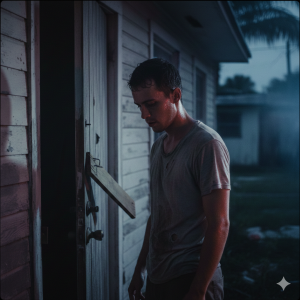
On May 5, 2023, in Florida, deputies were sent to perform a welfare check on a woman who hadn’t been seen for several days. What began as a routine knock on a door quickly unfolded into a disquieting search: a sour smell drifting from the home, neighbors with fragmented memories, and a son whose words didn’t match the scene. Here’s how the day unraveled—step by step—until the officers discovered what the house had been hiding.
The deputies arrived and approached the home. The air carried a heavy odor. They tried the door, circled the outside, and called out:
– “Sheriff’s Office. Hello?”
– Silence.
– “Did it smell when you went to the door?” one deputy asked another. “Yeah.”
They kept trying—knocking, peering by windows. The place was a disaster. The smell intensified. A deputy said it “smells like a seven.” The AC was running. There were doors on each side of the house, one of them ready to fall apart. They found a window. They listened. They knocked again.
They reached neighbors. One neighbor, easygoing and chatty, said he’d seen “the girl” Laney before—the next-door neighbor—and “the guys over there.” Asked how long since he’d seen her: “Her? I haven’t seen her in a while.” Pressed further—days? months?—he said, “Three years or something like that.” But he had seen “the boys” yesterday. Today? Nobody.
The deputies asked about commotion—fights, yelling, anything unusual. The neighbor said nothing in the last two days. The neighborhood felt different than what he was used to—louder, less settled. Another neighbor mentioned a man in his early-to-mid 30s, a recent arrival. There hadn’t been a tent before—then a tent appeared, and he did too. The man sometimes walked up and down the road, today on a bike. The color? The neighbor didn’t know. “But I can smell that smell familiar,” one deputy muttered as they got closer. “The AC is working.”
They considered entering. One deputy said he could make an open door; but they hesitated, continued to check, and decided to verify hospitals first. They went off to check if the woman had been admitted anywhere. After checking hospitals, they returned.
They knocked again. This time, someone inside stirred.
“Did you hear us knocking before—were you knocked out?”
A voice answered—drowsy, distant. The son had been sleeping. The deputies explained: they were looking for Mom. Had he seen her?
“She’s not around right now,” he said. They asked where she was; he didn’t know. Her sister was asking for her. She wasn’t in trouble—they just needed to make contact.
“When was the last time you saw her?”
“A few days ago,” he replied.
Where did she go? He mumbled something that sounded like “ES.” Was it normal for Mom to be gone for days? “Sometimes,” he said. Did she have favorite places? He didn’t say. Anything unusual? He said they last had a few cigarettes, a little bit of food, some hand soap—she told him he could come by and stay. He hadn’t seen her since. Last texts or calls? Nothing.
“When’s the last time you saw Dad?” the deputies asked. He wasn’t sure. Did he know where Dad was staying? No. The deputies said they’d heard Mom had called the cops long ago—Dad had been arrested on the 25th of last month for trespassing.
They asked who stayed in the tent. He said he could come by before she left. The deputies asked to go inside to make sure Mom “wasn’t stowed away in a closet or something.” He hesitated: “I can’t tell you no.” They pressed: he stays there, it’s his mom’s house, and they needed to make sure she wasn’t in danger or that Dad hadn’t come back to retaliate.
They asked him to lead the way inside. He tried the door. It was locked behind him. Why would he lock it? “I just usually do that,” he said. How did he get in? He didn’t know. The other small door was barricaded—with a garbage can and “some stuff.” The deputies’ patience thinned. “Do you understand how this looks?” they asked. He said he was probably going to sleep in the tent, and yes, he had locked the door.
The deputies said they weren’t focused on charging him for being there. “My main goal is making sure Mom’s okay.” He’d gotten inside before—did he push one thing open on the other door? Could he do it again so they could enter?
He agreed. They guided him: “Shimmy it to the right… now pull it out… push it out… there you go.” The barrier shifted. The deputies entered.
“Are you sure Mom’s not in there?”
“I don’t know,” he said. “I just stayed in my room—my living room.”
They were already inside and would find out.
Mom was inside. They confirmed. They called out for additional units: “Kohl’s 400… 417 400…” The deputies asked the son to step outside. One deputy prepared to read him his rights.
He read Miranda: the right to remain silent, the right to a lawyer. The son said he understood. He agreed to talk. The deputy clarified: “When we first got here and talked to you, you said you hadn’t seen Mom in how long?”
“A few days,” the son said.
“Is that the actual answer you want to swear to?”
He gave a story: He had seen her riding a bike; she gave him a few cigarettes and told him to stop by later. He did. They were talking and cleaning up the yard and the house. She told him he could stay inside. That was a few days ago.
But earlier, he had also said he wasn’t supposed to be staying inside—there was a no-contact order. He thought it might still be active. He wasn’t sure. He suggested Mom told him he should come and stay. The deputies asked what the no-contact order was for. He said she had said he slapped or punched her—a domestic battery.
They asked about Dad. He thought he’d seen Dad in the last week. When Mom got home, she told him and “Books” to leave, so he left and walked somewhere and stayed away. He didn’t know where Dad was now. He’d heard Dad might have been arrested, but then corrected—Dad didn’t actually get arrested then. He and Mom’s relationship had been good lately, he said.
The deputies asked if he noticed anything different while staying there. Did anything raise alarm? “Did you go and check?” He said he had looked in there—he’d looked in the room. He had seen her in the position she was in now. They asked: why did you tell us she wasn’t there? “You know better than me—I wasn’t the one that did it,” he said. One deputy told him he had smelled it before the son even came outside. “You knew damn well that she was in there.” The son agreed: “Yeah.”
Why didn’t he just tell the truth? They’d told him from the start they were there to make sure Mom was okay. What prompted him to lie? “Photo,” he said, vaguely. They asked whether, when he checked on her two days ago, he knew she was deceased. He wouldn’t say yes or no. The deputy pressed: someone who smelled like that wouldn’t be okay. Why didn’t he call law enforcement when he found her? “I don’t know,” he said.
Any idea why she was deceased? What could have happened? “I really don’t,” he said. The interview wrapped up. The deputy confirmed that he had nothing to add or change, that nothing had been discussed off tape. The time was 6:21 p.m.
The tension crested at the threshold—when the son, after denying knowledge and deflecting questions, physically unbarricaded the side entrance and let the deputies in. The smell the deputies had noted early on swept over them in force. Inside, they found Mom—just as the son had already seen her, days earlier.
Confronted with the reality, the son’s earlier statements unraveled. He conceded that he had looked in the room and seen her in that position. He acknowledged the obvious—that he had told them she wasn’t there even though she was. The deputies read him his rights, aiming to lock down a clear statement. He offered fragments: the bike, the cigarettes, the cleaning, permission to stay, the no-contact order from a past domestic case, uncertainty about Dad, and a vague admission that he had discovered her condition but hadn’t called anyone.
The pivotal moment wasn’t just the discovery—it was the contrast between what the nose knew, what the house revealed, and what the son had tried to conceal.
By early evening, the deputies had done what they came for: locate the woman. They confirmed her presence inside the house and documented the son’s statements on record. The final minutes captured the quiet formality of procedure: Miranda read, answers given, inconsistencies noted, and the time logged at 6:21 p.m.
The story concludes without a definitive cause of death or any allegation of who was responsible. The son admitted he saw her days earlier and didn’t call. He mentioned old legal constraints between them, recent interactions that seemed calm, and uncertainty about Dad’s whereabouts. The deputies’ job that day ended with discovery and documentation—leaving the next steps to investigators, medical examiners, and the slow machinery of follow-up work. The door, once barricaded, had been opened; the home’s silence had been broken; the questions, however, remained.
Disclaimer : This content may be created by AI for entertainment purposes. Any resemblance to real persons, events, or places is coincidental.