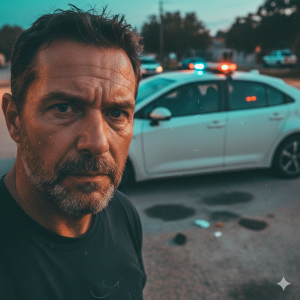
In early January 2024, a simple rental car agreement in Key Largo, Florida started like thousands of others—routine paperwork, a signature, a set of keys. The renter was a 52-year-old man named Andy, someone local deputies already knew. He left the Enterprise counter with a 2023 Toyota Corolla worth $21,700 and a clear understanding: the car was due back in two days. It should have ended as an errand-sized blip in a new year. Instead, it became a months-long tangle of missed calls, mailed notices, tracking pings, and a tense roadside arrest, punctuated by accusations of scams and rights violations—until the case landed in court, then in probation, and finally back into the hands of deputies.
Here’s how it unfolded, step by uneasy step.
The first turn came when Andy contacted Enterprise to extend the rental—yet didn’t pay for the added time. He reportedly brushed off the urgency, implying he was “essentially going to the grocery store to get some milk.” After that, Enterprise tried again and again to reach him. They sent a mailed notice: if the vehicle wasn’t returned by January 17, the matter would be reported to law enforcement.
No response. Two months passed.
On March 29, deputies from the Monroe County Sheriff’s Office visited the Enterprise location to gather information. Inside the office, staff laid out the timeline:
– Andy had picked up the car in January and agreed to return it within two days.
– He made only one payment—the initial rental fee—and nothing after January 12.
– He didn’t answer calls or emails.
– It was already late March; the car had been out for months.
Then something odd surfaced: Andy had just booked a new reservation to pick up another rental that day—around 3:30 p.m. Staff said they’d just seen him the day before. They showed deputies the demand letter and the FedEx timestamp, as well as the registration and notarized documents. The car, a 2023 Toyota Corolla, was “just been in the wind,” one staffer said—until an hour later, when Enterprise tracked it and sent its location to deputies.
Deputies responded to the address. The subject vehicle was on scene. Inside sat Andy.
They approached.
– “Sir, can you step out of the vehicle?”
– “For what?” Andy replied.
– “The rental car company called us about the rental car. You need to step out and talk to us.”
He kept the window up. He said he couldn’t hear because of traffic. He refused to get out. Deputies considered a window breaker. The message was blunt: Enterprise had reported the car stolen. He hadn’t paid since January. He needed to get out of the car—one way or another.
At last, after mounting insistence, Andy opened the door. He told them to keep their hands off him.
He wanted to talk to their body cameras.
He launched into his story: that “these guys” in town had been running a scam with phones, that he’d already been “put through the court system” with a similar U-Haul case under Judge Hamilton—one he said was dismissed. He said they were “bullshitting” a driver’s license, that he had everything on tape, and that he saw the rental employees every day. He insisted: this was a civil matter, not a criminal one. If they wanted to talk, they could do it at the rental counter.
Deputies reiterated: Enterprise sent certified letters. They had tried calling. He hadn’t paid since January 12. He argued back that no certified letter was sent, that he lived near the other vehicle and slept next to it nightly, that his phone number had never changed. He said the Spanish-speaking woman at the rental counter knew he was around and saw him all the time. He accused the police of running a long-standing scam since 2019—fabricated licenses, citations, bail percentages, an entire system designed to churn people through courts.
The deputies tried to bring the focus back: talk about the rental car.
He refused to concede. He said they could drive him to the rental office, or he could ride in the back of the squad car. But he would not wear handcuffs.
The standoff sharpened. For safety, if he rode in a patrol car, deputies said he had to be in handcuffs. He said no. He wasn’t going to let “you people” touch him anymore. He accused them of lies, of beating him down during the U-Haul case, of spinning fabricated paperwork that was ultimately dismissed after 15 months.
Deputies gave the command: hands behind your back.
He refused. Tensions snapped.
– “Put your hands behind your back now.”
– “Don’t touch me.”
– “I’m going to tase you.”
The taser popped.
He fell, cursing, swearing, saying he couldn’t move his hand, that they had done this to him. Deputies repeated commands—hands behind the back. He kept arguing through pain and disbelief. He accused them of lying again. He said they could have driven him to the rental place. He said he had told them everything before. He pledged to “make” them answer for this.
Deputies secured him. They tried to sit him up, to get his head off the hot pavement. He resisted the placement. An ambulance was already on the way. One deputy said he was “going to play fainting goat,” but confirmed he had good chest rise and was breathing. They urged him to sit, to lean against the car, to make it easier. He alternated between refusing and demanding to speak directly to the camera.
And speak he did.
He pressed into the lens a sweeping indictment: that officers had been “selling fabricated licenses,” writing citations, funneling people into courtrooms, bailing them out with percentages, and pocketing money. He said he’d been in town for almost six years, never left, sleeping nightly next to a vehicle by Paradise Bonds. He cited Judge Hamilton again, Pine’s Park, and a continuous stream of rights violations “since 2019.” He said he’d told the Attorney General’s office. He insisted the same thing had happened with the U-Haul, and the case was dismissed after 15 months.
Deputies, steady, kept trying to pivot back to the matter at hand: the rental car.
He refused to discuss it further. He wanted the camera. He wanted the record.
When paramedics and more deputies arrived, they prepared to move him. He asked to show something on camera: items in a plastic bag in his pocket—his birth certificate issued in Key Largo, his Social Security card attached, and the “fabricated” license he claimed was proof of the system’s wrongdoing. Deputies agreed to retrieve the items once he was standing, to keep it on camera.
A deputy summarized the situation for arriving personnel: Enterprise reported the vehicle stolen that morning. It was due back January 17. No contact, no payments. They found him in the driver’s seat. He refused to get out, eventually complied, then resisted handcuffing. They tased him, secured him, called EMS. He kept insisting this could have been avoided.
He asked to see their cameras again. He said it all needed to be on record.
The legal process moved with decisive speed. Andy was charged with felony grand theft of a motor vehicle and misdemeanor resisting an officer. A cash bond was set at $40,000.
About a month later, he pled no contest to both charges and was found guilty. The court withheld sentence, placing him on two years of probation with conditions. For a moment, that might have been the end—an uneasy truce between his narrative of systemic corruption and the state’s ledger of unpaid extensions, unanswered calls, and a car tracked to his door.
But the following week, he violated his probation. A warrant was issued. He was arrested again.
The Corolla, the certified letter, the taser sparks, the body cameras reflecting a face flushed with anger and conviction—everything folded back into the system he had denounced, one more time.
The music resumes somewhere else. The road is quiet again. And in the records, the dates line up: January pickup. January 17 deadline. March 29 tracking. No more phone calls, no more extensions. Just the weight of a key that stayed too long in the ignition—and a story that, once it started, would not let go.
Disclaimer : This content may be created by AI for entertainment purposes. Any resemblance to real persons, events, or places is coincidental.