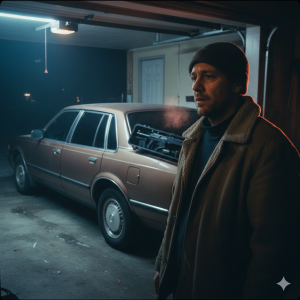
On the morning of February 18, 2022, an ordinary drive along Interstate 41 in Wisconsin turned into a chilling ordeal. A woman, shaken and searching for composure, called 911 to report a possible shooting on the highway. Her voice carried the tremor of someone who hadn’t yet processed what had happened, but knew enough to be afraid. The responding officers—from the Wisconsin State Patrol and the Grand Chute Police Department—found her vehicle marked by small, scattered impacts. The scene wasn’t chaotic; it was quiet but tense, the kind of quiet that follows danger that has just passed.
From her description came a thread for the officers to pull: a bronze-colored sedan, no plates, dark tinted windows, and a strange badge or emblem on the rear—shaped in a way she remembered by gesture, more like a hazard symbol than a standard logo. She didn’t know the people, didn’t know the car, and didn’t understand why this had happened. The officers kept their tone steady, coaxing clarity from shock. The impacts looked small—maybe BBs, maybe .22 caliber. Either way, something had struck her car. The pattern wasn’t clean, but it was unmistakable.
They suggested she drive to the police department a few minutes away—warmer, safer, easier to document. She agreed. While the officers shepherded her forward, a larger machine began turning: dispatch, traffic cameras, archives, time stamps, and geography all knitting together to follow the bronze sedan’s path through the morning.
Traffic cameras are not just indifferent witnesses—they’re patient ones. Using the victim’s description and recent highway footage, Wisconsin State Police, together with their Traffic Management Center, searched archives to identify the suspect’s location and possible exit. This wasn’t just about catching someone; it was about reconstructing truth along an otherwise featureless river of interstate speed.
Hours after the incident, officers moved to a neighborhood near the tracked exit. Official documents later described what they found: two men outside a residence, and in the driveway, a car matching the suspect vehicle. As officers approached, one man started the vehicle. During their contact, officers reported seeing what appeared to be a revolver-style handgun mounted or resting on a garage wall. The man in the car—the one they would later identify as Travis—remarked that he had a gun in his vehicle, too.
The conversation tightened. Consent to search was requested. Travis hesitated, explained he had to get to work, wanted to know what this was about, said he had been in a rush earlier. He read the form and declined consent. The officers acknowledged that refusal as his right and stated they would pursue the “other legal process.” Meanwhile, Travis’s car idled. He asked if he could turn it off. The body language said everyone knew this had moved beyond a casual chat.
They detained him, efficiently and without dramatics. He was searched—calmly—then placed in a squad car, the heat turned up against the February air. An officer snapped a photo of a receipt in his possession. It resembled those curious slips from the pandemic era—receipts generated by certain third-party ATMs that displayed wildly incorrect balances, sometimes convincing people, briefly, that they had millions. Whether that mattered yet was unclear; it could verify a time, a location, and an identity later if needed.
As they drove, Travis spoke little. He was tired—working long hours, trying to keep up, a daughter at home, sleep running thin. He wanted to know what this was about, why he was being held, whether this had something to do with the highway. He mentioned his gas cover sometimes flipping open in strong winds, the sort of detail people reach for when trying to anchor themselves to normal life.
Back at the station, officers obtained a search warrant. Footage confirmed a timeline: Travis pulling into the driveway and exiting his vehicle at 7:32 that morning—close enough to the reported time for the highway incident to place him within the orbit of suspicion.
In the interrogation room, Travis was searched again. He asked for water. He insisted the small bag of marijuana found was old, stale, clearly not fresh. The officers kept their pace steady. They cataloged findings. Among them: a large, AK-47-style black BB rifle on the back-seat floor of Travis’s car—identified as a Crosman Full Auto AK1 4.5 mm BB air rifle. Capable of firing about 1,400 rounds per minute—around 23 per second—it was not a mere toy. In the wrong hands, even BBs at speed can pierce plastic and thin metal, crack glass, scare drivers, and cause crashes.
The investigation, now formal and focused, began pulling in threads from Travis’s past. Records showed an extensive criminal history dating back to 2006, including possession of cocaine, possession of THC, bail jumping, and operating a vehicle while suspended. That history does not define every moment of a person’s choices, but it shaped how the case would be argued and how courts might weigh risk.
After his arrest, a $75,000 cash bond was set. Two motions to reduce the bond were denied. While jailed awaiting trial, Travis was charged with disorderly conduct. As the case developed, prosecutors brought several charges:
– One count of first-degree recklessly endangering safety, with a modifier for use of a dangerous weapon.
– One count of possession of THC as a second offense.
– One count of criminal damage to property, with a modifier for use of a dangerous weapon.
The weapon modifier included BB guns—this case would draw a line between a “real” firearm and a BB rifle, and then insist that line matters less than what the device can do to people and property. The physics—metal pellets, velocity, fear induced at highway speeds—spoke louder than semantics.
Meanwhile, the victim’s life had shifted. She reported growing paranoia around highway driving, unable to perform her delivery job—her livelihood—because the fear now lived in her body. Counseling became necessary. She asked for nearly $20,000 in restitution for losses: diminished vehicle value, missed income, and mental health care. Court documents noted that the event had an “almost immeasurable” impact on her—a phrase that tries to quantify the unquantifiable and acknowledges it cannot.
Six months after his arrest, Travis accepted a no contest plea. The court sentenced him to one year and ten months in state prison, plus five years of probation, for the single count of first-degree recklessly endangering safety. The other charges were dismissed. The sentencing came with conditions:
– Anger management assessments and counseling if recommended.
– Strict sobriety—no alcohol, no drugs.
– A prohibition on owning firearms, explicitly including BB guns.
The court’s logic was clear: the device at the center of this incident might not meet the legal definition of a firearm, but in context—fired at a moving vehicle on a highway—it was treated as a dangerous instrument. The law will often calibrate punishment not simply by category of object but by risk and harm.
On restitution, the conversation got thorny. The victim’s request, based on her losses, was one figure. Legal argument and negotiation adjusted it. The court ultimately granted just over $44,000 in restitution—greater than the victim’s initial ask, reflecting added valuation for the ongoing impact, diminished property value, lost work, and therapy.
By August 2022, the sentence was handed down. On paper, Travis should be out of prison and on probation by now. But the story doesn’t end with a release date. He has filed an appeal, seeking to reverse the conviction and reduce the restitution amount. The outcome of that appeal remains undecided—an ellipsis at the end of a paragraph that has not yet closed.
The highway incident began with uncertainty—small impacts on a car and a driver trying to steady her breath—and expanded into a full legal journey: cameras, interviews, warrants, a BB rifle with terrifying capabilities, a criminal history, and a sentence that insists on accountability and the possibility of rehabilitation.
For the victim, the aftermath lingers in the daily decisions of whether to drive, how to earn, and how to heal. A dollar figure is attached—over $44,000—but the felt impact sits outside any ledger. Fear is not easily itemized. Therapy is both a cost and a path back to ease.
For Travis, prison has ended but the law continues. Probation stretches forward with rules and conditions. The appeal hangs in the air, asking the court to reconsider what happened, how it has been framed, and how much it should cost. As of now, there is no final word on that.
What remains is a caution shaped by speed, surprise, and the lethal illusion that something “less than a firearm” can be harmless. Along a winter highway in Wisconsin, a few seconds of reckless force rippled into years of legal reckoning and personal repair—an ordinary morning turned into a marker in two lives, each now reading time differently, waiting for a decision that has yet to arrive.
Disclaimer : This content may be created by AI for entertainment purposes. Any resemblance to real persons, events, or places is coincidental.