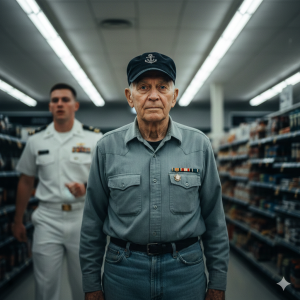
In the fluorescent hush of the base exchange, a sharp voice cut through the ordinary rhythm of shopping carts and scanner beeps. Lieutenant Commander Price—crisp uniform, polished ambition, hands on hips—stood glaring at an elderly man who had paused to read the ingredients on a can of soup. The officer’s tone was all impatience and unearned certainty, as if delay itself were an insult to his ascent. The old man, Silas, wore worn jeans and a faded Navy veteran cap, moving with the careful economy of age. His hands shook with arthritis, but when he finally lifted his eyes, they were clear and still. Not startled, not cowed—simply watchful.
Price pressed the attack, irritable and performative. “I asked you a question. You’re holding up the aisle. People have places to be. This isn’t a library.” Silas set the can back with a soft click and offered a small nod. “My apologies, Commander. I was just deciding.” His voice carried a gentle southern drawl wrapped in patience—a low rumble that neither provoked nor pleaded. He didn’t scurry away. He simply stood, composed, meeting the officer’s glare with a steady quiet that unsettled more than any angry retort could.
That stillness felt like defiance to Price. Recently promoted and eager to be seen enforcing standards, he read disrespect into every shadow. In his mind, this old civilian—probably some forgotten supply ship relic from half a century ago—had become a problem to fix. “It’s a can of soup, not a career choice,” he scoffed. “What’s your business here, anyway? This exchange is for active duty personnel and their dependents, not for ancient mariners to wander around and clog up the works.” He flicked his gaze at the veteran cap. “I’m sure your service was adequate, but that doesn’t give you a free pass to inconvenience the real Navy.”
Silas adjusted the brim of the cap, the fabric worn thin above the stitched anchor. “I have an ID card, Commander. I’m permitted to be here.” The calmness Price couldn’t scale only stoked his fury. Shoppers—young sailors and their spouses—began drifting closer, pretending to browse while they watched. Price, aware of the audience, doubled down. He wanted to demonstrate command presence, the uncompromising maintenance of standards, the refusal to tolerate even minor infractions.
“An ID card?” He snapped his fingers. “Let me see it.” Silas sighed—a small sound of infinite patience—and pulled a government-issued veteran ID from a weathered wallet. Price snatched it, hunting for any flaw, any expired date, any pretext. Finding none, he flicked it back with a sneer. “Fine. It’s valid. That means you’re technically allowed to be here. It doesn’t mean you own the place. I’m tired of seeing your type—here to relive long-lost glory days that weren’t that glorious to begin with.”
He leaned in, voice dropping to a conspiratorial hiss meant to wound. “What did you really do, old man? Push papers? Peel potatoes? I bet you haven’t been on a ship in fifty years. But you wear that hat like you single-handedly won a war.”
Silas didn’t flinch. Weariness, not anger, touched his eyes—the kind of tiredness born of seeing arrogance confuse rank for wisdom and authority for honor. He replaced his ID, turned to leave, deciding the soup wasn’t worth the trouble. Price stepped in front of him, blocking the way. “I’m not done with you. I think you’re a loiterer. I’m ordering you to leave the exchange. Now. And don’t let me see you around here again.”
The atmosphere rippled. A stocky Master Chief Petty Officer—Davies, twenty-five years in—had been watching from the end of the aisle. He recognized when a situation hovered on the edge of harm. He’d seen too many ambitious officers let their ego take the helm. He approached—not threatening, just steady, a presence that suggested things were about to get handled properly.
“Commander Price, sir,” he said, respectful but firm. “Is there a problem I can help with?”
Price barely concealed his annoyance. “It’s handled, Master Chief. This man was causing a disturbance, and I’ve ordered him to leave the base.”
Davies looked at Silas—who stood like a mountain—and saw not a troublemaker, but an old sailor with immense control. “With all due respect, sir, he doesn’t seem to be causing a disturbance now. Perhaps we can deescalate.”
Price flushed. The intervention felt like a public challenge to his authority. “Are you questioning my order, Master Chief? I am the senior officer here. This man is leaving. End of discussion.”
And then the aisle parted. Conversations dimmed. Admiral Thompson—base commander—entered with his aide shadowing two paces behind. Tall, gray at the temples, eyes that missed nothing, Thompson took in the tableau in an instant: a red-faced lieutenant commander puffing himself up; a concerned Master Chief standing firm; a small crowd; and at the center, a calm, elderly man.
Price snapped to attention, panic tightening his salute. “Admiral, sir. Good afternoon, sir.”
Thompson drifted past him without pause, stopping before Silas. He studied the face lined by sun and time, the quiet dignity of a bearing shaped by real service. Something in that posture felt deeply familiar—the kind of disciplined repose never taught behind a desk. He glanced at the worn cap, then into the clear eyes.
“Sailor,” he said, not a trace of condescension—only professional respect. “I sincerely apologize for my officer’s behavior. It is not the standard we uphold.”
Price flinched as if struck; the admiral spoke to the old man as an equal.
“My name is Admiral Thompson,” the admiral continued. “May I ask your name and what unit you served with?”
Silas met the gaze. “Silas Cain, sir. It’s been a long time. I was with the underwater demolition teams—back before they were called SEALs.”
Master Chief Davies’s eyebrows shot up. UDTs—the legends, the forefathers of Naval Special Warfare. Price felt the ground tilt beneath him. This was getting worse.
The admiral nodded slowly, recognition rising. He knew the history; he revered it. The pieces were falling into place, pointing at a possibility almost too extraordinary to believe. He had one question left—the one that would confirm the chilling suspicion growing in his mind. He leaned closer, voice dropping to a near whisper—a tone reserved for sacred spaces.
“Mr. Cain… Silas—did you have a call sign?”
For the first time, a shadow passed across Silas’s face. He didn’t hesitate out of doubt, but as if weighing the cost of unburying a name kept silent for half a century. Then he met the admiral’s eyes and spoke.
“They called me Ghost Five, sir.”
The name hit the aisle like a depth charge. Ghost Five.
To Price, it meant nothing. To Admiral Thompson, it meant everything. Color drained from the admiral’s weathered face; his jaw slackened. He staggered back a step, composure fractured. His aide gasped audibly, hand lifting to his mouth. Davies stared in disbelief and awe, like a figure had stepped out of scripture.
“Ghost Five,” Thompson whispered—reverence tipping toward holy terror. He didn’t see an old man anymore. He saw a living ghost. A myth made flesh.
“Sir—what is it?” Price stammered. “What’s Ghost Five?”
The admiral turned, eyes cold and blazing, locking onto Price. The transition was terrifying. The reverent warmth for Silas became a silent fury. He didn’t raise his voice. He didn’t need to. The quiet was more lethal than a shout.
“Commander,” he said, each word carved from ice. “You have the unmitigated gall to ask me what Ghost Five is—after what you just did.”
He stepped toward Price, who instinctively shrank. “Let me educate you, Commander, since you clearly slept through every history and ethics lesson at the Academy.”
“Ghost Team was a five-man SEAL element commissioned for Operation Nightfall in the winter of 1968. A black operation so deep, so secret, most of the Joint Chiefs weren’t read in. Their mission: HALO jump behind the Iron Curtain and destroy a new Soviet submarine guidance system.”
He swept the aisle with his gaze, letting the weight settle. “Their insertion was compromised. The welcome party: an entire Spetsnaz division. Four members of Ghost Team were killed in the initial contact. Only one survived.”
He pointed—hand trembling—at Silas. “Ghost Five.”
“For twenty-three days, he was the only friendly asset in a territory the size of Delaware. Hunted by the best trackers the Soviet Union had, he not only evaded them—he continued the mission. Alone, he found the target, destroyed it, and with no support and no exfil route, he walked two hundred miles through frozen wilderness to the Turkish border.”
The admiral’s voice thickened. “He is listed as killed in action. His file is sealed under the highest classification of national security. The story of Ghost Five is a legend told at BUD/S—a ghost story to inspire trainees, to show them the absolute limit of endurance and courage. We were told he died on that mountain. A hero. We had no idea he made it out. No idea he was still alive.”
He looked back at Silas, eyes wet. “This man’s Medal of Honor citation is sealed in a vault at the Pentagon because the mission is technically still classified. You didn’t just disrespect a veteran, Commander. You humiliated a living monument.”
The words hit Price like a physical blow. Air left his lungs. He looked at Silas—the quiet old man with calm eyes—and saw a figure who had walked through hell and returned. He saw the embodiment of every creed he’d recited, every ideal he had claimed to serve. His ambition, his arrogance, his petty tyranny curdled into a choking shame. He felt small—like a child playing with his father’s weapon who had just pointed it at a god.
Silence settled over the aisle, broken only by the distant hum of a freezer case. The young sailors stood ramrod straight, faces stamped with shock and profound respect. This wasn’t a confrontation anymore. It was the moment history stepped into the fluorescent light.
Admiral Thompson regained composure and turned to Master Chief Davies. His voice was firm, dressed in deep respect. “Master Chief Davies, please escort Mr. Cain to my personal office. See that he gets hot coffee, a comfortable chair, and anything else he requires. He is to be treated as our guest of honor.”
Davies nodded, eyes misted. “Aye, Admiral.” He approached Silas—not guiding, simply inviting. “Sir, if you’ll follow me.”
As they began to walk, the admiral’s attention returned to Price, steady and terrifying. “Commander,” he said, voice dropping back to that lethal quiet. “You will remain here. Then report to my aide, who will escort you to base legal. You will surrender your command at CIN. You will be confined to quarters pending a full review of your conduct and fitness for command.”
He didn’t blink. “Your punishment is only beginning. Your redemption—if possible—starts tomorrow. You are reassigned to the basement of the Naval History and Heritage Command for one year, archiving the stories of the men you clearly fail to comprehend. You will read every after-action report from Korea and Vietnam. You will learn their names. You will learn what they sacrificed. You will learn the meaning of the uniform you wear.”
Silas paused beside the ashen lieutenant commander. He looked at the young officer—no anger, no triumph—only profound pity. He turned to the admiral, who was still staring Price down.
“He’s just a boy, Admiral,” Silas said, calm and forgiving—a touch of vinegar wrapped in mercy. “He’ll learn.”
And with that quiet pronouncement, the living legend walked away, leaving behind a shattered officer and a lesson in humility that would echo across the base for years.
Price finally lifted his eyes to meet the admiral’s. For the first time in his life, he was truly afraid—not of punishment, but of the vast, honorable world he had just discovered he didn’t understand. His journey had only begun.
– Price’s initial confrontation:
– Attempts to drive Silas out for “holding up the aisle.”
– Demands ID, mocks service, insinuates menial duties.
– Blocks exit, publicly orders him to leave the base exchange.
– Community response:
– Shoppers gather; curiosity turns to concern.
– Master Chief Davies calmly steps in, advocating de-escalation.
– Price perceives a threat to authority and doubles down.
– The admiral’s entrance:
– Thompson bypasses Price to apologize to Silas.
– Asks for unit; learns Silas served in UDTs (pre-SEAL).
– Asks for call sign; Silas reveals: “Ghost Five.”
– The legend confirmed:
– Thompson explains Operation Nightfall (1968): five-man SEAL team, compromised insertion, four KIA, one survivor.
– Ghost Five continues mission alone, destroys target, treks 200 miles to Turkey.
– Listed KIA; Medal of Honor citation sealed; story told at BUD/S as mythic inspiration.
– Realization: the “old man” is a living monument.
– Thompson’s fury turns surgical:
– Rebukes Price with the weight of history and ethics.
– Names Ghost Five’s deeds, reframing the aisle as hallowed ground.
– Orders immediate consequences: surrender of command, confinement, and a year immersed in the stories of those who wore the uniform with meaning.
– The turning point for Price:
– Shame replaces bravado.
– He sees Silas not as a nuisance but as the living embodiment of service and courage.
– The aisle becomes a classroom; the lesson is humility.
– Silas’s final mercy:
– “He’s just a boy, Admiral. He’ll learn.”
– Forgiveness, not fury, defines the legend’s exit.
– Silas is escorted with honor to the admiral’s office—coffee, comfort, and respect due.
– The crowd stands transformed—from onlookers to witnesses of history.
– Price remains, stripped of pretense, facing legal, facing history, and facing himself.
– Fear becomes enlightenment: not fear of punishment, but of the moral universe he has ignored.
– The story closes not with a verdict, but with an open horizon—the start of Price’s hard, necessary education, and the echo of a name spoken like a prayer: Ghost Five.
Disclaimer : This content may be created by AI for entertainment purposes. Any resemblance to real persons, events, or places is coincidental.