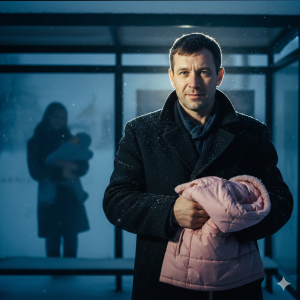
On a December evening thick with heavy, clinging snow, Thomas Bennett tightened his black coat and guided his six-year-old daughter, Maya, through the downtown bus station. At forty-two, Thomas knew plans rarely survived the force of real life. He’d been a widower for three years, raising Maya alone while running the family construction company his father built. They’d just finished a rare dinner out—pizza with extra cheese—and were cutting through the station to reach their car. The bus station always felt melancholy to Thomas, a place for people caught between where they are and where they hope to be.
That’s when Maya stopped. She stood perfectly still, staring toward a bench beneath the schedule board. Thomas followed her gaze and felt his chest tighten. A young woman sat hunched on the bench in a flimsy summer dress, drenched and shaking, no older than twenty-five. Her dark hair hung wet and tangled. In her arms, swaddled in a thin yellow blanket already soaked with snow, lay an infant.
“Dad,” Maya whispered, urgent and small. “Dad, she’s freezing.”
Thomas knelt, his expensive suit pants soaking on the concrete. “I know, baby. Stay here for just a moment, okay?” He approached the woman carefully. Up close, he saw her violet-blue lips and the violent shivering of cold and exhaustion. The baby—tiny, maybe a few months old—was barely visible in the inadequate wrap.
“Excuse me,” Thomas said gently. “Are you all right? Do you need help?”
She lifted her eyes, and fear flickered into resignation. “We’re fine,” she said, voice trembling. “Just waiting for the next bus.”
“The next bus on this line won’t come for three hours,” he said, glancing at the board. “Not this late on a Sunday.”
Her face crumpled for an instant before she composed herself. “We’ll manage,” she murmured, clutching the baby closer.
Maya had slipped to Thomas’s side. Before he could stop her, she shrugged out of her bright pink jacket and held it toward the infant. “Here,” she said simply. “For the baby.”
Thomas started to protest—“Maya, no, you’ll freeze”—but the look on the young woman’s face stopped him: shock, raw gratitude, a kind of stunned wonder that a child would offer warmth so freely.
Thomas shrugged off his heavy coat. “Please,” he said. “Take this for you. And my daughter’s jacket for your baby. We’re not far from our car.”
“I can’t—” the woman began.
“You can,” Thomas said, kind but firm. “And you will. That baby needs warmth. So do you. And because I have a six-year-old who will never forgive me if we leave you here.”
She took the coat with shaking hands. Thomas helped her into it, trying not to notice the torn shoulder of her dress, the bare feet in thin socks worn to threads. Maya tucked her pink jacket around the infant with solemn care.
“What’s your name?” Maya asked.
“Catherine,” the woman whispered. “Cat. And this is Emma. She’s four months old.”
“I’m Maya. That’s my dad, Thomas. We just had pizza,” Maya added matter-of-factly, not realizing how the mention of food made Cat’s eyes fill with tears.
Thomas made a decision. “Cat, I’m going to be direct. That baby won’t survive the night out here. Neither will you. I’m not going to ask your story now. I’m asking you to come with us. Get warm. Eat. Then we’ll figure out what comes next. No strings. No judgment. Just basic human decency.”
“You don’t know me,” Cat said, her voice breaking. “I could be anyone. I could be dangerous.”
“You’re a mother in the snow, trying to protect her child,” Thomas said softly. “That’s all I need to know right now.”
The drive was quiet. Cat sat in the back with Emma. Maya chattered—school, stuffed animals, how her dad made the best hot chocolate with real marshmallows. Thomas drove carefully through thick snow, catching glimpses of Cat in the rearview mirror—a blend of terror and relief etched on her young face.
Thomas’s home wasn’t flashy—three bedrooms in a good neighborhood, comfortable, not ostentatious. Warm air hit them inside, and Cat swayed with sudden weakness.
“When did you last eat?” Thomas asked, steadying her elbow.
“I—two days, maybe. I’ve been feeding Emma. I’m still nursing, but I don’t know if—” She stopped, looking at her daughter with a love so fierce and afraid that Thomas had to look away.
“Okay,” he said gently. “First things first. Maya, show Cat the bathroom upstairs? There are clean towels in the closet. Cat, there’s a robe on the door. Put your dress in the hamper—I’ll wash it. I’ll leave some clothes outside. My late wife’s. You look about the same size.”
While Cat was upstairs, Thomas heated leftover soup and made sandwiches. Maya helped on her step stool, brow furrowed with careful thought.
“Daddy,” she asked softly, “is Cat like the people we see downtown sometimes? The ones with signs?”
“She’s someone who needs help right now,” Thomas said, slicing bread. “That’s what matters.”
“But why doesn’t she have a home?”
“I don’t know, sweetheart. Sometimes life is hard. Sometimes people have bad luck or make mistakes. Sometimes they don’t have anyone to help when things go wrong. That’s why we help when we can.”
Cat returned in Laura’s jeans and a soft sweater, hair damp but clean, Emma wrapped in a fresh towel and sleeping deeply. Thomas had kept Laura’s clothes all this time—intending to donate them one day, never quite finding the day.
Cat ate slowly at first, then faster as her body remembered hunger. Thomas, having pulled Maya’s old baby supplies from the attic, fed Emma a bottle. The tiny weight in his arms felt familiar, natural—years falling away to when Maya had been this small.
After Maya had been tucked into bed—promised that Cat and Emma would be there in the morning—Thomas and Cat sat in the living room. The shaking had finally stopped.
“You can tell me what happened,” he said carefully. “You don’t have to. Sometimes saying it out loud helps.”
The silence stretched. Emma slept against Cat’s chest. Slowly, words found their way.
A boyfriend who’d seemed kind—until pregnancy. Violence that escalated until she fled. No family to turn to; parents gone, an only child. Friends who had tried to help, but shame and pride drew her back from asking too much. A shelter, then being forced to leave when Emma’s cry—sick and inconsolable—disturbed residents. A desperate attempt to reach another city, a cousin who might help. Money gone. The winter night closing in.
“I’m not lazy,” Cat said fiercely. “I worked two jobs before Emma. I’m not looking for a handout. I just—” her voice cracked—“I couldn’t let her freeze. I didn’t know what else to do. I thought if we could just make it through the night, if I could just find somewhere warm—”
“You’re incredibly brave,” Thomas said. “And a good mother. Not everyone would sacrifice everything. But you can’t do this alone. Let me help—if you’ll accept it.”
“Why?” Those exhausted eyes. “Why would you help me? You don’t know me. For all you know, I’m lying.”
“Three years ago,” Thomas said, “my wife, Laura, died in a car accident. Maya was three. I was alone—trying to be both parents while running a business. What saved me? People who helped. My father came out of retirement. A neighbor started a meal train. Maya’s preschool teacher stayed late when I was stuck in traffic. People helped because that’s what people do—or what they should do.” He leaned in, gentle and steady. “I’m not trying to save you, Cat. I’m trying to help you save yourself. That’s the difference. Stay a few days. Rest. Take care of Emma. I’ll call people I know—a lawyer who does pro bono work, a social worker for resources, an employment counselor. Give yourself a chance to breathe and make a plan.”
“I don’t do charity,” Cat said, but her voice wavered.
“It’s not charity. It’s a hand up, not a handout. And Maya? She’s already planning breakfast.”
Cat stayed. Days became a week, then two. Thomas learned she’d completed two years of college before money ran out. That she devoured books, loved to read, had a dry humor that caught him off guard. That she was a deeply patient mother, even through fear and exhaustion. He watched her and Maya bond—the easy way friendship sometimes crosses age. Maya taught Cat hand-clap games and found ways to make Emma laugh. Cat helped with homework and taught Maya how to braid, a skill Thomas had never quite mastered.
The lawyer helped Cat file for custody and a restraining order. The social worker connected her to assistance programs and daycare options. The employment counselor found her a receptionist job at a medical office—stable, with benefits.
After a month, Thomas helped Cat move into a small apartment he owned across town. He hadn’t planned to mention he owned it, but it had sat empty, and she needed somewhere safe. He charged a nominal rent—enough for dignity, not enough to sink her.
“This is too much,” Cat protested as they carried in her few belongings—many newly purchased with Thomas’s help.
“It’s what’s right,” Thomas said. “And one day you’ll pay it forward. You’ll see someone who needs help. You’ll remember. You’ll extend a hand.”
Years slipped by. They built an unexpected friendship—not romance; they carried too much grief and caution for that—but something steadier. They ate dinner together weekly while the girls played. Maya and Emma grew inseparable, like sisters despite the years between them. Cat bloomed: back to school, part-time nursing studies, friends, laughter, dreams spoken aloud. Emma grew bright and curious, calling him Uncle Thomas and Maya her best friend in the world.
Five years after that first snowy night, Thomas was at a father-daughter dance at Maya’s school when the phone call came. A massive stroke. His father—teacher of business, integrity, decency—wasn’t expected to live through the night.
Thomas left Maya with a friend’s family and drove to the hospital, hands shaking on the wheel. He braced himself to face it alone.
But he wasn’t alone. In the ICU waiting room, Cat stood up as he entered. Someone had called her—maybe Maya’s friend’s mother. She wrapped him in a hug without a word, and the strength he’d carried since Laura died cracked open. He sobbed into Cat’s shoulder—the woman he had once helped now holding him up—and for the first time, he understood why he’d been in that station on that winter night.
We help each other. That’s what makes us human.
His father passed that night, Thomas holding his hand. Cat stayed through all of it: the death, the funeral planning, the family gatherings, the reading of the will. She brought meals. Watched the girls. Sat beside him in silence when silence was all he could take.
A week later, sorting through his father’s papers, Thomas found a letter addressed in his father’s careful hand—dated a year earlier.
Son, I’m writing while I still can, while my hands are steady and my mind is clear. I want you to know I’m proud of you. Not because you kept the business running—though you did. Not because you’ve been a good father—though you are. I’m proud because you remembered what I tried to teach you: success means nothing if you use it only for yourself.
That young woman you helped—Cat—told me you saved her and Emma. She didn’t understand why I laughed. It’s because you didn’t save her, son. You gave her a chance to save herself. That is the greatest gift one person can give another. Not rescue, but opportunity. Not charity, but respect.
I’m watching you build a different kind of legacy than I did. I built a company. You’re building a community of people who care for each other. That’s worth more than all the money I ever made.
Be happy, son. Let yourself be happy. You deserve it.
Thomas read the letter three times, then folded it and slid it into his wallet, a talisman to carry always.
That evening, Cat dropped off dinner and found him on the back porch watching the sunset.
“You okay?” she asked, sitting beside him.
“I’m… I don’t know. Sad. Grateful. Overwhelmed.”
“That sounds about right for grief,” she said, and they sat in the kind of quiet only years of friendship make comfortable.
“My father wrote me a letter,” Thomas said finally. “He talked about you. About that night. He said I gave you a chance to save yourself.”
“He was right,” Cat said softly. “You gave me my life back. You gave Emma a future. I don’t know how to repay that.”
“You already have. You’ve been here. You’ve been a friend. You’ve shown Maya what strength looks like. You’ve reminded me I’m not alone.”
Cat took his hand, warm and steady. “You’re not alone. You never will be. That’s what family does. We show up. We stay. We help each other through.”
“Family,” Thomas repeated. “Is that what we are?”
“Isn’t that what we’ve always been?” Cat smiled. “Since that night when a beautiful little girl gave me her coat and her father gave me hope. We’ve been a family ever since. Maybe not the traditional kind. The kind that matters.”
Ten years after the snow-laden night at the bus station, Thomas sat in a crowded auditorium as Cat crossed the stage to receive her nursing degree. The applause thundered—from Thomas, from Maya now sixteen, from ten-year-old Emma, from the community Cat had built around her. After the ceremony, Cat found them, laughing with tears in her eyes—a radiant echo of the terrified young woman she once was.
“We did it,” she said, pulling them in.
“You did it,” Thomas corrected. “This is all you, Cat.”
“No,” she said firmly. “This is us. You taught me we aren’t meant to do life alone. Asking for help isn’t weakness—it’s wisdom. The bravest thing we can do is accept love when it’s offered.”
Maya, now a young woman, grinned. “I’m writing about you for my college essay,” she told Cat. “About how you taught me family isn’t just blood—it’s showing up. Choosing each other every day.”
“I’m going to be a nurse like Cat,” Emma chimed in. “And help people who need it.”
Thomas looked at the three most important girls in his life—his daughter; the woman who had become his closest friend; her daughter, like a second child to him—and felt his father’s presence like a warm hand on his shoulder. This was legacy: not money, not buildings, not business. People helping people. Kindness rippling outward. Love multiplying.
That night at the celebration dinner, Thomas raised a glass. “A toast,” he said, “to Cat—who showed us what courage looks like. To the reminder that our lowest moments can become our greatest blessings if we’re brave enough to accept help and wise enough to offer it.”
“And to pink jackets,” Maya added, grinning. “And dads who stop when a kid says someone is freezing.”
They drank to that. To pink jackets and snowy nights. To strangers who become family. To second chances and hard-won victories. To the beautiful truth that we’re all just walking each other home.
Sometimes the greatest thing we can do is see someone, reach out, and say, “You don’t have to do this alone.”
That’s what Cat learned in the bus station, what she carried into every hospital room and every late-night call as a nurse, what she wove into Emma’s life and her friendships. It’s what Thomas had known, dimly but surely, the moment he stopped and offered his coat: we’re all trying to make it through the winter, and sometimes the only thing that saves us is someone else’s warmth.
Disclaimer : This content may be created by AI for entertainment purposes. Any resemblance to real persons, events, or places is coincidental.