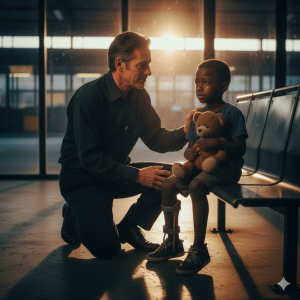
The sunset pressed itself against the glass walls of Edge Hill Bus Terminal, staining the station in an orange glow that made loneliness harder to face. On the far end of a metal bench sat a little Black boy, no older than three, clutching a teddy bear with both hands. His name was Micah. One of his small legs was strapped inside a brace tucked beneath his gray socks. He hadn’t moved in hours. He watched the buses come and go, whispering, “Daddy’s coming soon, right?” He didn’t know that his father had walked away for good.
Earlier that afternoon, Derek Miles had pulled up in his old silver sedan—the back seat littered with bills, tools, and a half‑empty beer bottle slipping under the floor mat. He parked, killed the ignition, and sat in silence for a long minute before turning to his son.
“Micah,” he said, forcing a smile, “you like buses, huh?”
Micah nodded, voice small. “Yes, Daddy.”
“You want to go for a ride? Maybe see some big buildings?”
Micah giggled, holding his teddy up like it understood. “Teddy, too?”
“Yeah,” Derek said quietly. “Teddy, too.”
Inside, his stomach twisted. He wasn’t taking his son anywhere. He had made his decision two nights ago after losing his last job. He’d spent those hours staring at Micah asleep, the leg brace resting beside the bed, and heard Naomi’s voice rise in his mind: He didn’t ask for this life, Derek. You protect him. But Naomi was gone. She had bled too much delivering the child now gazing at him like he was everything in the world. The doctors said Micah’s leg never worked right because of lack of oxygen during birth. They had to choose. They saved the child. Derek never forgave himself for agreeing.
So, when he led the boy to the bench that evening, he told him softly, “Wait right here, buddy. Daddy’s just going to get our tickets.”
Micah nodded. “Okay.”
Derek turned, walked past the ticket counter, and kept walking until the automatic doors swallowed him. He didn’t look back.
Hours passed. The station thinned. Lights flickered on one by one. The last bus—Route 17—pulled in, headlights cutting through the gold haze.
Behind the wheel sat Elliot Grant, a man whose tailored shirt and tired eyes didn’t quite match the uniform he wore. As the passengers filed off, he caught sight of the boy on the bench, still alone. He frowned and stepped down from the bus.
“Hey there, little man,” he said softly. “Where’s your folks?”
Micah hugged his bear tighter. “Daddy went to buy tickets.”
Elliot looked around: no luggage, no adult nearby, no tickets in the boy’s hands. Just a half‑empty juice box at his feet. And a child too patient for his age.
“How long ago did Daddy go?” he asked.
Micah glanced at the clock. “When the sun was big.”
Hours ago. Elliot’s throat tightened. He crouched. The child’s eyes—calm, brown, tired—reminded him of Theo, his own son, gone two years now from a disease money couldn’t cure. Loss had taught him to both hate and fear silence.
“You know your name?” Elliot asked gently.
“Micah. Micah Miles.”
“And your daddy’s name?”
“Derek Miles.”
“Okay, Micah,” Elliot said, voice faltering. “How about we find someone to help while we wait?”
“Yeah.”
He led the boy to the ticket counter. The clerk shook her head. No one had bought tickets under that name today.
That’s when Elliot felt it—that heavy choke of anger mixed with sorrow, the kind that comes when a man sees cruelty masked as despair. He pulled out his phone to call the police, but his hand trembled. He kept staring at the child, thinking about the irony: a man who’d spent years donating to children’s hospitals now standing face to face with a life that no donation could fix.
Micah tugged his sleeve. “Mister, is Daddy mad at me?”
Elliot swallowed hard and crouched again. “No, buddy. He’s just lost right now. Sometimes grown‑ups get lost.”
Micah nodded slowly, believing him, clutching his bear like it could explain the world.
By the time the officers arrived, Micah had fallen asleep in the waiting area. One of them leaned in and whispered to Elliot, “We found the car abandoned near the old bridge.” Empty.
Elliot stared out at the horizon where the sunset bled into night. He didn’t know why he couldn’t walk away. Maybe because he recognized that look—the silent waiting for someone who would never come. He touched the teddy still tucked in Micah’s arms and whispered, “You don’t deserve this, kid.”
When police asked if he could stay until child services arrived, he said yes without thinking. He sat beside the boy until the last bus left. The lights dimmed, and the silence grew thick. He didn’t realize yet that he wasn’t just watching over a stranger’s child. He was watching over the beginning of his own redemption.
Morning crept into the terminal with the color of worn‑out steel. Micah was still asleep on the bench, his small chest rising and falling against the teddy bear. Elliot hadn’t left his side. His suit jacket hung over Micah like a blanket. The police promised to search for Derek Miles, but Elliot could hear it in their tone—they’d filed him away as another parent who vanished when life turned heavy.
A social worker arrived—a woman with tired eyes and a clipboard. “Sir, thank you for staying, but we’ll take it from here.”
Elliot nodded, but something in him resisted. He’d seen broken systems swallow kids whole. He looked down at Micah’s peaceful, unguarded face. “Can I visit him later?”
“Of course,” she said, with the emptiness of a promise no one keeps.
Elliot did visit. Two days later, he walked into the foster center. Micah sat at a small table, drawing circles on paper with a blunt pencil. His brace squeaked when he moved his leg, but he didn’t complain. When Elliot knelt beside him, Micah’s face lit up.
“Bus man?”
Elliot smiled. “You remember me?”
Micah pointed at his paper. “Look, I’m making numbers.”
At first it looked like doodles—loops and squiggles—until Elliot noticed the pattern: perfect circles, each divided like pie charts. Beside them, tiny digits repeated sevens and threes with eerie precision.
“What’s this?” Elliot asked.
Micah tapped the page. “Teddy said if you divide the big one into three, you get forever sevens. Look.”
“You mean repeating decimals?” Elliot blinked.
“Maybe,” Micah shrugged.
The foster attendant chuckled. “He’s been doing that since he got here. Doesn’t talk much, but give him numbers and he won’t stop.”
Three years old, barely forming full sentences, yet intuitively writing what looked like fractional conversions. Elliot felt something shift, a quiet thread tying them together.
That night, Elliot called his lawyer. “Find Derek Miles.”
It took a week. They found him in a motel outside town—drunk, broke, hollow‑eyed. When Elliot walked in, Derek came out swinging with words.
“You here to judge me, rich man? You think I don’t know what I did?”
Elliot didn’t raise his voice. “You left a child at a bus stop, Derek. A child who can barely walk.”
Derek slammed the beer can down. “You think I didn’t try? You think I didn’t love him? That kid—he reminds me every day what I lost. Naomi’s blood was on that hospital floor and they told me to choose. I chose him. And she died. You know what that does to a man?”
Elliot’s jaw tightened. “Yeah. I do.”
Derek blinked, thrown.
“My son died,” Elliot said, eyes soft but voice sharp. “A disease I couldn’t buy my way out of. I’d give everything to hear him call me dad again. And you—you had that and threw it away.”
For the first time, Derek’s bravado cracked. He slumped, hands trembling. “I didn’t know what else to do.”
“Then learn,” Elliot said coldly. “Because he’s still waiting for you. Even now.”
Derek couldn’t meet his eyes. “I’m not the man he needs.”
“No,” Elliot said after a long pause. “You’re not. But I can be.”
A month later, they held a hearing. Derek signed the papers quietly, without protest. Elliot didn’t feel victorious—just responsible. Micah sat beside him, drawing invisible lines on his palm, whispering numbers under his breath.
Afterward, Elliot took him home.
The mansion that had once echoed with grief filled slowly with small sounds: the squeak of a brace on marble, the clatter of crayons, the soft hum of Micah counting stars by the window. Each evening, they sat at the dining table. Puzzles fell to him faster than Elliot’s old laptop software. Fractions, shapes, mental arithmetic—everything came like breathing.
“How do you know?” Elliot asked one night.
“I see patterns like music in my head,” Micah said simply.
Elliot watched him, remembering how his own son had struggled with numbers. “You’re something special, kid.”
Micah looked up. “Teddy says I’m just me.”
And somehow, that was enough.
One evening, Elliot drove him back to the bus station—the same bench, the same fading light. Micah limped forward, placed his teddy gently on the seat, and said, “So other kids don’t feel lonely.”
Elliot swallowed back the lump. “You sure?”
Micah nodded. “Teddy’s brave. He can wait.”
Elliot crouched, pulled him into his arms, and for the first time in years the emptiness inside him went quiet.
The shock came weeks before any headline appeared. Elliot hadn’t just taken Micah home; he’d scheduled a full medical evaluation. During the tests, doctors noticed something unusual. Micah’s brain scans showed patterns unlike anything they’d seen in a child his age. Regions linked to logic and pattern recognition lit up like wildfire—far beyond average.
The doctor spoke almost in a whisper. “He’s gifted—possibly a mathematical savant.”
Elliot sat stunned in the sterile room, staring at the child humming softly, drawing invisible shapes in the air. The same boy the world called disabled was doing complex arithmetic in his head before he could properly read. His damaged leg had taken his balance. His mind? Extraordinary.
But the most shocking discovery wasn’t Micah’s genius. It was what Elliot found next. When he opened the small box of belongings child services had collected, he found a folded envelope—the one Derek had left behind at the motel. Inside was a note written in clumsy, uneven letters:
“If anyone finds him, tell him I couldn’t be the man he deserved. But maybe the man who can love him right will find him.”
Elliot read those words a dozen times, hands shaking. He saw it—not cruelty alone, but guilt, fear, self‑hatred driving Derek away. That night, Elliot drove to the motel parking lot and sat there for hours, reading the note under a streetlight, wondering whether redemption could exist for men like them.
When he came home, Micah was awake at the window, counting stars.
“How many are there, Micah?” Elliot asked softly.
“Too many to count,” Micah said, “but I try every night.”
“Then keep trying,” Elliot smiled faintly.
He understood then: the miracle inside the tragedy. The boy the world abandoned had a mind that could change it.
Weeks later, a local newspaper ran the headline: “Bus Stop Boy Finds a Home and a Future.” The story told of a retired businessman adopting a disabled child abandoned at a terminal, and of how the boy’s unusual grasp of mathematics caught the attention of a university research team.
Behind the glossy words were nights when Micah still woke whispering, “Daddy’s coming soon.” Elliot would gather him close and answer softly, “He already did.”
In that silence—between guilt and grace, between loss and redemption—both learned what it means to be found. And the world, if it paid attention, could see what love looks like when blood leaves but love stays.
Disclaimer : This content may be created by AI for entertainment purposes. Any resemblance to real persons, events, or places is coincidental.