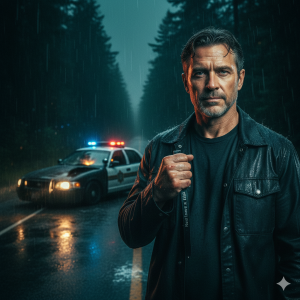
On a rain-lashed night, the empty road outside the city looks like a black ribbon cut through a forest that most people avoid after dark. A pickup truck slows when flickering red-and-blue emerges through the curtain of rain—police lights at a bad angle, smoke rising, danger coiling in the shadows. The driver, Jack Rowan, steps out and freezes. A female officer lies motionless beside her crashed patrol car. Blood everywhere. She whispers, weak but urgent: “Back up—they’re not coming.”
Jack’s instincts snap taut. He rips off his jacket, cuts her seatbelt with a knife, and presses hard on the wound. As she starts to fade, he says with calm certainty, “Stay with me. I’ve seen worse. You’re not dying tonight.”
An hour later, in a hospital room, the police captain stares at her perfectly stitched wound, hands trembling. “Who the hell did this? That’s military precision.”
Jack Rowan, forty years old, single father, wakes at 5:30 every morning in a small house at the edge of town—the kind of place where neighbors wave but don’t ask questions. In the kitchen, he packs lunch for his ten-year-old daughter, Ella, bright eyes, always asking why he has scars on his hands. He never tells her the truth. Because the truth is complicated: Jack used to be someone else—a combat medic in Special Forces, sent when things went wrong in places that didn’t exist on any map. He saved lives under fire, stitched wounds in the dark, kept men breathing when death was already reaching for them.
But that was before. Before the explosion that killed his wife, Sarah, during a routine traffic stop five years ago. Before he realized the drug cartel operating in their county was the same one he’d encountered overseas. Before he walked away from everything. Now he drives a delivery truck, hauls supplies to rural stores, lives quietly, raises Ella alone. On his wrist, he wears a black rubber bracelet, faded letters carved into it: “Never leave a fallen.”
It’s eleven PM when Jack finishes his last delivery. Rain hammers the windshield; the forest road is empty, dark. He doesn’t mind the silence. Then—flashing lights, red and blue, barely visible through the rain. A patrol car overturned, smoke rising from the hood. Every instinct tells him to call 911 and keep driving. Don’t get involved. You’re not that person anymore. But he stops. He always stops.
Flashlight in hand, he steps into the rain. Up close, the wreckage is worse: the car flipped twice, broken glass everywhere, the driver’s door crushed. Inside, slumped against the steering wheel, a young woman in a police uniform—badge catching his light: Officer Sarah Miles, twenty-nine, on the force for eighteen months. Tonight she was following a lead on the cartel alone. Big mistake. Her eyes flutter open. Blood runs down her face; her vest is torn; a deep laceration across her abdomen. She tries to whisper: “Back up—called them twenty minutes ago.”
Jack checks her pulse: weak. Breathing: shallow. She’s losing blood fast. He pulls out his phone: no signal—the forest swallows everything. Sarah grabs his arm, grip surprisingly strong. “If you run, they’ll find you too. They’re watching.” Jack looks at her—really looks. He sees fear, pain, resignation. He sees his wife—not the same face, but the same uniform, the same terrible situation, the same chances slipping away. He takes a breath and says, “Then I guess we both fight.”
He runs to his truck. In the back, under a tarp, an old military-grade medical kit he kept—maybe for this moment. He returns to the car. Sarah’s eyes closing. “Hey—stay with me. What’s your name?” “Sarah.” “Okay, Sarah, I’m Jack. I’m going to get you out of here, but you need to stay awake. Talk to me—why’d you become a cop?” She tries to smile. “Wanted to make a difference.” “Good reason.”
He assesses quickly. The wound needs immediate pressure. The car could explode—gasoline thick in the air. He decides: time to be that person again. He cuts her seatbelt with his tactical knife. Old blade, still sharp. Muscle memory takes over—his hands don’t shake. He shifts her weight; the wound is worse than he thought—deep puncture, possible internal bleeding. “This is going to hurt,” he says. “Everything already hurts.” Fair point.
From the kit he pulls hemostatic gauze, a trauma bandage, surgical clamps—tools he hasn’t touched in years, still familiar. He packs the wound; Sarah screams; he doesn’t stop. If he stops, she dies. “Talk to me, Sarah. Who did this?” Through gritted teeth: “Following a suspect—cartel. Spas connection. They ran me off the road.” Jack’s jaw tightens. The cartel. Always the cartel. “How many?” “Two vehicles—maybe six men. They left me. Think I’m already dead.” “Let’s keep it that way.” He wraps the trauma bandage tight. Field dressing—rough but effective. Bleeding slows; breathing stabilizes slightly.
But the gas smell is stronger; fuel leaking; one spark and they’re gone. “Can you move?” “I—I don’t know.” “You’re going to have to try. On three—one, two, three.” He lifts her. She’s light—too light. Adrenaline surges. He carries her away: twenty feet, thirty, fifty. Behind them the engine sparks—“Get down!” He throws himself over her as the car explodes. The fireball lights the forest; heat washes over them; metal shrapnel whistles overhead. For a moment, everything is fire and noise—then silence, rain, crackling flames.
Sarah looks up at Jack, his face lit by the burning wreckage. “You’re insane.” “I get that a lot.” He checks the wound—still holding. He tries his phone—still no signal. “We need the road. An ambulance won’t find us here.” “I can’t walk.” “I know. I’ll carry you.” He lifts her again in a fireman’s carry. She’s dead weight now—shock setting in. He needs to move fast. The road is half a mile uphill in rain with a dying woman on his shoulders. Jack has done worse. He starts walking. Every step is agony—for her. Each movement jostles the wound. She winces but doesn’t complain.
“Tell me about your daughter,” she says weakly. “What?” “Your jacket—drawing in the pocket. From Ella.” Jack almost smiles. Of course she noticed—even half-dead, still a cop. “She’s ten. Smart—too smart. Keeps asking why I won’t teach her how to stitch.” “Why won’t you?” “Because I don’t want her to need that skill.” Silence. Then: “Your wife—was she a cop?” Jack falters for a second. “How did you know?” “The way you looked at me—like you’ve seen this before.” “She was. Died five years ago. Same kind of setup—cartel ambush.” “I’m sorry.” “Don’t be sorry. Just stay alive. That’s all I ask.”
They reach the road. Jack lays Sarah down gently, flags a passing truck. The driver takes one look and calls 911. Fifteen minutes later: sirens, lights, an ambulance and three police cars. Paramedics rush to Sarah, cut open her uniform, see the wound, the field dressing. A veteran EMT, Rodriguez, stares at the stitching. “Who did this?” The other paramedic shakes his head. “This is military-grade trauma care. Whoever did this saved her life. She’d have bled out in ten minutes without it.”
Police surround Jack with questions. “Name?” “Jack Rowan.” “Did you see who did this?” “No. I just found her.” “You a doctor?” “No.” “Then how the hell did you—?” “I used to be a medic. Long time ago.”
The police captain arrives—Marcus Stone, thirty-year veteran. He looks at Sarah being loaded into the ambulance, then at Jack, then at the exploded patrol car in the distance. “You carried her half a mile—more or less—through a potential crime scene.” Jack: “She was dying. Didn’t have time to worry about evidence.” Stone studies him—old scars, calm demeanor, stance like someone who’s been in combat. “Full name?” “Jack Rowan.” “You military?” Jack hesitates. “Was. Not anymore.” “What branch?” “Does it matter?” “It does to me.” Jack meets his eyes. “Special Forces combat medic. Honorably discharged five years ago.” Stone nods, pieces clicking together. “We’ll need a statement tomorrow.” Jack: “I need to get home to my daughter.” As he turns to leave, Stone calls, “Mr. Rowan—thank you. You saved one of ours tonight.” Jack doesn’t turn. “Just did what anyone should do.”
At his truck, he notices his wrist—bracelet gone, must have fallen off during the rescue. He looks back at the ambulance. Sarah is being loaded inside, conscious, looking at him. Their eyes meet across the distance. She raises a hand weakly—his black bracelet wrapped around her wrist. “Never leave a fallen.” Jack nods once and drives away into the night.
Three days later, Sarah wakes in County General—white walls, beeping machines, pain meds flooding her veins. Captain Stone sits beside her, face serious. “How are you feeling?” “Like I got hit by a truck.” “What happened to the case?” “Forget the case—tell me about the man who saved you.” She closes her eyes, remembering: tall, maybe six-two, dark hair with some gray, forties, calm under pressure—really calm—like he’d done it a thousand times. “What did he say?” “That I wasn’t dying tonight. That he’d seen worse.” She pauses. “Captain—whoever he was—he knew exactly what he was doing. Military trauma care. Perfect field stitching. He carried me half a mile through the rain.”
Stone pulls a tablet, shows her a photo. “Is this him?” Jack Rowan—driver’s license. “Yes. That’s him.” “Who is he?” “That’s what we’re trying to figure out.”
Detective Maria Reeves traces the truck registration, finds Jack’s address—small house, quiet neighborhood, nothing suspicious. She runs his background. What she finds makes her call Stone immediately. “Captain—you need to see this.” Conference room. Jack’s military record on screen—most redacted, black bars everywhere, classified missions. Some details remain: Special Forces combat medic, seven deployments to classified locations, Silver Star recipient, expert in tactical medicine and emergency trauma care, honorably discharged five years ago after his wife was killed. Stone reads the name of Jack’s deceased wife: Sarah Rowan, patrol officer, killed during a drug interdiction gone wrong. Reeves pulls the case file: suspects never caught, intelligence suggested cartel involvement—the same cartel operating in their county now. “Jesus,” Stone whispers. “He’s been hunting them—or avoiding them.” Reeves counters: “He left the service, became a civilian. If he wanted revenge, he’d have taken it by now.” “Maybe he’s waiting for the right moment.”
Two detectives drive to Jack’s house, eight AM. Jack is making pancakes; Ella does homework. Peaceful. The doorbell rings. Jack knows who it is—saw the unmarked car. “Mr. Rowan?” “That’s me.” “Detective Reeves; Detective Park. Questions about the incident three nights ago.” “I already gave a statement.” “Follow-ups. May we come in?” He glances at Ella—curious. “Give me a minute.” He kneels beside her. “Honey, I need to talk to these people. Can you go to your room and finish your homework?” “Am I in trouble?” “No. I am—a little—but it’s okay.” She looks worried; he kisses her forehead. “Everything’s fine. I promise.”
They sit in the modest living room. Reeves notices a shadow box on the wall—medals and ribbons: Purple Heart, Bronze Star, and at the center, a Silver Star. “That’s quite a collection.” Jack doesn’t look. Detective Park opens his notebook. “We reviewed your military record—Special Forces combat medic, expert in trauma care.” “That’s not a question.” “Why didn’t you mention that when we asked how you saved Officer Miles?” “You asked if I was a doctor. I said no. You asked if I was a medic. I said I used to be. Answered honestly.” “You were evasive.” Jack meets his eyes. “I was private. There’s a difference.”
Captain Stone enters—the detectives didn’t expect him; he must have waited outside. “Mr. Rowan—we need to talk.” “About what?” “About why a decorated Special Forces medic is driving a delivery truck in the middle of nowhere.” Jack stands. “Is that illegal?” “No—but it’s interesting. Especially when that same medic saves a police officer investigating the same cartel that killed his wife five years ago.” Silence. Jack’s expression doesn’t change; his hands tighten slightly. “I don’t know what you’re implying.” Stone steps closer. “Not implying—stating facts. Your wife, Sarah, was killed by cartel members during a traffic stop. The case went cold. You left the military, moved here, stayed quiet. And now you save an officer investigating that organization. Coincidence? I don’t believe in coincidences.” Jack’s voice drops. “What do you want from me?”
Stone sits. “Officer Miles is alive because of you—but she’s still in danger. The cartel knows she survived. They’ll come for her again.” “Then protect her. That’s your job.” “We’re trying—but we’re outgunned. Military-grade weapons. Tactical training. They know how we operate. We need someone who thinks like they do.” Jack shakes his head. “No.” “We need a tactical consultant—combat medicine, ambush tactics, counterinsurgency.” “I said no.” “Why?” Jack points toward the hallway where Ella disappeared. “Because I have a daughter who needs a father, not a corpse.” Detective Reeves speaks softly: “Mr. Rowan—if we don’t stop them, how many more officers die? How many more wives lose husbands? How many more daughters lose fathers?” Jack looks at her, then at the medals. He thinks of Sarah Miles—young, brave, bleeding out in the rain. He thinks of his wife—same uniform, same commitment, same fate. He thinks of Ella—what would she want him to do? The answer is clear: she’d want him to make sure no other kid loses a parent the way she lost her mother.
Jack breathes. “I’ll consult. Nothing more. I don’t go into the field. I don’t carry a weapon. I analyze tactics and teach your people how to stay alive. That’s it.” Stone extends his hand. “Deal.” They shake. Reeves smiles. “When can you start?” “Tomorrow. But we do this my way: I train your officers in tactical combat medicine; I review your plans; and if I say something’s too dangerous, you listen.” “Agreed.”
At the door, Stone turns. “One more thing—Officer Miles asked me to give you this.” A small box: the black bracelet, cleaned and polished, and a note in shaky handwriting: “Never leave a fallen. Thank you for not leaving me. —Sarah M.” Jack stares at it, then puts it back on his wrist, where it belongs.
Two weeks later, in the police training room, fifteen officers watch. Sarah sits in front—still healing, determined. Stone introduces: “This is Jack Rowan—former Special Forces medic. He’ll teach you how to survive.” Jack steps forward. “The first sixty seconds in a crisis determine if you live or die. I’m here to make sure you live.” Three hours: tourniquets, wound packing, pressure points. Jack corrects technique—professional, patient.
After class, Sarah approaches. “Thank you for everything.” “How’s recovery?” “Slow but steady.” She pauses. “Captain told me about your wife.” “Did he?” “I’m sorry.” “You couldn’t have known.” “Is that why you saved me?” Jack thinks. “I saved you because it was right. But yes—I saw her in you. Same uniform. Same courage.” Her eyes water. “We’re closing in on the cartel—raiding their warehouse in three days. Captain wants you there as tactical consultant.” Jack hesitates. “I don’t go into the field.” “Just observe. Your judgment could save lives.” He thinks of the young, inexperienced officers. “Fine. But I stay in the command vehicle.” “Deal.”
Three days later, dawn. Twenty officers surround a warehouse. Jack sits with Stone in the mobile command center—radio chatter everywhere. “Team 1 in position. Team 2 ready. Team 3 holding.” Stone: “Advice?” Jack studies screens. “Rear exit—probably rigged to explode. Keep Team 3 back. That’s where they’ll run.” “How do you know?” “Because it’s what I’d do.”
The raid begins—flashbangs, shouting, chaos. Inside, six cartel members surrounded, outgunned. Their leader, Vargas, runs for the back door—just as Jack predicted. Team 3 waits. “Freeze—police!” Vargas pulls a detonator, smiles. “Come closer, and we all die.” Sarah’s voice on the radio: “Captain—he has explosives.” Jack grabs the mic. “Sarah—see a wire from the detonator?” “Yes. Red wire.” “Where does it connect?” “Pressure switch on the door frame.” Jack’s training clicks. “Don’t let him touch that door—the building will blow. Take the shot.” Silence, then Sarah, steady: “Copy. One shot. Clean.” Vargas drops the detonator, falls. Target down. Building secure. Officers emerge—suspects arrested. Zero casualties. Stone exhales. “Too close.” Jack nods. “Always is.”
Later, at debrief—exhausted but alive. Stone addresses the room. “We took down a major cartel operation tonight. No officers killed or injured. That’s because of preparation, training, and one man who refused to let us go in blind.” He looks at Jack. “Jack Rowan reminded us why we wear this badge: to protect, to serve, to never leave a fallen.” Applause fills the room. Doubters stand and salute—respect earned. Sarah approaches with something in her hands—Jack’s Silver Star. “This belongs at the station—so everyone remembers what real courage looks like.” Jack tries to refuse. “I didn’t do this for recognition.” Sarah smiles. “I know. That’s exactly why you deserve it.” She pins it on the wall of honor, beside the fallen officers. Jack stares—old life and new purpose finally connected. Stone shakes his hand. “You saved my officer, then my team. We owe you everything.” Jack looks around—young faces, grateful faces, alive faces. “You don’t owe me anything. Just promise me one thing.” “What?” “Go home safe to your families—every single night.” Stone nods. “That’s a promise.”
As Jack leaves, officers line up—a corridor of respect. Each one nods. Sarah walks him out. “You changed everything here.” Jack looks back at the station—lights on, officers inside, safe. “No—I just reminded them what they already knew.” He gets in his truck and drives home—to Ella, to peace, to purpose—the hero who never wanted to be one.
One year later, Jack stands before a small classroom. Twenty civilians—nurses, teachers, truck drivers, regular people who want to learn emergency medical care. The sign above the door reads: “Rowan First Response Training.” Because everyone should know how to save a life. Ella sits in the back row—thirteen now—watching her father teach, pride in her eyes. Jack demonstrates CPR on a training dummy. “Most people freeze in emergencies. That’s normal. But if you know what to do, you can override that fear. Muscle memory takes over.” A student raises her hand. “What if we make a mistake?” Jack smiles. “Then you make a mistake. But doing something is always better than doing nothing. I’ve made plenty of mistakes. People still lived.”
After class, Sarah Miles enters—not in uniform—civilian clothes. She graduated to detective last month. “Hey, stranger.” Jack looks up. “Detective Miles—congratulations.” “Thanks. Couldn’t have done it without you.” They walk outside into golden evening. She hands him a folder. “Thought you’d want to see this. We closed your wife’s case. DNA evidence finally came through—three arrests—all connected to the cartel.” Jack opens the folder, sees the mugshots—the men who killed Sarah. He feels nothing—no anger, no satisfaction—just closure. “Thank you.” “It doesn’t bring her back.” “No—but it means she didn’t die for nothing.”
They stand in comfortable silence. Then Sarah asks, “You ever think about coming back full-time? Consulting with the department?” Jack shakes his head. “This is where I belong. Teaching civilians—giving them skills they hopefully never need. It’s quieter. Simpler.” “Less dangerous.” “That too.”
Ella steps out, spots Sarah, waves. “Hi, Sarah.” “Hey, kiddo—your dad teaching you all his secrets?” “Some. He won’t teach me the really cool stuff until I’m older.” Jack ruffles her hair. “Because the really cool stuff is also the really scary stuff.” They watch Ella climb into the truck. Sarah turns to Jack. “You know what I realized? You never stop being a soldier—you just change your mission.” Jack considers. “Maybe. Or maybe I finally figured out what I was fighting for all along.” “What’s that?” “Not glory. Not revenge. Just making sure good people get to go home to their families.” Sarah nods, understanding. She hugs him briefly. “The world needs more people like you.” Jack smiles. “The world needs more people like everyone. We all have something to give.”
She leaves. Jack walks to his truck. Ella is playing music, singing off-key. He climbs in, starts the engine. On the dashboard, his black bracelet hangs from the mirror—words visible: “Never leave a fallen.” He doesn’t wear it anymore. He doesn’t need to. Because he’s not leaving anyone behind—not anymore, not ever. He drives home as the sun sets, his daughter beside him, his purpose clear: a former soldier, a single father, a teacher, a man who stopped at an accident and changed everything.
What began on a rain-drowned road became a promise carried through training rooms, command vans, and quiet kitchens: to keep people breathing when death reaches for them, to send officers home to their families, to teach civilians the first sixty seconds that decide everything. Jack’s Silver Star hangs where it matters—not for glory, but as a reminder of why those badges are worn. The cartel is weakened, cases are closed, and a detective with a scar where a life almost ended now wears his motto on her wrist. Courage didn’t retire; it found a new mission.
Subscribe if you believe courage doesn’t retire.
Disclaimer : This content may be created by AI for entertainment purposes. Any resemblance to real persons, events, or places is coincidental.