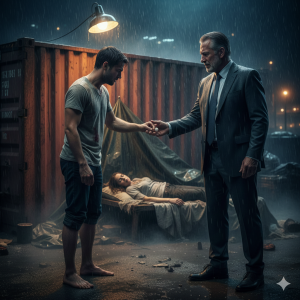
The storm had passed, but the city still wore its memory. Rainwater pooled along the gutters, clouds hung low and swollen, and the scent of metal and damp earth clung to the alleys like a warning. Posters fluttered on lampposts, plastered to bus stops, taped to glass doors and telephone poles: Margaret Hail—missing. Her photograph was everywhere, the image of a woman with pearl earrings and gentle eyes. Across screens and street corners, news loops replayed Ethan Hail’s fractured voice—son, millionaire, and suddenly very small in the face of loss—begging anyone with information to call. Vanessa, in a striking red dress that had become a signal flare of urgency, pleaded in press conferences: “Please, if anyone has seen Margaret Hail, report immediately.”
Forty-eight hours had turned the city into a search grid. Teams organized, drones swept rooftops, taxis flashed her image, shopkeepers shared posts, and strangers peered at every face in crowds—hoping, fearing, failing. It felt as if everyone was looking, and yet no one could find her.
Malik had been running since morning. Barefoot, cuts stinging and bleeding where glass had flashed cruelly beneath puddles, he sprinted past shuttered storefronts and chain-link fences, through slick backstreets where the posters had already softened from rain. He ran because he had sat with a woman through the cold—the woman the city was searching for—covering her with his own torn shirt, whispering to keep her awake, promising he would find help. He ran because dawn had touched her face and she hadn’t moved. Because he’d already tried telling people and the city had turned him into background noise.
When he saw Ethan—tall, furious, desperate—and Vanessa beside him in the same red dress from the news, his voice tore out of him like a flare thrown into darkness. “Sir—sir! Your mother—she’s alive. I saw her in the dump.”
Ethan spun. Exhaustion and rage sharpened his face. “Not again,” he snapped, voice raw. “God, not another kid.” Malik stumbled closer, breath hitching. “No, please. I’m telling the truth. She’s there. She fell. She can’t move.”
Ethan stormed forward and gripped Malik’s shoulder. “Stop lying to me. Do you understand? Stop using my mother for money.”
Malik flinched—then straightened with the last of his courage. “I don’t want your money. I want help.” Vanessa gasped; Ethan’s jaw locked. “I’ve had false leads all day. Scammers, liars—”
“She was robbed!” Malik shouted over him, voice cracking with urgency. “A thief pushed her down. She hit her head. She lost everything—phone, wallet, ID. In the storm!”
Ethan froze—only for a second. Vanessa moved fast, voice steady despite the tremble in her hands. “Ethan, listen to him.” He shook his head, breath ragged. “No. I can’t. I can’t fall for another lie.”
Malik’s hands shook so hard he could barely reach into his pocket. He managed. He pulled out a broken pearl earring—mud-stained, cracked at the clasp. The same one from the interviews. The same pair Vanessa had held up to cameras as a vital clue. The same earring Margaret had been wearing the morning she vanished.
Vanessa’s eyes widened as if struck. “Oh my God. Ethan—that’s hers. That’s hers. I picked that pair myself.”
Ethan’s face drained. “What are you—Vanessa?” But she wasn’t listening anymore. She dropped to her knees and grabbed Malik’s arm, urgent, shaking. “Sweetheart, please. Where did you see her? Where?”
“Behind Sector 9,” Malik sobbed. “Near the broken green container. She was cold. She was shaking. I tried to help. I stayed all night. She kept saying his name.”
Ethan staggered, the word caught in his throat. “My—my name?”
Malik nodded, tears spilling, voice breaking. “She said, ‘My Ethan doesn’t sleep when I’m gone. My Ethan will find me.’”
Vanessa covered her mouth. Tears fell instantly. “Margaret. Margaret.” Ethan took Malik by both shoulders—not in anger now, but fear. “Is she alive? Answer me. Is she breathing?”
“Slow,” Malik hiccupped. “Very slow. She wasn’t waking up. I promised—I told her I’d find you. I promised I’d bring you.”
Vanessa’s voice steadied, soft but firm. “Ethan, this is real. He’s not lying. Look at him.”
Ethan looked. Malik’s feet were bleeding. His clothes were soaked with dump water. Dirt streaked his face; tears had carved pale lines through grime. The boy’s hands shook uncontrollably. This wasn’t a scammer. This was a child who had kept vigil by a stranger’s side through a night that could have swallowed them both.
Something in Ethan gave. For the first time in forty-eight hours, his voice didn’t have edges. “Take me to her.”
Malik led, cutting through streets most people avoided even in daylight. Ethan’s polished shoes slapped through oily puddles; Vanessa lifted the hem of her red dress, not caring that the fabric was wet and heavy. They moved with that tight, silent urgency of people racing the clock—every step feeling like a countdown.
“She’s this way,” Malik gasped, glancing back every few seconds to make sure they were still behind him, as if slow footsteps could put distance between Margaret and survival. Ethan didn’t answer; the pressure had locked his throat. His mind replayed every false lead, every sleepless hour, every long moment when he imagined his mother alone, trapped, terrified—while he chased rumors and ignored the one truth that had been screaming in the city’s blind spot.
Vanessa squeezed Ethan’s hand, whispering, “Stay with him. No matter what happens, stay calm.”
Calm was impossible. They left asphalt for dirt. The smell hit them: industrial rot, smoke, metal, decomposing plastic. The dump spread out like a city of broken buildings; piles of scrap towered crooked as toppled skyline. Dogs barked somewhere out of sight. Wind rattled loose tin sheets with a metallic clatter.
Malik slowed. Pointed to a massive rusted container, half-crushed and coated in soot. “She’s behind there.” His small voice was nearly swallowed by the wind.
Ethan pushed past him. “Mother! Mom!” No answer. He called again into the shadows. Nothing. Vanessa’s gaze flicked to Malik. “Sweetheart, are you sure?”
“I wouldn’t lie,” he said, shaking his head violently. “She was here. I swear. Behind the container. She—she wasn’t moving.”
They rounded the container and froze. Margaret lay collapsed against cold steel, half covered by Malik’s torn shirt. Her hair was tangled. Scrapes scored her hands. Her bracelet had snapped, but still clung to her wrist. Dirt smeared her cheeks, her clothes were drenched from the storm, but—her chest moved. Barely.
Ethan’s mouth opened without sound. His knees buckled; he dropped beside her with a sound that was part prayer, part sob. “Mom! Mom! Oh my God—Mom!” His hands trembled as they cupped her face. Warm. Too warm. “Fever,” he whispered—thin, desperate—while Margaret moaned softly, shifting, trying to breathe.
Vanessa knelt and took Margaret’s hand. “It’s us. Margaret, it’s us, sweetheart. We found you.”
Malik stayed a few steps away, arms wrapped around himself. He didn’t approach. Fear stretched across his shoulders: the braced instinct of someone who expects to be blamed for bad endings. Ethan looked at him through pain. “How long was she like this?”
“Since last night,” Malik managed, swallowing. “After the storm stopped, she tried to stand, but fell again. I—I didn’t know what to do.”
Vanessa’s voice was gentle. “Why didn’t anyone else see her, Malik? Why not the police? The rescue teams? They were everywhere.”
He didn’t answer at first. His eyes dropped. He took two ragged breaths. “They don’t listen to boys like me,” he whispered.
Ethan went still, the words cutting straight through the armor of his anger. Malik’s voice turned raw. “I tried, okay? Last night I tried. I told a man in uniform near the bridge. He brushed me away. Said he was busy. Said I was just begging. I told a shopkeeper. She said I was making stories for money. I tried again this morning—two people. They didn’t even look at me. They just walked.”
He wiped his face with his sleeve. “No one listens to poor kids. They think we lie all the time.”
The sentence landed like a weight none of them could dodge. Vanessa placed a steady hand on Malik’s shoulder. “Why didn’t anyone else see her?”
Malik pointed, voice soft and tired. “This place… No one comes here in storms. Everyone hides. And even in the morning, guards don’t check this side. They only look near the gates. The broken container hides her. You don’t see behind it unless you walk right here.”
He kicked the dirt, helpless. “I didn’t leave her because I thought if I left, she’d die alone. She was shaking. She was scared. She held my hand and kept saying, ‘Don’t go.’ So I stayed. I stayed all night. I wasn’t greedy. I wasn’t thinking about rewards. I just didn’t want her to die alone.”
Silence heavier than scrap metal fell. Ethan rose slowly, voice cracked but clear. “You saved her.”
Malik blinked, stunned. “No, I didn’t. I tried. You—”
“You saved her,” Ethan repeated, louder, firmer, breaking on the last word. “If you hadn’t stayed, she’d be dead.”
Vanessa nodded, tears spilling again. “You did more than most adults would.” The boy’s shoulders finally loosened—barely, but enough to breathe.
Ethan gathered his mother carefully, arms tightening around her fragile frame as if she were the last anchor in a storm. Vanessa fumbled her phone, hands shaking so badly she could hardly press the buttons. “Emergency—please. This is Vanessa Carter. We found Margaret Hail. She’s alive but unresponsive. Sector 9 Industrial Dump. Hurry.”
Malik stood behind them, exhausted, hugging himself, mud streaked up his legs. He watched Ethan—braced for blame that didn’t come—and then watched the horizon, where the faint ambulance siren rose like a lifeline.
“Hey,” Ethan said, noticing the fear in Malik’s eyes. His tone turned gentle. “Come closer.”
Malik didn’t move. “Are they going to take her away?” he whispered.
“Yes,” Ethan said, swallowing hard. “To help her. To make sure she wakes up.”
Malik’s shoulders dropped a fraction. He still stayed back, head bowed—the posture of someone who’d learned to stay on the edges of other people’s stories even when he was the reason they were still being written.
The ambulance arrived. Medics knelt by Margaret, checked her pulse, wrapped her in thermal blankets, set an oxygen mask. She moaned faintly—alive, fighting. “Pulse weak but present,” one said. “Dehydrated and hypothermic, but responding.”
Ethan let out a sound that wasn’t a sob and wasn’t a breath—something broken in between. They lifted Margaret onto a stretcher and slid her into the ambulance. Vanessa turned to Malik. “Sweetheart… come with us. She’ll want to see you when she wakes.”
“I can’t,” Malik said quickly. “This is your family. I’m just a street kid.”
Ethan stepped forward. “You are the reason my mother is still breathing. Do you understand?” His voice was low, intense, sincere. “You stayed with her when she had no one. You believed her when no one else cared. You fought to find me even when I didn’t believe you.”
Malik’s eyes filled. Ethan knelt so they were level. “Look at me. You’re not ‘just’ anything.” He placed a careful hand on the boy’s shoulder. “You’re coming with us.”
“But I don’t belong in an ambulance with rich people,” Malik whispered, overwhelmed.
Ethan smiled through tears. He didn’t hide them. “You belong with the people who believe you. And that’s us now.”
Vanessa extended her hand. “Come on, honey.”
Malik hesitated—only a second—then stepped forward into the ambulance and sat beside Margaret, holding her hand with careful, small fingers. Her eyelids twitched, as if sensing him. “I promised you,” he whispered. “I told you I’d bring him.”
Ethan heard. His throat tightened. “You kept your promise,” he said quietly. “Better than anyone else could.”
Doors shut. “Hospital,” Ethan ordered, voice steady for the first time in two days. The engine roared. The ambulance sped into the city—away from a place where Malik’s voice had been ignored—toward a future none of them had expected to share.
Malik watched the dump recede through streaked glass. He had never imagined a single night could change anything. But the cold had turned him into a guardian, and the dawn had turned him into a witness. He hadn’t just saved a millionaire’s mother. He had saved the part of himself that believed promises matter when no one’s watching.
The hospital was reheated air and humming machines, fluorescent lights softened by the urgency of people moving on purpose. As soon as they arrived, medics transferred Margaret with fluid precision, monitoring vitals, raising her temperature, threading careful lines into the crook of her elbow. “Hypothermia,” a nurse confirmed. “Dehydration. Potential concussion. She’s strong.”
Vanessa moved like someone walking on water, calm and rushing at once. Ethan hovered near his mother’s bed, a hand on the rail, eyes locked on the rise and fall beneath the oxygen mask. When the doctor said “she’s stabilizing,” Ethan’s body sagged with a relief that felt like collapse in slow motion. He touched her hand lightly, as if fear could still break her. “Mom,” he whispered. “We’re here.”
In the waiting area, nurses brought water and blankets. Vanessa folded a blanket around Malik’s shoulders. His feet—bandaged quickly in triage—rested on a towel. He couldn’t stop watching the corridor, where the team had wheeled Margaret out of sight. He held the broken pearl earring in his fist so tight his knuckles whitened.
Ethan sat beside him—not across, not apart, but close enough that their shoulders almost touched. For a long time they were quiet, listening to distant beeps and doors opening and closing softly. Finally, Ethan spoke. “I saw you,” he said, voice threaded with apology. “I saw you and I didn’t believe you.”
Malik looked down. “No one does,” he said, almost lightly—as if accepting weight could make it weigh less. “It’s okay.”
“It’s not,” Ethan said, and the word felt like a line drawn on the floor. “It isn’t okay.” He swallowed. “I should have listened. I should have—”
“You did,” Malik said. “You’re here.”
Ethan nodded, but the guilt stayed, heavy and sober. “That earring,” he said softly, glancing at Malik’s closed fist. “It changed everything.”
Malik unclenched his hand. The broken pearl lay in his palm, small and stubborn in its refusal to be lost. “She dropped it when she fell,” he said. “I picked it up. I thought someone would believe if I showed it.” He frowned, memory steeling his voice. “I found a cop by the bridge. He said I was begging. I found a shopkeeper. She said I was lying. The morning got loud, and I got quieter.” He shrugged, a small movement that tried to hide a big truth. “Then I saw you.”
Ethan’s throat ached with the simple brutality of those sentences. “Why did you stay?” he asked, because he needed to hear the reason, even though he already knew it.
“She asked me not to go,” Malik said. “She kept whispering your name. It was cold. I didn’t know what else to do.” He looked at Ethan, eyes dark and earnest. “If it was my mom, I’d want someone to stay.”
Vanessa returned from speaking to the doctor. “She’s stable,” she said, emotion tremoring under composure. “Hypothermia was the worst of it. They’re warming her. Monitoring for concussion. She’ll need rest. But she’s going to be okay.”
Ethan closed his eyes. A breath he hadn’t been able to take found its way in. “Thank God.”
Vanessa looked at Malik—at his bandaged feet, the blanket up to his chin, the way he glanced toward every sound in the hallway as if he needed proof that good things continued happening after the first one. “We’ll get you taken care of,” she said. “Food. Clean clothes. Shoes. And someone to look at those cuts properly.”
Malik shook his head as if kindness might break him. “I’m fine,” he said, which meant he wasn’t used to people arranging comfort around him. Vanessa smiled in a way that said argument wasn’t necessary. “You’re with us now.”
A nurse padded over. “She’s warming up nicely,” she said. “We’ll allow visitors in short intervals soon.” She looked at Malik’s feet and knelt to rewrap the bandage more carefully. “You did something incredible,” she said, meeting his eyes. “Don’t let anyone tell you different.”
When they were alone again, Ethan breathed carefully against the quiet. “I searched everywhere,” he said. “The city turned itself inside out. But we didn’t look here.” He glanced toward the windows, beyond which the world was already resuming routines. “I keep thinking: how many people walked past the places that mattered because they didn’t look like help?”
Malik didn’t answer. He didn’t have to.
Minutes stretched into two hours measured in beeps and soft footfalls. Margaret stabilized. The fever eased. Color returned slowly under the mask. When at last the doctor nodded, they went in—Ethan, Vanessa, and Malik—quiet as people entering a sacred place. Margaret’s eyes opened, slow and searching, anchoring themselves first on her son. Ethan’s cheeks, exhausted, lit up with a tenderness that erased forty-eight hours in a single moment. “Mom,” he said. “I’m here.”
She blinked, then smiled—small and breaking at the edges. He took her hand gently. “You kept saying my name,” he whispered. “I heard you.”
She turned her head, saw Vanessa, and then saw Malik—small, uncertain, the blanket tucked under his chin as if belonging were something he might lose if he moved too quickly. Margaret’s smile deepened. “You,” she said softly, voice fragile but clear enough. “You stayed.”
Malik nodded, tears starting in a way that embarrassed him and didn’t. “I promised,” he said. “I told you I’d bring him.”
Margaret’s gaze flicked to the boy’s hand. He held out the broken pearl earring. “You dropped it,” he whispered. “I kept it.” She touched the earring lightly, then touched his hand. “Thank you,” she breathed. “For being exactly where I needed you.”
Ethan swallowed, the moment too full for the ways language fails. Vanessa stood beside him, steadying the air around the bed. After a few minutes, the nurse asked them to give Margaret time to rest. In the hall, Ethan turned to Malik.
“I have a lot,” he said carefully, trying not to make it sound like a transaction. “But I’ve never had something like today.” He paused. “There’s a world of things we can do. Starting with shoes and clothes and food. We’ll figure the rest out together. If you’ll let us.”
Malik’s instinct—honed by years of being turned away—told him to say no to any offer that sounded like pity. But nothing in Ethan’s voice felt like pity. It felt like respect given in the wake of rightness. Malik nodded. “I’ll… I’ll let you,” he said.
Ethan smiled. “Good.”
The day unspooled into smaller kindnesses. A cafeteria worker found a pair of donated sneakers. A nurse smuggled an extra pudding. Vanessa sent someone to get Malik clean clothes. Margaret slept, stabilized and soft under warm blankets. Ethan sat with her and, when allowed, told her the story—the broken container, the necklace, the boy who stayed.
By evening, the city’s relentless rhythm softened at their window. Clouds thinned. Streetlights woke. Posters of Margaret’s face began to come down, each one removed carefully, as if honoring the worry they had carried. Into that fragility, a nurse asked, “Family?” The three of them—son, fiancée, and boy who refused to be invisible—looked at each other and nodded yes.
Later, in the quiet beyond visiting hours, Vanessa stepped into the hall with Malik. The red dress had wrinkled, the fabric tired from rain and movement, but it gave off a kind of brave brightness anyway. “My mother used to say,” Vanessa murmured, “the hardest things teach us how to keep each other.” She looked at him. “We’re keeping you.”
Malik blinked quickly. “I never thought—” He stopped, because some sentences are too heavy to finish.
Ethan joined them, carrying a small bag. He held out a new pair of shoes. “They’re not fancy,” he said, smiling. “But they’ll do better than blisters and bandages.”
Malik took them, turning them over as if they might vanish. “Thank you.”
“Thank you,” Ethan said, meeting his eyes, because some exchanges matter more when they go both ways.
At home that night—if you could call the sterile hospital lounge a kind of home—the three of them made a plan. Not grand, not a press conference. Just a list on a napkin of things that needed doing: check on Margaret’s recovery, report the robbery to the police, cover Malik’s medical needs, find him a safe place to sleep that wasn’t the edge of a city’s blind spot. Ethan wrote phone numbers. Vanessa wrote names. Malik watched the way the ink made promises without shouting.
When Margaret woke again in the early morning, she was stronger. She held Ethan’s hand and asked for water. When she saw Malik, she asked if he had eaten. He lied and said yes; Vanessa rolled her eyes and handed him a sandwich. Margaret laughed softly—the kind of laugh that means the world is returning, a piece at a time.
News crews showed up at the hospital lobby by noon, hungry for a neatly packaged story. Ethan declined interviews. Vanessa, who had learned long ago how to speak when the world demanded soundbites, said only this: “A boy saved her. He stayed. Remember that when you decide which voices to hear.”
They left it there. No spectacle. No viral moment to swallow the quiet truth. Margaret rested. Ethan and Vanessa made phone calls. Malik slept in a real bed for the first time in a very long time.
Days later, Margaret returned home to a living room that smelled faintly of lemon cleaner and new beginnings. Ethan refused to let anyone throw away the broken pearl earring. He had it set in a small shadow box, the clasp still cracked, the mud stain persistent, the tiny flaw now a relic of rightness. He placed it on a shelf in the entryway—the first thing you saw upon walking in, a reminder that sometimes the most ordinary objects carry the weight of everything we didn’t know how to ask for.
Malik visited often at first, and then simply belonged. Shoes by the door. A hoodie on the back of a chair. Homework stacked on a coffee table where plans had once lived. Vanessa taught him how to make tea the way Margaret liked it—strong, sweet, steady. Margaret taught him to sew buttons back on shirts. Ethan taught him that trust could be as simple as “stay for dinner.”
On an evening when the city was all gold and forgiving, Ethan stood in the doorway and watched Malik and Margaret laugh over a story about a cat that didn’t exist and a puddle that did. He looked down at his hands—hands that had been clumsy with helplessness—and felt how they had learned to be useful again.
“Sometimes,” he said to Vanessa, who was placing fresh flowers beneath the shadow box, “we need something small to carry something big.” He nodded at the broken pearl. “This did that.”
Vanessa smiled. “No,” she said, and shook her head gently. “He did.”
Ethan’s gaze drifted to the street—where posters had been replaced by unremarkable evenings—and then back to the people inside. He thought about the sentence that had cut him open: “They don’t listen to boys like me.” He thought about the way one boy had made the city listen anyway.
When Malik hugged him goodnight, he pressed something small into Ethan’s hand—a button from his own worn shirt, smooth from years of trying to hold fabric together. “So you don’t forget me,” he said, grinning in a way he hadn’t allowed himself to before.
Ethan closed his fingers around the button, felt the weight of two tiny objects that had moved a world. “I won’t,” he said. He meant it.
The city continued. Buses sighed. Windows reflected sunsets. The dump remained what it had been—a place most people didn’t look. But somewhere inside the city’s restless heart, a new habit had begun: to listen when a voice trembles but refuses to go quiet. To check behind the containers. To believe the truth when it arrives barefoot, bleeding, and holding the broken evidence of a night that changed everything.
Your mother is alive, he had said, and the city had eventually heard it. A boy had saved a millionaire’s mother. A broken earring had become a beacon. A promise whispered into the cold had been kept.
And in a house where the first thing visitors saw was a cracked pearl in a glass box, hope moved in with its few belongings and decided to stay.
Disclaimer : This content may be created by AI for entertainment purposes. Any resemblance to real persons, events, or places is coincidental.