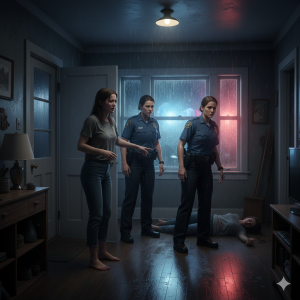
Rain had been falling since sunset—steady, indifferent—turning lamplight into hazy gold and the city into a quiet after-midnight hush. Inside patrol car 213, Officer Marcus Hail let the hypnotic rhythm of the wipers match the fatigue in his bones. Another long shift, more paperwork and silence. In his late forties, his posture told the story of years behind a dashboard; his voice had worn down to something low and gravelly.
Beside him sat Officer Julie Rain, new to the precinct, idealistic, her uniform too clean, badge gleaming. Marcus remembered when he had that same brightness—when a badge felt like a promise. Time dulls such edges.
“Quiet night,” Julie said, watching the slick streets. “Quiet’s good,” Marcus replied. “Means nobody’s bleeding.” The radio crackled—static, then silence. Neon reflected across puddles in an old industrial district: warehouses, storage yards, the occasional diner blinking through the rain.
Lightning flashed. Then movement: a small figure, low to the ground, darting across the road. A girl—no older than eight—barefoot, soaked, a thin dress clinging like paper. Her hair, dark and matted, stuck to her cheeks; her arms pumped weakly. For an instant Marcus thought fatigue had conjured her. Then Julie gasped, “Marcus, do you see her?”
He eased the car forward. Headlights caught her face for a split second—eyes wide, glassy with tears—before she turned away and ran. “She’s barefoot,” Julie said, disbelief cutting through her voice. Marcus stepped into the rain. “Hey!” he called. But the child didn’t stop.
He could have called it in. Waited for procedure. Instead, something buried beneath years of cynicism rose up. This wasn’t aimless. The urgency in her movement said she was fleeing something. He slid back into the driver’s seat, water dripping from his sleeves. “No time. We’re following her.”
They followed, headlights cutting a narrow path. The girl reappeared along the curb, glanced back—panic written across her face—and kept running. “She’s leading us somewhere,” Marcus said. “Or running from somewhere,” Julie countered. Either way, they wouldn’t lose her.
The city shifted: well-kept houses faded into boarded windows and empty lots. A dog barked like a warning. The girl slipped, caught herself, kept going; her bare feet left faint streaks of blood on wet pavement. “She’s hurt,” Julie said. “Let her lead,” Marcus answered, trusting instinct over protocol.
Finally, she darted into a dead-end. Buildings stood skeletal: broken windows, rusted hinges. At the block’s end, the girl stopped, shaking in the rain, and pointed to a slouched house half hidden by overgrowth. Marcus killed the engine. “That’s it.”
She reached for a gate latch, hand trembling. The rusty creak echoed down the empty street. The house waited—dark, still, breathing something not quite like life. “We follow her,” Marcus said softly. They crossed a yard littered with a rusted tricycle, a broken umbrella, and knee-high wet weeds. The porch sagged under years of rot. “Abandoned doesn’t mean empty,” Marcus murmured.
Inside, damp wood and mildew smothered the air, with something else beneath—the odor of neglect. Peeling wallpaper. A broken lamp. A couch overturned. “Police,” Marcus called, voice steady. No answer—only echo. The child stood in the hall, shoulders shaking. “This way,” she whispered, barely audible over rain pounding the roof.
She pointed to a shadowed door—a basement entrance. Marcus’s stomach tightened. The smell grew stronger: stale alcohol, something burnt, and the faint metallic tang of blood. He turned the cold handle. Hinges groaned. Heavy, wet air rose from below. Flashlight beams caught glass bottles scattered on the steps, water dripping somewhere in the dark.
He descended, Julie close behind. The girl’s sobs blended with the rain. The flashlight swept the floor—and found a body. A woman sprawled on the cold linoleum: pale skin, tangled hair, swelling on cheekbone and jaw, one arm bent awkwardly, the other reaching toward the stairs with curled fingers.
“Julie—she’s here,” Marcus called. Julie rushed down, pressed two fingers to the woman’s neck. A long breath. “She’s alive,” she said. “Barely—but breathing.”
Marcus radioed for EMS, priority 1, at 1149 Riverside Industrial. The child—Nia, they later learned—collapsed beside her mother, whispering, “Mommy… please wake up.” Julie wrapped her arm around the girl. “You did so good bringing us here.”
“He hurt her again,” Nia whispered, voice shaking. “He was yelling. Then she stopped moving. I ran to find people with badges.”
Sirens approached through softening rain. “Help’s coming,” Marcus said. “You’re safe now.” But safety was only the beginning. Bruises mapped history. Fear clung like smoke. As paramedics worked, Marcus promised himself: whoever did this wouldn’t walk free for long.
The ambulance departed. The house exhaled. Marcus’s flashlight carved through the dark: bottles in clusters, cigarette burns on tables, yellowed wallpaper. Rot born of fear. Julie wrapped Nia in a blanket. Names gave shape: the girl was Nia, the mother Leah.
Evidence spoke: an overturned chair with a broken leg, a shattered frame, a bloody handprint at adult height near the kitchen. A forced back door and fresh heavy footprints leading out. “He was here when we arrived,” Marcus said. “Slippped out when the sirens hit.”
“He always comes back,” Nia said quietly. A rhythm of repetition lived in her words—years, not one night. “We’ll make sure he doesn’t,” Marcus promised.
They sealed the house and carried Nia to the patrol car, wrapped in another blanket, asleep by the time the door clicked shut. Dawn silvered the edges of the sky. “She’ll need someone until her mom wakes,” Julie said. “I’ll call the shelter,” Marcus replied. “And we’ll do more than hide her. We’ll find him.”
Daylight made the city look tired rather than menacing. Marcus hadn’t slept. He worked the case file: notes, photos, reports—simple, brutal: a child, a mother, a man who turned a home into a cage. Forensics returned blood samples, partial prints, shoe impressions—adult male, likely the husband: Richard Mallerie, 42. Neighbors whispered: fights for months, screaming, breaking glass. No one wanted to get involved.
Nia spent the night at St. Bridget’s, clinging to her doll, barely speaking. Leah lay in intensive care—broken ribs, concussion, internal bruising—stable but not safe. Doctors saw old fractures, scars that never healed. Leah had drafted an email to the city attorney about illegal weapons shipments in warehouse district yards—never sent. “If that’s true,” Marcus said, “it’s bigger than domestic violence. He was night security—useful to people who wanted silence.”
Forensics brought a silver locket—initials RM—found under the porch, along with imported cigarette butts. Tracks had led toward the old freight yard before rain washed them out.
A witness reported a thin man in a gray jacket moving fast near an abandoned river warehouse. They arrived to damp air and shafts of light through a scorched roof. Footprints in dust—large, fresh, heel worn down. A door half ajar. Inside, a man stood with smoke curling around him. He turned, annoyed rather than surprised. “Officers,” he drawled.
“Richard Mallerie,” Julie said. “You’re under arrest for aggravated assault and attempted homicide.”
“Homicide?” he sneered. “She’s alive. I kept her fed. Kept that brat off the streets.” Marcus clenched his jaw. “You nearly killed her.”
“She pushed me,” he smirked. “Always threatening to call the cops. Weak, useless, nothing without me.” Julie stepped closer. “You broke her ribs. You terrified your stepdaughter. And you call that strength?” He glared. “The girl’s the same—always crying, hiding. Thought she could turn her mother against me. They got what they deserved.”
Marcus held still. Cold voice: “Turn around. Hands behind your back.” Click. Cuffs locked. Outside, bravado returned. “You think this changes anything? She’ll retract. Women cry and forgive.” Julie shoved him toward the car. “Not this time.” He laughed, hollow. “They need men like me.”
Back at the station, evidence stacked into a wall no judge could ignore. Late that night, under a thin moon, Julie asked, “Does justice ever feel like enough?” Marcus said, “No. But it’s what we can give. And now they have a chance.” For the first time in years, he felt a steady conviction: what they’d done mattered.
Morning rose soft and colorless. At the hospital, Leah looked fragile but awake—bruises fading from black to yellow, machines beeping steady. “Is Nia safe?” she asked. “She is,” Marcus said. “St. Bridget’s is caring for her.” “Did you find him?” “We did. He’s in custody.”
“I told Nia once,” Leah whispered, crying quietly, “if you’re scared, run toward the light. Find people who can help.” She hadn’t thought her child would need it. Julie arrived with warm tea. “Nia’s awake,” she said. “She wants to see you.” Minutes later, Nia entered clutching her battered doll and climbed carefully onto the bed. Leah pressed her face into her daughter’s hair, reclaiming something she thought lost forever.
That afternoon, sentencing moved swiftly—evidence too clean to argue. The judge’s voice was firm and cold: years in prison, no parole for a long time. Mallerie didn’t flinch. Marcus remembered Leah’s words—he always comes back—and knew this time he wouldn’t.
Back at the hospital, Nia asked, “Is it over?” “It’s over,” Marcus said. “He won’t hurt you again.” “Don’t thank me,” he told Leah. “Thank your daughter.” Nia held up a crayon drawing: two tall figures, two small ones beneath a bright yellow sun. “That’s us,” she said. “You, Mommy, Miss Julie, and me.” Julie arrived with flowers—“Hero of the week,” she joked. Leah laughed faintly. “I don’t feel like a hero.” “You don’t have to,” Marcus said. “Just keep living.”
When they left, Nia ran to hug Marcus. “You helped my mommy.” He knelt. “You did that. You didn’t give up.” She pressed a smooth, worn button from her doll’s dress into his palm. “For you, so you don’t forget us.” He tucked it carefully into his pocket. “We’ll check in,” he told Leah. “Make sure you’re okay.” “We will be,” Leah said. “I think we finally will.”
Outside, the afternoon felt warmer, the air fresh with garden scent. “What keeps people like her fighting?” Julie asked. “Love,” Marcus said. The kind that doesn’t wait to be rescued.
They drove away. In a hospital window, a child’s drawing fluttered—sun, figures, blue sky. The city kept its restless rhythm. But for Marcus Hail, Julie Rain, Leah, and Nia, the storm had passed, and in the quiet heart of the city, hope had begun to grow again.
Disclaimer : This content may be created by AI for entertainment purposes. Any resemblance to real persons, events, or places is coincidental.