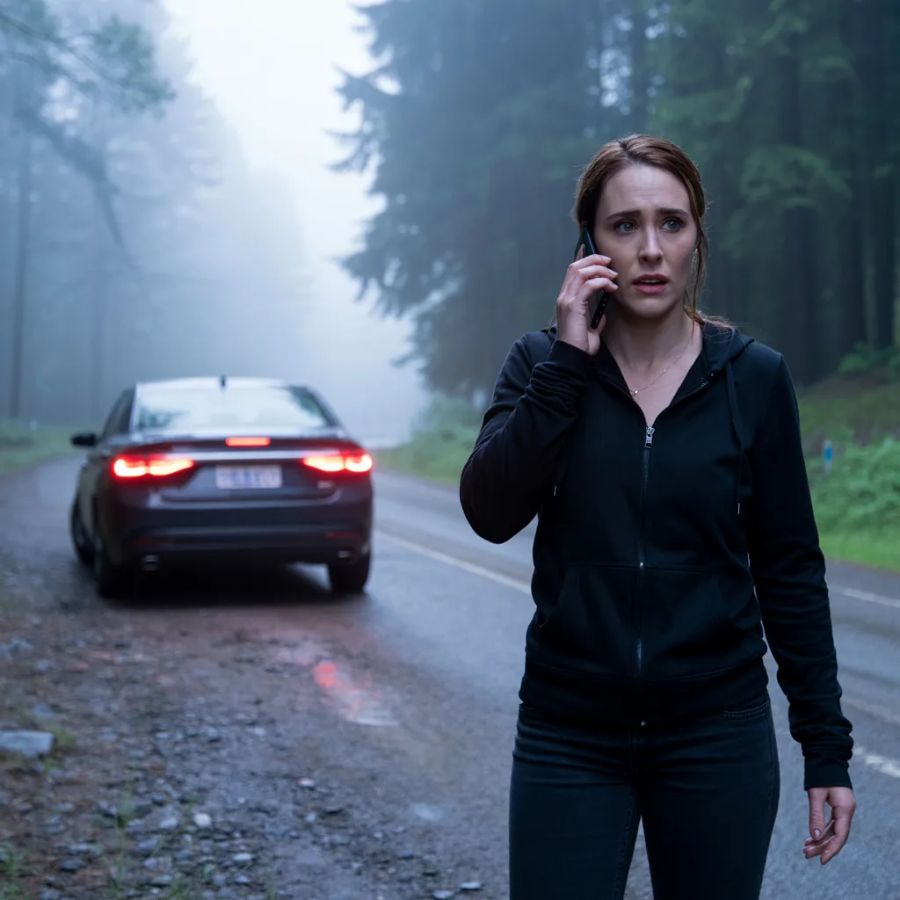
The call came at 6:12 a.m., and it didn’t sound like my aunt Marlene anymore—her voice was thin, frantic, all air and fear.
“Emma, your dad collapsed. They’re taking him to St. Catherine’s right now.”
My hands went numb around my phone. My dad, Robert Hale, is the steady one. The man who never misses a car payment, never forgets a birthday, never complains even when his back hurts. Hearing “hospital” attached to his name felt unreal, like someone had swapped my life with a stranger’s.
I ran to the bedroom and shook my husband awake. Dylan blinked at me like I was interrupting something important.
“My dad’s in an ambulance,” I said. “Please—drive me to St. Catherine’s.”
Dylan rubbed his face, sighed, and sat up. “Fine. Get dressed.”
I didn’t question the tone. I didn’t have the emotional space. I pulled on jeans, a hoodie, sneakers—my hands shaking so hard I dropped my keys twice. Dylan drove like he was annoyed by the morning itself, tapping the steering wheel, jaw tight.
Halfway there, he missed the highway exit.
“Dylan!” I said sharply. “That was our turn!”
He shrugged. “Traffic. I’m taking a shortcut.”
A shortcut turned into smaller roads. Smaller roads turned into trees. The city thinned out until it was just fog, pine trunks, and a narrow two-lane that looked like it hadn’t been repaved in years. My stomach twisted.
“Where are we?” I asked.
He didn’t look at me. “Relax.”
Then, without warning, he pulled onto a gravel shoulder near a wooded trailhead. No houses. No gas station. Just a wooden sign, a dark treeline, and a stretch of quiet that felt too big.
He put the car in park.
“What are you doing?” My voice cracked.
Dylan turned to me with a flat expression I didn’t recognize. “You’ve been ‘too much’ lately,” he said. “Always your family, your stress, your drama. I need space.”
“My dad might be dying,” I whispered.
He reached across me, popped the passenger door open, and said, “Get out.”
I stared at him. “Are you serious?”
“Yep,” he said, already shifting into drive. “You’ll figure it out.”
I stumbled out onto the gravel, heart hammering, and the door clicked shut behind me. For one second, I thought he’d come to his senses.
Instead, Dylan’s tires spit stones, and his car disappeared down the road, leaving me alone in the fog with nothing but my phone and the sound of my own breathing.
I stood there shaking, then forced myself to move. I found a weak signal, called the hospital, confirmed my dad was in the ER, and started walking—fast—down the shoulder, wiping tears with my sleeve like it was a chore.
Twenty minutes later, a pickup truck slowed beside me. The driver, a middle-aged woman with kind eyes, rolled her window down.
“Honey,” she asked, “are you okay?”
I swallowed hard. “My dad’s in the hospital,” I said. “And my husband just left me in the woods.”
She looked past me at the empty road, then back at my face—then said, “Get in. Right now.”
As we drove toward the highway, my phone buzzed with a text from Dylan:
“Don’t bother coming home. Also… we need to talk about what YOU made me do.”
And I realized the worst part wasn’t the forest.
It was that he thought I’d blame myself.
By the time we reached St. Catherine’s, my hands were trembling so badly I could barely sign in at the front desk.
The woman who’d picked me up—Janine—walked me inside like I was her own daughter. She didn’t ask for details until she knew I was under fluorescent lights, surrounded by people, not trees. When I thanked her, she squeezed my shoulder.
“Go to your dad,” she said. “Handle the rest later.”
I ran to the ER desk, gave my name, and the nurse’s expression softened in that practiced way medical staff use when they’ve already seen the tests.
“He’s stable,” she said. “It was a cardiac event. He’s awake, but they’re running more imaging.”
My knees almost gave out from the relief. “Can I see him?”
A few minutes later, I was at his bedside. My dad looked smaller under the hospital blanket, oxygen tube looping around his ears. But his eyes were open. When he saw me, he tried to smile.
“There’s my girl,” he rasped.
I grabbed his hand, pressing my forehead to his knuckles. “I’m here,” I whispered. “I’m here.”
My aunt Marlene arrived soon after, crying quietly. We listened while the doctor explained what happened: a blockage, caught early enough to treat, but serious enough that my dad would need a procedure and recovery time. It was frightening—but it wasn’t the end.
And that’s when the anger finally found room in my body.
Because I’d gotten to the hospital despite Dylan. Not because of him.
While my dad rested, I stepped into the hallway and stared at Dylan’s text again: Don’t bother coming home… what YOU made me do. The audacity made my throat burn.
I called him. Straight to voicemail.
I called again. Voicemail.
Then my phone rang—an unknown number. I almost ignored it, but something in my gut told me to answer.
“Is this Emma Hale?” a man asked.
“Yes.”
“This is Officer Keller with county patrol. We have your husband, Dylan Pierce, pulled over on Route 17 near Pine Hollow. He’s reporting a ‘domestic dispute’ and says you’re refusing to answer. Are you safe?”
My mouth went dry. “He… reported me?”
The officer hesitated. “Ma’am, he’s… upset. He also mentioned leaving you near a trailhead. I need to confirm: did he drop you off on a rural shoulder this morning?”
I swallowed hard. “He forced me out of the car while I was trying to get to the hospital. My father had a medical emergency.”
There was a pause. The officer’s voice changed—less neutral. “Understood. Please stay on the line.”
I could hear muffled voices in the background. Dylan’s voice—sharp, defensive. “She’s dramatic! She does this!”
Then another voice cut in, calm and firm. “Sir, you can’t abandon someone on a roadside and then call them the problem.”
My aunt Marlene stepped beside me, eyes wide. “What is it?”
I covered the phone. “The police have Dylan.”
Marlene’s face hardened. “Good.”
Officer Keller returned. “Ma’am, here’s what I can tell you: Mr. Pierce’s vehicle is being towed.”
“What?” I blurted.
“He parked partially on a restricted shoulder near a no-stopping zone by the forest access road,” the officer said. “He also appears to have an unregistered replacement debit card in his wallet that doesn’t match his ID—he claims it’s ‘yours,’ but he couldn’t explain why. We’re documenting everything.”
My heart hammered. “I didn’t give him any card.”
“Noted,” the officer said. “Also—he has a flat tire, and he attempted to drive on it. That’s why we stopped him. The rim is damaged.”
I stared at the wall, trying to process the irony. Dylan dumped me in the woods to “teach me a lesson,” and now he was stranded on the side of the road, arguing with police, his car being hauled away.
“Do you need me to come get him?” I asked, and even to my own ears, it sounded ridiculous.
Officer Keller’s tone stayed professional, but I heard a hint of disbelief. “That’s… your choice. But he’s not free to leave with you right now. And ma’am—if you want to file a report about abandonment or coercive behavior, we can take your statement.”
I looked through the ER doors at my dad’s room, at the man who would’ve driven through a hurricane to reach me if I needed him.
Then I said, “Yes. I want to make a statement.”
Dylan wanted me powerless. Instead, he handed me documentation.
And when I finally hung up, my hands started shaking again—not from fear this time.
From the first spark of something that felt like justice.
I gave my statement in a quiet consultation room near the ER—facts only, no exaggeration.
I described the call about my father, Dylan agreeing to drive me, taking “shortcuts,” pulling over near the trailhead, opening my door, telling me to get out, and leaving. I showed the officer Dylan’s text blaming me for “making” him do it. I also gave Janine’s contact information, because she’d witnessed my condition and picked me up.
The officer didn’t promise me a movie-style outcome. He just nodded and said, “This matters. A pattern matters.” Then he handed me a case number.
When I returned to my dad’s room, I expected to feel guilt. Instead, I felt strangely calm. My father squeezed my hand and whispered, “You look like you’ve been through something.”
I hesitated—then told him the truth, gently.
His eyes closed for a moment. When he opened them, they were tired but clear. “Emma,” he said quietly, “a man who abandons you during an emergency will abandon you in smaller ways every day. Don’t build a life on that.”
My dad didn’t say it with drama. He said it like a father who’s lived long enough to recognize a warning sign.
Over the next two days, my world rearranged itself around hospital schedules and hard decisions. My dad had his procedure. My aunt stayed with him overnight. I handled calls, insurance, and medication lists. Dylan called from different numbers, leaving messages that bounced between rage and self-pity.
“You humiliated me.”
“You turned cops against me.”
“You’re going to regret this.”
Not once did he say, “I’m sorry I left you alone.”
On the third day, Dylan finally texted something different: “Can you come get me? My car’s impounded. I’m stuck.”
I stared at the message for a long time.
And then—this is the part people don’t believe until they’ve been there—I started laughing. Not a cute laugh. Not a polite laugh. A full, uncontrollable, shoulders-shaking laugh that came from pure disbelief at the universe’s timing.
Because the man who had left me in a forest during my father’s emergency was now asking me for a rescue ride.
I didn’t answer.
I forwarded the message to my attorney instead.
Yes—attorney. Because while my dad slept after his procedure, I sat with my aunt and my mom, Patricia, and we made a plan. I didn’t want revenge. I wanted separation, safety, and clarity. I wanted my finances protected and my home peaceful.
My mom was furious in a way that made her voice quiet. “He thought you’d panic and crawl back,” she said. “He thought fear would keep you loyal.”
That night, I went to our apartment with my mom and my cousin. Not alone. Never alone. We packed essential clothes, documents, and the things that mattered most—my grandmother’s necklace, my dad’s old letters, Lily’s childhood photos from my own keepsake box. Dylan’s things stayed.
Two weeks later, we moved me into a small rental near the hospital—temporary, practical, mine. My dad was recovering, and I wanted to be close. The move wasn’t glamorous. It was cardboard boxes and exhausted arms and a borrowed dolly that squeaked like a complaint.
And still, I couldn’t stop laughing.
Not because moving is funny. Because freedom feels absurd when you’ve spent so long negotiating for basic decency. Because I kept thinking about that foggy shoulder and Dylan’s smug certainty that he could leave me stranded—only to end up stranded himself, calling for help like the world owed him softness.
A few days after the move, Dylan showed up at my new place. He didn’t get inside. He stood on the sidewalk, looking smaller than I remembered.
“I made a mistake,” he said.
I didn’t argue. I didn’t raise my voice. I simply replied, “You made a choice.”
He blinked. “So that’s it?”
“That’s it,” I said.
If you were in my shoes, would you have picked him up after he stranded you—just to prove you’re “better”—or would you let consequences do their job? And where would you draw the line: abandonment once, or the pattern behind it? Drop your honest thoughts in the comments, and if this story made your stomach twist, share it with someone who needs the reminder that love is not proven by how much disrespect you tolerate.
Disclaimer : This content may be created by AI for entertainment purposes. Any resemblance to real persons, events, or places is coincidental.