Part I: The Lock
I thought a single night could be contained. I thought of it as a pocket universe—a few hours stolen from reality that would dissolve the moment I stepped back into the timeline of my real life. I told myself that what happened in a hotel room in downtown Chicago stayed in the static of the city, unconnected to the quiet, suburban rhythm of my life in the outskirts.
I was wrong. Betrayal doesn’t stay contained. It bleeds. It seeps under doorframes and into bank accounts; it stains memories you haven’t even made yet.
It was a Tuesday in November when the bill came due. It was raining—a freezing, miserable rain that turned the world gray. I was driving home from work, the windshield wipers slapping a frantic rhythm against the glass. I remember feeling a strange sense of relief as I turned onto our street. The guilt that usually sat in my stomach like a cold stone was lighter that day. I had decided to end it. I had decided that the affair was over, that I would recommit to Ryan, that I would be the wife he deserved. I was going to cook his favorite pasta. I was going to suggest we book that trip to Italy. I was going to fix it.
I pulled into the driveway. The house was dark, which was unusual for 6:00 PM. Ryan usually had the porch light on. I grabbed my bag, shielding my hair from the rain, and ran up the steps.
I slid my key into the lock. It stopped halfway.
I frowned, jiggling it. I pulled it out, wiped the rain off the metal, and tried again. It wouldn’t turn. It was like trying to open a stranger’s house. A wave of irritation hit me—had the old lock finally jammed? I was about to knock, to call out for Ryan, when I looked down.
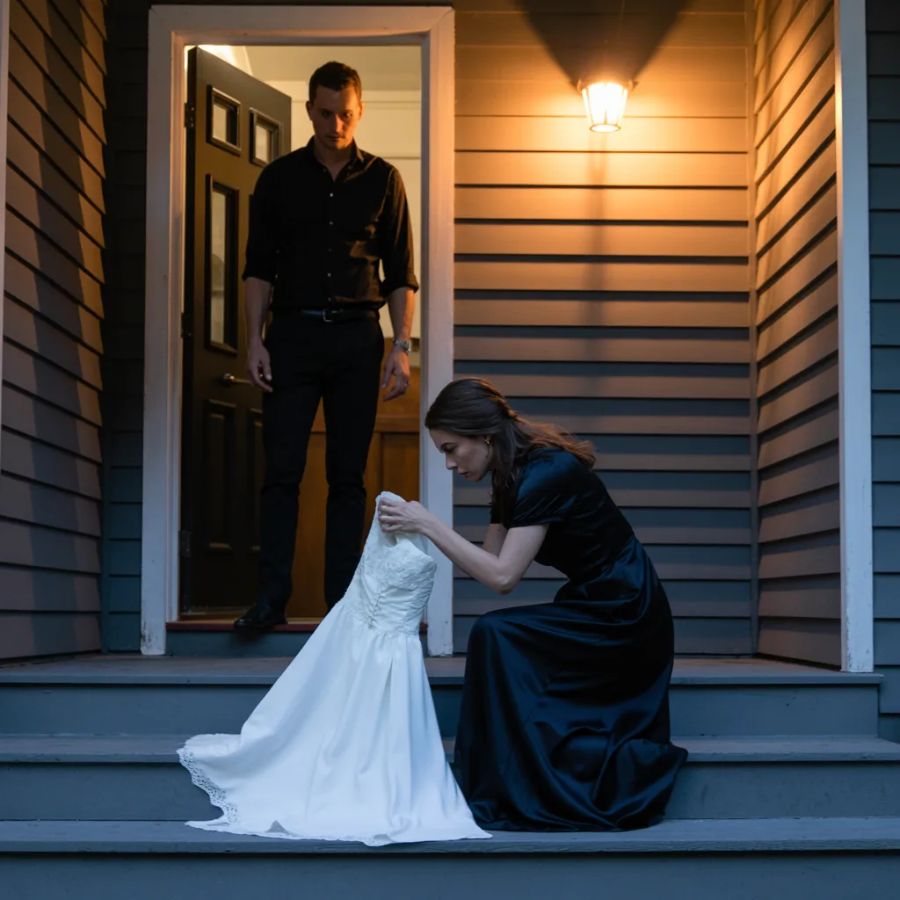
To the right of the welcome mat, sitting in the shadows of the porch pillar, were two suitcases. They were mine. The black Samsonite hard-shells.
My heart didn’t just drop; it vanished.
Sitting on top of the suitcases was a garment bag—the heavy, white plastic kind. It was slashed open. Inside, I could see layers of ivory tulle and lace. My wedding dress. It looked like it had been attacked by a wild animal. The bodice was shredded, the silk skirt ripped into ribbons. It wasn’t just damaged; it was executed.
Pinned to the plastic was a single index card. Ryan’s handwriting. Small, precise, architectural.
Get lost from my life.
I couldn’t breathe. The air in my lungs turned to glass. I pounded on the door. “Ryan! Ryan, open the door! What is this?”
Nothing. No footsteps. No barking from the dog (where was the dog?). Just the sound of the rain and my own blood rushing in my ears. I pounded again, harder, until my knuckles bruised. “Ryan, please! It’s cold! Let me in!”
Finally, the deadbolt clicked. It was the loudest sound I had ever heard.
The door swung open. Ryan stood there. He wasn’t yelling. He wasn’t red-faced. He was dressed in jeans and a gray sweater, holding a glass of water. He looked calm. He looked like he was watching a stranger try to sell him a magazine.
“Ryan,” I choked out, water dripping from my nose. “My key… the dress… what is happening?”
He stepped back to let me into the foyer, but he didn’t move to hug me. He didn’t offer me a towel. He leaned against the hallway wall, creating a physical barrier between me and the rest of the house—our house.
“The key doesn’t work because I changed the locks this morning,” he said. His voice was flat. Devoid of affect. “And the dress… well, you voided the vows, so I voided the symbol.”
“Ryan, stop,” I said, shaking, my hands reaching out for him. “We need to talk. I don’t know what you think you know, but—”
“I didn’t just find out about the affair, Elena.”
He cut me off without raising his voice. That somehow made it worse. If he had screamed, I could have screamed back. I could have cried, pleaded, turned it into a passionate fight that ended in makeup sex or a tearful negotiation. But this? This was a business transaction.
He walked into the kitchen. I followed, trailing muddy water on the hardwood floors. He leaned against the granite counter, arms crossed, watching me with a look of clinical curiosity.
“I waited,” he said.
I froze, halfway to the paper towels. “Waited? Waited for what?”
“For you to tell me,” he replied. He took a sip of water. “I found the first message three months ago. The guy’s name is Mark. He works in logistics. You met him at the conference in August. I know about the hotel on Wacker Drive. I know about the lunch breaks. I know about the ‘late meetings.'”
My legs gave out. I actually had to grab a dining chair to keep from hitting the floor.
“Three months?” I whispered.
“Ninety-two days, to be exact,” he said. “I hoped you’d stop. I hoped you’d wake up. I watched you every morning, making coffee, kissing me goodbye, and I wondered if that was the day you’d choose us. But you didn’t.”
The horror of it washed over me. Three months.
Thanksgiving. His sister’s wedding. Our anniversary dinner at that French place. The nights we spent watching movies, his head in my lap.
He knew. He knew the whole time. Every time I smiled at him, he was watching a liar. Every time I said “I love you,” he was cataloging the deceit.
“Why didn’t you say anything?” I cried, the tears finally coming hot and fast. “If you knew, why did you let me keep… why did you let me live here like everything was normal?”
Ryan’s eyes narrowed slightly. It was the only crack in his armor.
“Because I needed to see who you really were,” he said. “And I needed time to protect myself.”
Part II: The Clause
He reached into a folder on the counter and slid a document toward me.
“Do you remember this?”
I looked at the paper. It was the postnuptial agreement.
I remembered signing it a year ago. We had been going through a transition. Ryan was leveraging some of our assets to start his own firm. It was a risky move. He had suggested the post-nup to separate our liabilities, to protect me in case the business went under. He had said it was about safety. He had said it was the “practical phase” of our marriage.
I hadn’t read it closely. I trusted him. I just signed where the little sticky flags told me to sign.
“Page four,” he said. “The infidelity clause.”
I picked it up, my hands trembling so hard the paper rattled.
Clause 7B: In the event of dissolution of marriage due to proven adultery…
It was clear. It was brutal. It was ironclad.
If I cheated, and if there was proof, the division of assets shifted dramatically. I waived my right to spousal support. I waived my claim to the primary residence. I waived my claim to any appreciation in his business assets during the marriage.
Basically, if I cheated, I walked away with what I came in with. Which, compared to what we had built, was almost nothing.
“You have proof?” I asked, my voice barely audible.
Ryan pulled out his phone. He didn’t even unlock it. He just set it on the table. “I have everything, Elena. Screenshots. Hotel receipts. E-ZPass logs. I hired a PI six weeks ago just to cement it. It’s not ‘he said, she said.’ It’s a fact.”
I looked at him, really looked at him, and for the first time, I saw a stranger. This wasn’t the man who forgot to put the toilet seat down. This was a man who had executed a ninety-day military operation against his own wife.
“You planned this,” I spat out, a sudden flare of defensive anger rising up. “You let me think we were okay while you were building a trap. You manipulated me.”
“I prepared,” he corrected, his voice ice cold. “You are the one who planned the betrayal. You planned the lies. You planned the logistics of sleeping with another man. I just planned the exit.”
He looked at his watch.
“You have ten minutes to take whatever fits in your car. The locks are changed. The joint accounts were frozen this afternoon. I’ve already transferred your personal savings—what little there was—to your individual account. The dog is at my mother’s house.”
“Ryan, you can’t do this. This is my home.”
“Not anymore,” he said. “You broke the lease when you invited a third party into the contract.”
He turned his back on me and started washing his glass in the sink.
I stood there for a full minute, waiting for him to turn around. Waiting for him to break. Waiting for the screaming match where I could apologize, beg, bargain. But the silence stretched. The only sound was the running water and the rain outside.
He was done. He wasn’t angry anymore; he was resolved. And that was infinitely more terrifying.
I grabbed my purse. I walked out the front door, into the rain, and dragged the two suitcases and the shredded remains of my wedding dress to my car.
As I backed out of the driveway, I looked up at the kitchen window. Ryan was standing there, watching me. He didn’t wave. He didn’t look sad. He reached up and closed the blinds.
Part III: The 90 Days
I drove to my sister Sarah’s house. I didn’t have anywhere else to go.
The drive was a blur, but my mind kept looping back, not to the confrontation, but to the last three months. The realization of what Ryan had done—what he had endured—was a slow-motion car crash in my brain.
The Birthday Dinner. Two months ago. We were at a steakhouse. I had given him a watch. An expensive tag he had wanted. I remembered smiling, leaning over the table, kissing his cheek. “Happy birthday, baby. I love you.” I remembered he had paused. Just for a second. He had looked at the watch, then at me. “Thank you, Elena. Timing is everything, isn’t it?” I thought he was making a pun about the watch. Now I knew. He was looking at a woman who had spent her lunch hour sexting Mark, and then bought him a gift with their joint credit card. He was testing me. He was giving me rope.
The Sunday Morning. Six weeks ago. Mark had cancelled on me. I was moody, restless. Ryan had made pancakes. He asked me what was wrong. “Just work stress,” I had lied. “You seem distant,” he had said, pouring syrup. “Is there anything you want to tell me? Anything we need to work on?” That was the off-ramp. That was the moment I could have confessed. I could have said, “I’m messing up. I’m lost. Help me.” Instead, I snapped at him. “God, Ryan, stop analyzing me. I’m just tired.” He had just nodded and taken a bite of his pancake. “Okay. Just checking.” He wasn’t checking. He was confirming.
I arrived at Sarah’s house looking like a drowned rat. When she opened the door and saw the suitcases, she didn’t ask what happened. She just sighed.
“He found out, didn’t he?” she asked.
I looked at her, shocked. “You knew?”
“I didn’t know,” she said, pulling me inside. “But Elena… you haven’t been subtle. You’ve been different. Distant. I figured it was a matter of time.”
That night, lying on her beige microfiber couch, I tried to text Mark. Ryan knows. He kicked me out. I’m at my sister’s.
I watched the three little dots appear. Then disappear. Then appear again. Finally, a response: “Wow. That’s heavy. I’m sorry.”
I need to see you, I typed. I need to talk.
His reply came an hour later. “Listen, Elena. I like you. But I can’t get involved in a divorce drama. My wife is already suspicious. I think we need to cool it.”
I stared at the screen. The man I had risked everything for. The man whose attention made me feel “alive” again. The man for whom I had sacrificed my home, my financial security, and the trust of the only person who had truly loved me.
“Cool it.”
He had nothing to lose. It was a game to him. I was a Tuesday afternoon diversion.
I threw the phone across the room. It hit the wall with a satisfying crack, but it didn’t fix anything. I curled into a ball under my sister’s throw blanket and cried until my throat felt like it was bleeding.
Part IV: The Fall
The next few weeks were a humiliating blur of legal documents and social subtraction.
Ryan wasn’t bluffing about the post-nup. My lawyer, a tired-looking man named Mr. Henderson, looked over the document and sighed.
“It’s solid, Mrs. Vance,” he said. “And the evidence… well, he sent over a digital file. It’s extensive. If we go to court, this becomes public record. Given the clause, you’ll lose. The best advice I can give you is to sign the quitclaim on the house and walk away. Save yourself the legal fees.”
“But I have nothing,” I pleaded. “I have $4,000 in my checking account. How am I supposed to live?”
“You have your job,” Henderson said, adjusting his glasses. “And you have your freedom. That’s what you bought with the affair, essentially.”
The social fallout was quieter but more painful. Ryan didn’t trash me on Facebook. He didn’t make a scene at the country club. He simply told people the truth. “Elena and I are divorcing. She was seeing someone else. I wish her the best.”
It was the “I wish her the best” that killed me. It made him look like a saint and me like a monster.
Friends stopped calling. Dinner invitations evaporated. I became a pariah. Not because people are puritans, but because people choose sides. And when one side is a dignified, grieving husband and the other is a wife who cheated for months and got caught, the choice is easy.
I moved into a studio apartment thirty minutes from the city. It was the size of my old walk-in closet. The faucet leaked. The neighbors argued loudly at 2 AM.
I spent my nights drinking cheap wine and stalking Ryan’s social media, until he blocked me. Then I created a fake account to stalk him.
I saw him going to the gym. I saw him travelling. He looked thinner, sharper. He looked like a man who had cut off a dead limb and was learning to walk faster without the weight.
I tried to justify myself in therapy. “He was working all the time,” I told my therapist, Dr. Aris. “We had lost the spark. I was lonely. Mark made me feel seen.”
Dr. Aris was a tough woman with gray hair and no patience for self-pity. “Elena,” she said one day, interrupting my monologue. “You weren’t lonely. You were bored. And you didn’t want connection; you wanted validation. There is a difference. Connection requires vulnerability. Validation just requires an audience. You traded a partner for an audience member.”
That hit me hard. I realized something that cut deeper than any insult Ryan could have thrown at me: He hadn’t acted out of revenge alone. He had acted out of self-respect.
For years, I had mistaken his kindness for weakness. I thought he was the “safe” option, the one who would always be there, the one who would tolerate my moods and my selfishness because he was lucky to have me. I thought I was the prize.
But when he discovered the betrayal, he didn’t beg. He didn’t cry. He didn’t try to “win me back” from Mark. He assessed my value in his life, realized I was a liability to his happiness, and he liquidated the asset.
He valued himself more than he valued the relationship. And that, I realized, is what a healthy person does.
Part V: The Long Road
It has been three years since that night on the porch.
The recovery was slow. I had to rebuild my career because the stress caused me to miss targets, and I was let go three months after the divorce. I worked retail for a year while taking night classes to pivot into marketing.
I live in a better apartment now. It has a balcony and a dishwasher.
I date, occasionally. But it’s different. I’m terrified of the beginning of relationships now—the shiny, fake part where everyone is presenting their best self. I look for the cracks immediately.
I saw Ryan last week.
I was in a grocery store, in the pasta aisle. I heard a laugh—a deep, familiar laugh. I froze. He was at the end of the aisle. He had a beard now, salt-and-pepper. He looked good. He wasn’t alone. There was a woman with him. She was petite, with dark curly hair. She was laughing at something he said, her hand resting easily on his forearm. She looked at him with total adoration.
But it was the way he looked at her that stopped my heart. He looked at her with a protective, calm certainty. He looked like a man who was safe.
They walked past the end of the aisle. He didn’t see me. Or maybe he did, and he just didn’t care. I was a ghost from a past life.
I found out later through a mutual friend that they got married last summer. They are expecting a baby in the spring.
I went home that night and sat on my balcony. I didn’t cry. I just felt a heavy, hollow ache in my chest.
I’m not telling this story to get sympathy. I don’t deserve it. I’m not telling it to demonize Ryan. He did what he had to do.
I’m telling this because affairs are often romanticized in movies and books. They are painted as these passionate, inevitable storms that sweep you away. We tell ourselves, “I deserve to be happy,” or “I just need to feel something.”
We treat our partners like furniture—reliable, static, incapable of movement.
But people are not furniture. And trust is not a renewable resource.
If you are reading this, and you are standing on that ledge—if you are flirting with the co-worker, if you are sending the text you know you shouldn’t send, if you are telling yourself “he’ll never know”—please, listen to me.
Ask yourself what you are truly risking. You aren’t just risking a breakup. You are risking your integrity. You are risking your home. You are risking the ability to look at yourself in the mirror without flinching.
And you are risking the possibility that the person you are lying to is stronger than you think. You might think you are the main character in a romantic drama, but you might actually be the antagonist in someone else’s survival story.
Ryan survived me. He thrived. And I am still here, picking up the pieces, trying to glue them back together into something that resembles a decent human being.
Accountability is the only way forward. I own this. I broke it. Some bridges, once burned, are never rebuilt. The smoke clears, the ash settles, and you are left on the other side, looking at the life you could have had, realizing that the only person holding the match was you.
Epilogue: The Conversation
“So, do you think he ever forgave you?”
The question came from a young woman sitting across from me. Her name is Sarah (no relation to my sister). We were at a coffee shop. She was a friend of a friend who had heard my story and reached out. She was “confused” about her own marriage, teetering on the edge of an affair with a gym trainer. I agreed to meet her.
I stirred my black coffee. “Forgiveness is a tricky word,” I said. “I don’t think he holds onto the anger anymore. He’s happy. When you’re truly happy, you don’t have room for hate. So in that sense, maybe he has forgiven. But did he forget? No. Did he reconcile? No.”
“But three months…” Sarah shook her head. “How could he sleep next to you for three months knowing?”
“That’s the part that haunts me,” I admitted. “I think about those ninety days more than I think about the affair itself. He was grieving us while I was still there. He was saying goodbye to me, and I was too busy looking at my phone to notice.”
Sarah looked down at her hands. “I haven’t done anything physical yet,” she whispered. “Just texts. Lunch.”
“That’s how it starts,” I said. “It’s not the sex, Sarah. It’s the intimacy you steal from your marriage and give to a stranger. It’s the secrets. The secrets are the cancer.”
“I just feel… unseen,” she said. The same words I had used.
“Then tell him,” I said. “Go home and tell your husband. Scream it if you have to. Start a fight. Go to therapy. Or leave him. If you are unhappy, have the courage to leave with your dignity intact. Don’t force him to become a detective in his own life. Don’t make him find out that the person he sleeps next to is an enemy.”
Sarah nodded slowly. “I’m scared to lose what we have.”
“You’ve already lost it,” I said gently. “The moment you started the texts, the marriage you knew was gone. Now you have to decide if you want to build a new one with him, or burn the house down.”
I paid for her coffee. I walked out into the sunshine.
It wasn’t raining today. The air was crisp. I walked to my car, unlocking it with a beep. I sat in the driver’s seat and checked my reflection in the mirror. I looked older than I did three years ago. There were fine lines around my eyes.
But the eyes were clear. I wasn’t hiding anything anymore.
I drove home to my quiet apartment. It’s not the house in Coyoacán. It doesn’t have a grand porch or a custom kitchen. But the key works. And when I lock the door at night, I know that everything inside it—the furniture, the books, the peace of mind—is mine. I paid for it.
The price was high. But I finally paid it.
Disclaimer : This content may be created by AI for entertainment purposes. Any resemblance to real persons, events, or places is coincidental.