The Vineyard of Truth: Emily Carter’s Final Stand
Chapter 1: The Illusion of Perfection
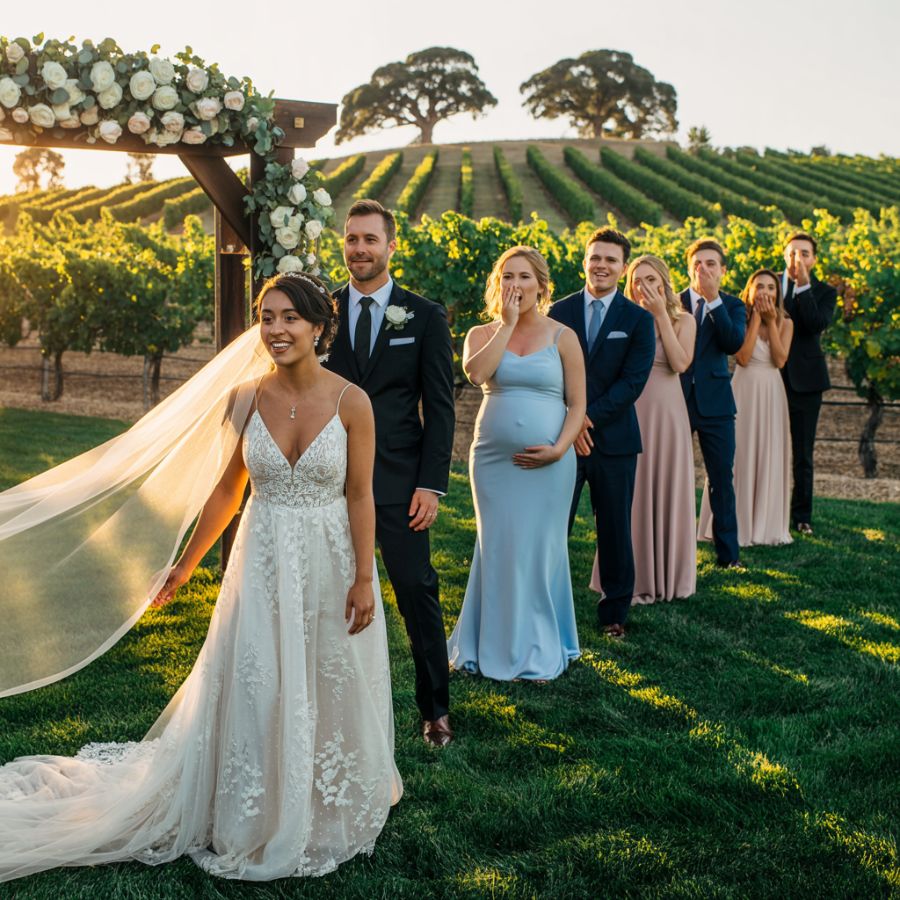
The Napa Valley sun was a relentless gold, spilling over the undulating rows of Cabernet grapes like honey. To any of the three hundred guests seated on the manicured lawn of the St. Helena vineyard, I was the picture of a woman who had it all.
My dress was a custom Vera Wang, a cloud of silk and lace that cost more than my first car. The scent of five thousand white roses hung heavy in the air, sweet and suffocating.
“You look breathtaking, Em,” my father whispered as he tucked my arm into his. His eyes were moist. He saw a beginning. I saw an execution.
At the end of the aisle stood Daniel Wright. He looked like a prince from a mid-century film—strong jaw, eyes the color of the Pacific, and a smile that had convinced me for four years that I was the center of his universe. Beside him, Lauren Mitchell, my maid of honor, adjusted her lavender dress. She had been my “person” since we shared a cramped dorm room in freshman year.
I started the walk. Each step was a beat in a countdown.
Chapter 2: The Interruption
The ceremony progressed with a haunting beauty. The officiant spoke of “two souls weaving into one,” a sentiment that made my stomach churn with a cold, sharp bile.
Then came the moment. The traditional prompt that most officiants omit these days, but which I had specifically requested be kept in the script.
“If any person can show just cause why these two may not be lawfully joined together,” the officiant intoned, his voice echoing against the valley walls, “let them speak now, or forever hold their peace.”
The silence lasted three seconds. Then, the rustle of silk.
Lauren stepped forward. Her face was a mask of tragic heroism. She looked at me, then at the floor, her hands trembling as she clutched her bouquet.
“I can’t,” she sobbed, the sound amplified by the lapel mic she didn’t realize was picking her up. “I can’t let this happen. Emily, I am so sorry.”
The crowd erupted in a low, collective gasp. My mother’s hand flew to her throat. Daniel froze, his skin turning the color of ash.
“Lauren?” Daniel stammered, his voice cracking. “What are you doing?”
“I’m pregnant, Daniel,” she cried out, her voice now gaining a desperate strength. “It’s yours. We both know it’s yours. I can’t let you walk into a lie.”
She turned to me, her eyes brimming with calculated tears. “Emily, please. I never meant to hurt you. It just happened. We fell in love.”
Chapter 3: The Counter-Strike
I didn’t scream. I didn’t faint. I simply let go of Daniel’s hands. They felt like lead.
“Is that all, Lauren?” I asked. My voice was eerily steady, cutting through the heavy air like a scalpel.
Lauren blinked, her practiced expression faltering. “What?”
“I asked if that was all,” I repeated. I turned to Daniel. “Are you going to deny it, Daniel? Or are you going to tell her about the hotel receipts from the St. Regis back in February?”
Daniel’s mouth opened, but no sound came out. He looked like a landed fish, gasping for air.
“Emily, I…”
“Or perhaps the iPad messages?” I continued, stepping closer to him. “The ones where you told her you’d find a way to break it off after the honeymoon because you didn’t want to lose the merger my father was facilitating for your firm?”
The silence that followed wasn’t just quiet; it was a vacuum. I looked toward the front row. “Michael, if you please.”
Michael Reynolds, my attorney, stood up. He didn’t look like a wedding guest; he looked like a predator in a navy suit. He walked toward the altar, pulling a folder from his jacket.
“What is this?” Lauren shrieked, her voice losing its melodic sorrow and becoming shrill. “Emily, you’re being cruel! I’m carrying his child!”
“And you’re also carrying a life insurance policy,” Michael said, his voice professional and cold. He handed a document to Daniel. “Mr. Wright, this is a notice of a civil claim filed this morning. It concerns the breach of the pre-nuptial trust and the fact that you diverted shared investment funds to pay for Ms. Mitchell’s private medical bills and a life insurance policy naming her as the sole beneficiary.”
“You spied on us?” Daniel whispered, horror dawning on his face.
“I protected myself,” I corrected. “I found the first receipt three months ago. I could have ended it in our living room. But you both decided to humiliate me by continuing this charade. You wanted to use my wedding, my family’s money, and my reputation to build your secret life. So, I decided we should all share the truth together.”
Chapter 4: The Reclaimed Day
I turned to the three hundred guests. I saw my mother crying, but my father was standing tall, his eyes fixed on me with a new kind of pride.
“I apologize to all of you,” I said into the microphone. “There will be no wedding today. But the catering is paid for, the wine is excellent, and I refuse to let a beautiful day go to waste on two people who don’t deserve it.”
I looked at Lauren. “You wanted to be the center of attention, Lauren. Enjoy it. But you’ll be doing it without my friendship, my house, or the trust fund my father set up for you as a ‘sister.’ Michael has the paperwork for the severance of all ties.”
Lauren fled. She ran through the vineyard, her heels sinking into the dirt, sobbing into her hands. Daniel stood alone for a moment, looking at the documents in his hand—the evidence of his greed and infidelity—before the weight of the guests’ glares forced him to slink away toward the parking lot.
I turned to the officiant. He looked bewildered.
“I believe we’re done here,” I told him. I looked at the band. “Play something upbeat. Not a love song. Something with a rhythm.”
Chapter 5: The Aftermath and the Light
The party that followed was the strangest, most liberating event I had ever attended. I took off my veil and handed it to a flower girl. I drank a glass of vintage sparkling wine with my father.
“Are you okay, Em?” he asked, squeezing my hand.
“I’m better than okay, Dad,” I said. “I’m free.”
The months that followed were a blur of legalities and healing. Daniel tried to call. Lauren sent long, rambling emails about “hormones” and “mistakes.” I blocked them both.
I didn’t need an apology. An apology is a request for the victim to do the work of moving on. I had already moved on the moment I decided not to let them define my narrative.
One evening, nearly a year later, I sat on my balcony overlooking the city. I thought about the girl who had stood in that vineyard. I realized that the “happily ever after” I had been promised wasn’t in the marriage. It was in the moment I chose myself.
I stood in my truth when my knees were shaking. And in doing so, I didn’t just survive a betrayal—I authored my own liberation.
Disclaimer : This content may be created by AI for entertainment purposes. Any resemblance to real persons, events, or places is coincidental.